All species › Passerines › Ovenbirds and woodcreepers › Olive-backed Woodcreeper
Olive-backed Woodcreeper | Xiphorhynchus triangularis
Olijfrugmuisspecht | Trepatroncos dorsioliva | Arapaçu-de-dorso-oliváceo
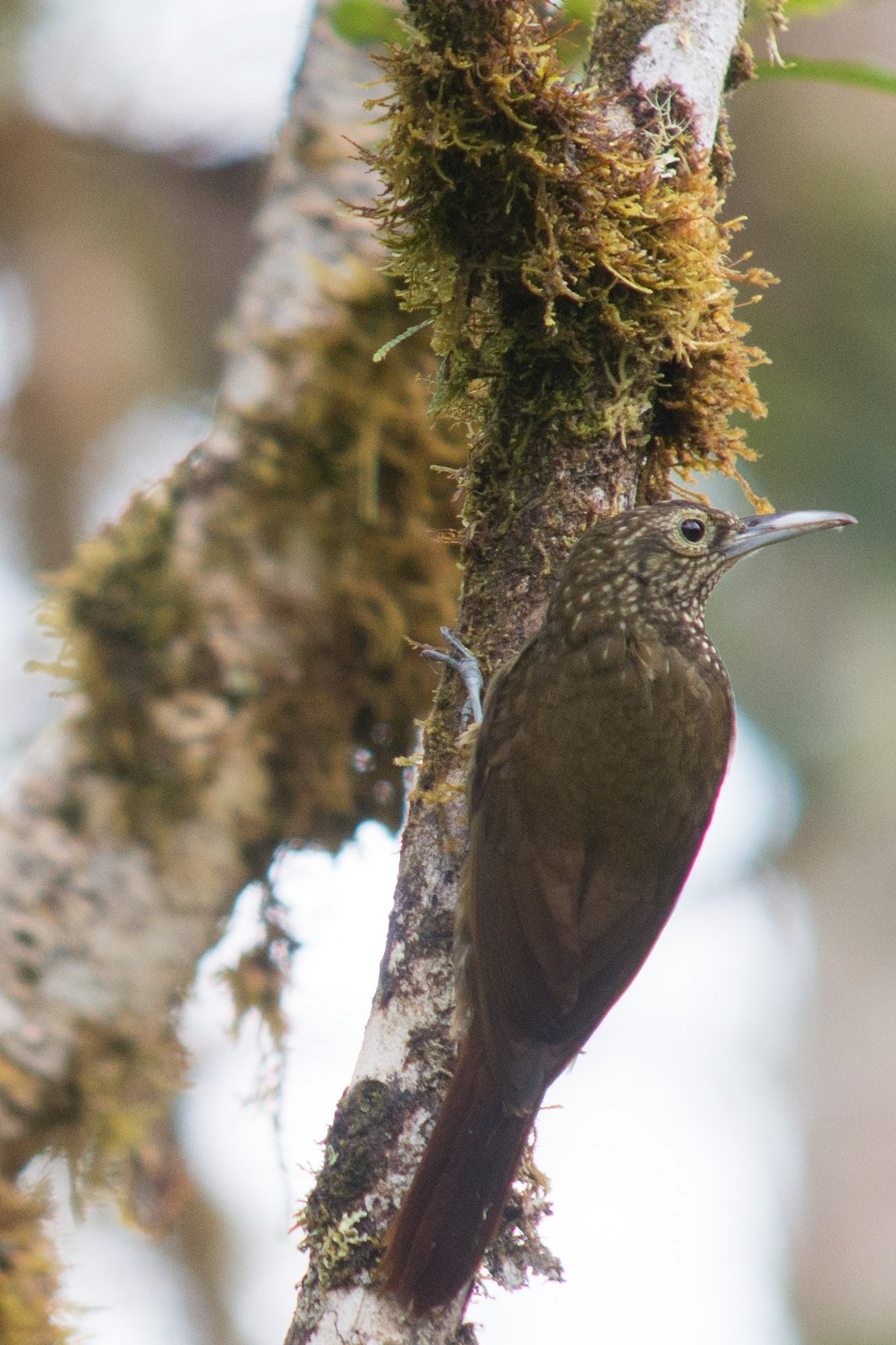
The Olive-backed Woodcreeper is the Xiphorhynchus of Andean montane forest, from Colombia to Bolivia. It has a plain olive back and a scaled throat and breast. It climbs mossy trunks and thick branches and is a regular member of mixed flocks in cloud forest.
Voice
The song is a fast, slightly descending series of clear notes that accelerates into a trill. The call is a short, somewhat hoarse chew.
Recording: Fabrice Schmitt — CC BY-NC-SA 4.0 · xeno-canto
Identification
23–24 cm, with a fairly long, slightly decurved bill: upper mandible dark, lower mandible pale horn. The back is plain olive-brown; the rump, wings and tail are rufous. The crown is dark with fine buff spots. The throat is buff with dark scaling; the breast bears buff, black-edged drops that fade towards the belly. The sexes are alike.
Confusion species
Montane Woodcreeper Lepidocolaptes lacrymiger is smaller, with a thin, pale, more decurved bill and white streaks below. Strong-billed Woodcreeper Xiphocolaptes promeropirhynchus is much larger, with a heavy bill. Spotted Woodcreeper Xiphorhynchus erythropygius of the western slope has a buff eye-ring and round spots on an olive-brown throat. Lower on the eastern slope lives Ocellated Woodcreeper Xiphorhynchus ocellatus, with a plainer buff throat and more contrasting breast spots.
Habitat
Humid montane forest and cloud forest, also edges and older secondary forest, mostly from 1000 to 2600 m. It searches trunks and branches in the middle and upper levels, among moss and epiphytes, for insects and spiders. The nest is in a tree cavity.
Where the bird is most at home, classified by the vegetation units of the Andes and the west coast.


Range and movements
Colombia: in all three Andean ranges and the Sierra de Perijá. Ecuador: on the eastern slope of the Andes and locally in the north of the western slope. Peru: along the whole eastern slope of the Andes. Bolivia: in the Yungas of La Paz, Cochabamba and western Santa Cruz. Absent from the Galápagos. Outside the guide area in the Andes of western Venezuela.
- Resident
- dark = core range, pale = thinly spread
How and when to look
In cloud forest, follow the mixed flocks of tanagers and ovenbirds; the Olive-backed Woodcreeper often climbs the mossy trunks with them. It is seen regularly along the Manu road in Peru and in the montane forests of eastern Ecuador.
Conservation status
Least Concern. The species is locally common in suitable montane forest; deforestation of the Andean slopes reduces its habitat.
Scientific name
Xiphorhynchus triangularis | (de Lafresnaye, 1842)
De Lafresnaye described the species in 1842 as Dendrocolaptes triangularis; because it was later moved to another genus, the author and year stand in brackets. The genus Xiphorhynchus was introduced in 1827 by Swainson. The genus name comes from Greek xiphos, 'sword', and rhunkhos, 'bill'. The species name comes from Latin triangularis, 'triangular', referring to the triangular spots. The specimen the first description was based on came from Bogotá, Colombia.