All species › Passerines › Ovenbirds and woodcreepers › Spotted Woodcreeper
Spotted Woodcreeper | Xiphorhynchus erythropygius
Gevlekte muisspecht | Trepatroncos manchado | Arapaçu-pintado
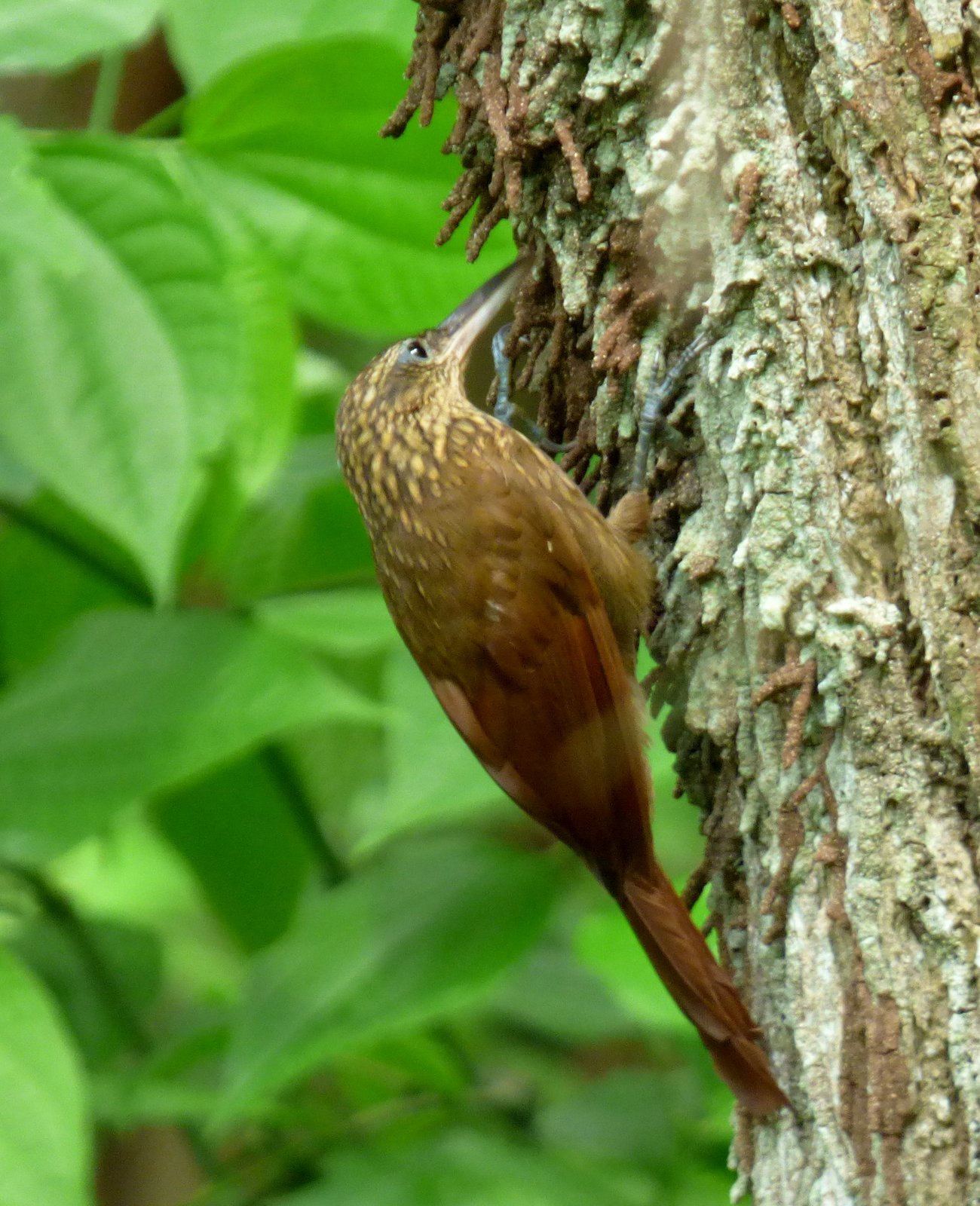
The Spotted Woodcreeper is a medium-sized woodcreeper of the humid forests on the western slope of the Andes and in the Chocó. Its olive-brown plumage is marked on the head and breast with small buff drops. The drawn-out, plaintive whistles of its song belong to the morning sounds of montane forest on the Pacific side.
Voice
The song is a series of two to four long, descending, plaintive whistles, kweeeu … kweeeu … kweeeu. It also gives a fast, descending trill.
Recording: José María Loaiza B. — CC BY-NC-SA 4.0 · xeno-canto
Identification
21–23 cm, with a fairly long, slightly decurved bill: upper mandible dark, lower mandible horn-coloured. The upperparts are olive-brown, the wings, rump and tail rufous. The head, throat and breast are olive-brown with round to drop-shaped buff spots that fade towards the belly; a narrow buff ring surrounds the eye. The sexes are alike; juveniles are more dully spotted.
Confusion species
Olive-backed Woodcreeper Xiphorhynchus triangularis has a plain olive back and a scaled throat, and usually lives higher. Black-striped Woodcreeper Xiphorhynchus lachrymosus is larger, with a black-and-buff striped back, and lives lower. Montane Woodcreeper Lepidocolaptes lacrymiger is smaller, with a thin, pale, more decurved bill and streaked underparts. Wedge-billed Woodcreeper Glyphorynchus spirurus is much smaller and has a short, wedge-shaped bill.
Habitat
The interior and edges of humid foothill and montane forest, also tall secondary forest, from about 400 to 2000 m, locally lower. It searches trunks and thick branches in the middle levels for insects and spiders, often in mixed flocks. The nest is in a tree cavity.
Where the bird is most at home, classified by the vegetation units of the Andes and the west coast.


Range and movements
Colombia: on the Pacific slope and in the Western and Central Andes. Ecuador: on the western slope of the Andes and in the western foothills, south to the southwest. Absent from Peru, Bolivia and the Galápagos. Outside the guide area in Panama and Central America north to Mexico.
- Resident
- dark = core range, pale = thinly spread
How and when to look
In montane forest on the western slope, for example in northwestern Ecuador, listen in the early morning for the descending whistles. The bird then often sits still against a trunk in the middle level.
Conservation status
Not Evaluated in the current circumscription of the species. In the guide area locally common in foothill and montane forest; deforestation of the western slope reduces its habitat.
Scientific name
Xiphorhynchus erythropygius | (Sclater, 1860)
Sclater described the species in 1860 as Dendrornis erythropygia; because it was later moved to another genus, the author and year stand in brackets. The genus Xiphorhynchus was introduced in 1827 by Swainson. The genus name comes from Greek xiphos, 'sword', and rhunkhos, 'bill'. The species name comes from Greek eruthros, 'red', and pugē, 'rump'. The specimen the first description was based on came from Xalapa, Veracruz, Mexico.