All species › Passerines › Ovenbirds and woodcreepers › Black-striped Woodcreeper
Black-striped Woodcreeper | Xiphorhynchus lachrymosus
Zwartgestreepte muisspecht | Trepatroncos pinto | Arapaçu-de-listras-pretas
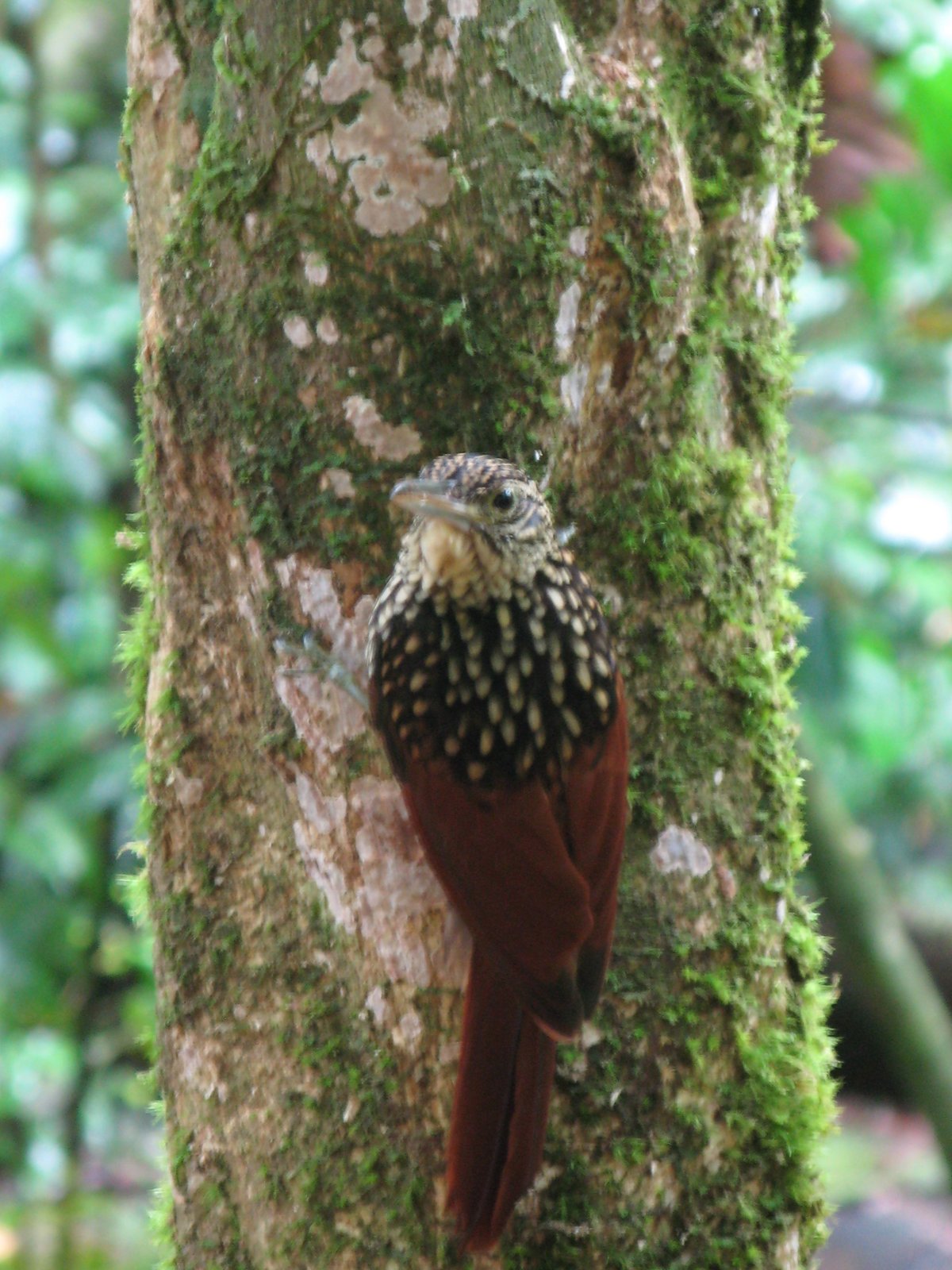
The Black-striped Woodcreeper is a large woodcreeper of the humid lowland forests on the Pacific side of Colombia and Ecuador. Its head, back and underparts are black with broad buff stripes, a pattern unique within the genus Xiphorhynchus. It often forages high on trunks and thick branches and joins mixed flocks.
Voice
The song is a loud, descending series of laughing notes that slows at the end, wee-hee-hee-hee-hu-hu. The call is a sharp, falling wheeyew.
Recording: rudy gelis — CC BY-NC-SA 4.0 · xeno-canto
Identification
24–25 cm, large, with a long, slightly decurved bill: the upper mandible dark, the lower mandible paler. The head, mantle and underparts are black with broad buff to cream stripes and drops; the wings, rump and tail are rufous. The throat is buff. The sexes are alike; juveniles are duller, with less crisp streaking.
Confusion species
Spotted Woodcreeper Xiphorhynchus erythropygius is smaller, olive-brown with small buff drops, and lives mainly higher in the Andean foothills. Northern Barred Woodcreeper Dendrocolaptes sanctithomae is finely barred black rather than striped. Streak-headed Woodcreeper Lepidocolaptes souleyetii is much smaller, with a thin, pale, decurved bill and a plain brown back. Cocoa Woodcreeper Xiphorhynchus susurrans has a plain olive-brown back and streaking only on the head and breast.
Habitat
The interior and edges of humid and wet rainforest in the lowlands and lower foothills, also tall secondary forest and shade plantations, mostly below 800 m, locally to about 1000 m. It searches trunks and thick branches in the middle and upper levels for insects and spiders. The nest is in a tree cavity.
Where the bird is most at home, classified by the vegetation units of the Andes and the west coast.


Range and movements
Colombia: in the Pacific lowlands and the humid lowlands of the northwest. Ecuador: in the western lowlands and foothills, mainly in the northwest. Absent from Peru, Bolivia and the Galápagos. Outside the guide area from Honduras through Nicaragua and Costa Rica to Panama.
- Resident
- dark = core range, pale = thinly spread
How and when to look
In Chocó lowland forest, watch for a large, black-and-buff striped woodcreeper climbing high up trunks, often in a mixed flock with antshrikes and tanagers. The laughing song is heard mainly in the morning and at dusk.
Conservation status
Least Concern. The species has a large range and is locally common, but disappears where lowland forest is cleared; much of that forest in western Ecuador has already gone.
Scientific name
Xiphorhynchus lachrymosus | (Lawrence, 1862)
Lawrence described the species in 1862 as Dendrornis lachrymosus; because it was later moved to another genus, the author and year stand in brackets. The genus Xiphorhynchus was introduced in 1827 by Swainson. The genus name comes from Greek xiphos, 'sword', and rhunkhos, 'bill'. The species name comes from Latin lacrimosus, 'tearful', referring to the teardrop-shaped markings. The specimen the first description was based on came from Lion Hill, Panama.