All species › Passerines › Ovenbirds and woodcreepers › Buff-throated Woodcreeper
Buff-throated Woodcreeper | Xiphorhynchus guttatus
Geelkeelmuisspecht | Trepatroncos golianteado | Arapaçu-de-garganta-amarela
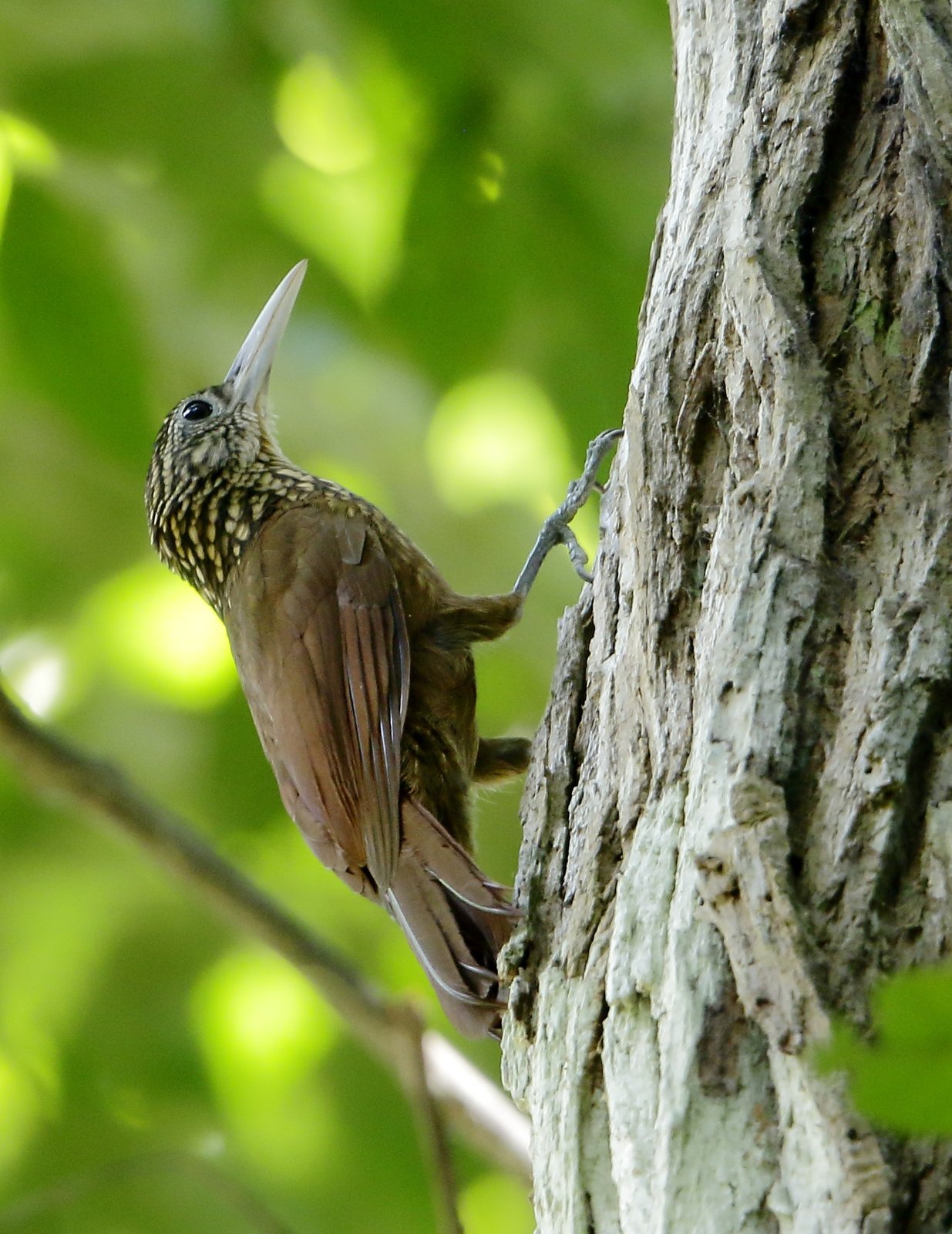
The Buff-throated Woodcreeper is a large, brown woodcreeper with a long, pale bill and one of the most frequently heard birds of the Amazonian forest. It climbs trunks at all levels and often follows mixed flocks or army ants. Birds of the western Amazon basin, including those of the guide area, are sometimes treated as a separate species (Xiphorhynchus guttatoides); in this guide they belong to this species.
Voice
The song is a loud, rapid series of whistles that rises and then falls and slows, tee-tee-tee-tew-tew-tew; at dusk also a slower series of descending notes. The call is a loud, descending kyew.
Recording: JAYRSON ARAUJO DE OLIVEIRA — CC BY-NC-SA 4.0 · xeno-canto
Identification
26–29 cm, large, with a long, fairly straight, pale, horn-coloured bill. The upperparts are olive-brown; the crown and nape bear buff drops, the mantle narrow pale streaks. The rump, wings and tail are rufous. The throat is buff and unmarked. The breast has buff, dark-edged drops and streaks that fade on the belly. The sexes are alike.
Confusion species
Ocellated Woodcreeper Xiphorhynchus ocellatus and Elegant Woodcreeper Xiphorhynchus elegans are clearly smaller, with a shorter, darker bill. Cocoa Woodcreeper Xiphorhynchus susurrans is smaller and lives north and west of the Andes in Colombia. Long-billed Woodcreeper Nasica longirostris has a very long, thin bill, a white throat and a streaked head. Cinnamon-throated Woodcreeper Dendrexetastes rufigula has a shorter, pale bill and a cinnamon throat. Strong-billed Woodcreeper Xiphocolaptes promeropirhynchus is larger and heavier.
Habitat
Terra firme rainforest, várzea, older secondary forest and forest edges, in the lowlands and foothills up to about 1000 m, locally higher. It climbs trunks and thick branches from the lower storey into the canopy and searches bark, epiphytes and dead wood for insects, spiders and small vertebrates. The nest is in a tree cavity.
Where the bird is most at home, classified by the vegetation units of the Andes and the west coast.


Range and movements
Colombia: in the lowlands east of the Andes, in the Orinoco and Amazon basins. Ecuador: in the eastern lowlands and foothills. Peru: in the Amazonian lowlands and the foothills of the eastern slope. Bolivia: in the lowlands of the north and centre. Absent from the Galápagos. Outside the guide area in Venezuela, the Guianas and most of Amazonian Brazil, and in the Atlantic Forest of eastern Brazil.
- Resident
- dark = core range, pale = thinly spread
How and when to look
At dawn in the Amazonian forest, listen for the loud series of whistles; the bird often sings from a trunk at the forest edge. Mixed flocks and army-ant swarms regularly attract it.
Conservation status
Not Evaluated in this treatment. The Red List treats the birds of the western and eastern Amazon basin as two species, both rated Least Concern. The species tolerates some forest disturbance.
Scientific name
Xiphorhynchus guttatus | (Lichtenstein, 1820)
Lichtenstein described the species in 1820 as Dendrocolaptes guttatus; because it was later moved to another genus, the author and year stand in brackets. The genus Xiphorhynchus was introduced in 1827 by Swainson. The genus name comes from Greek xiphos, 'sword', and rhunkhos, 'bill'. The species name comes from Latin guttatus, 'spotted, speckled'. The specimen the first description was based on came from Bahia, Brazil.