All species › Passerines › Ovenbirds and woodcreepers › Cocoa Woodcreeper
Cocoa Woodcreeper | Xiphorhynchus susurrans
Cocoamuisspecht | Trepatroncos cacao | Arapaçu-do-cacau
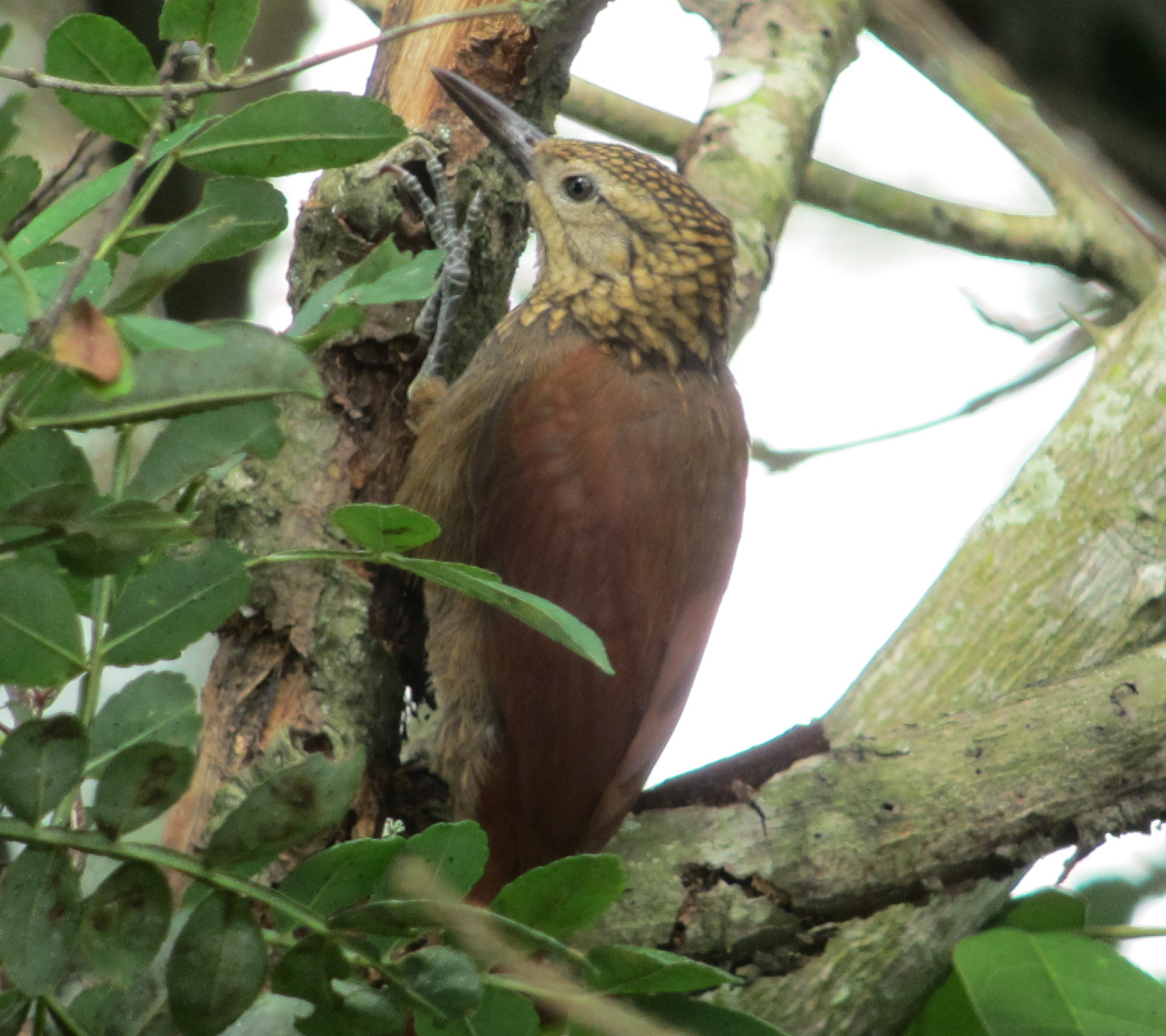
The Cocoa Woodcreeper is a fairly large, brown, long-billed woodcreeper of forest and forest edge in Central America and northern South America. It was formerly treated as one species with Buff-throated Woodcreeper. In the guide area it occurs only in Colombia, north and west of the range of Buff-throated Woodcreeper.
Voice
The song is a loud series of seven to twenty whistles rising in pitch; in the breeding season it sings at length at dawn and dusk. A longer call is an even, rolling laugh on one pitch that grows louder towards the end. Also short calls such as cheer and pyewl.
Recording: AUDEVARD Aurélien — CC BY-NC-SA 4.0 · xeno-canto
Identification
21–25 cm, with a long, fairly straight bill: the upper mandible dark, the lower paler and greyish. The upperparts are olive-brown; the crown and nape bear small buff drops, the mantle narrow pale streaks. The rump, wings and tail are rufous. The throat is buff and unmarked. The breast has pale, dark-edged drops and streaks that fade on the belly. The sexes are alike.
Confusion species
Buff-throated Woodcreeper Xiphorhynchus guttatus is larger, with a longer and heavier bill, and lives east of the Andes. Black-striped Woodcreeper Xiphorhynchus lachrymosus has a black-and-white scaled back and underparts and a shorter bill. Streak-headed Woodcreeper Lepidocolaptes souleyetii is smaller and slimmer, with a thin, decurved, pale bill. Straight-billed Woodcreeper Dendroplex picus has a straight, whitish bill and a scaly breast.
Habitat
Humid evergreen forest, gallery forest, deciduous woodland and the edges of old-growth and older secondary forest, less in the interior of primary forest, in shade plantations and in semi-open country with scattered trees; also mangroves. Mostly below 900 m, in Colombia up to about 1600 m. It climbs trunks and thick branches at all levels and searches bark, epiphytes and dead wood for insects and spiders. It sometimes follows army ants. The nest is in a tree cavity.
Where the bird is most at home, classified by the vegetation units of the Andes and the west coast.


Range and movements
Colombia: in the north, in the Caribbean lowlands, the northern Pacific lowlands, the Magdalena valley and the Sierra Nevada de Santa Marta region, and in the upper Cauca valley in Valle del Cauca. Absent from Ecuador, Peru, Bolivia and the Galápagos. Outside the guide area from Guatemala through Central America to Venezuela and Trinidad and Tobago.
- Resident
- dark = core range, pale = thinly spread
How and when to look
In forest and forest edge of the Caribbean lowlands and the Magdalena valley, listen at dawn and dusk for the loud, rising series of whistles. The bird often climbs trunks at forest edges and in shade plantations.
Conservation status
Least Concern. The species tolerates forest edge, secondary forest and shade plantations and is common over much of its range.
Scientific name
Xiphorhynchus susurrans | (Jardine, 1847)
Jardine described the species in 1847 as Dendrocolaptes susurrans; because it was later moved to another genus, the author and year stand in brackets. The genus Xiphorhynchus was introduced in 1827 by Swainson. The genus name comes from Greek xiphos, 'sword', and rhunkhos, 'bill'. The species name comes from Latin susurrans, 'whispering, murmuring'. The specimen the first description was based on came from Tobago, Trinidad and Tobago.