All species › Pelicans, herons and ibises › Herons, egrets and bitterns › Rufescent Tiger Heron
Rufescent Tiger Heron | Tigrisoma lineatum
Rosse tijgerroerdomp | Garza tigre colorada | Socó-boi
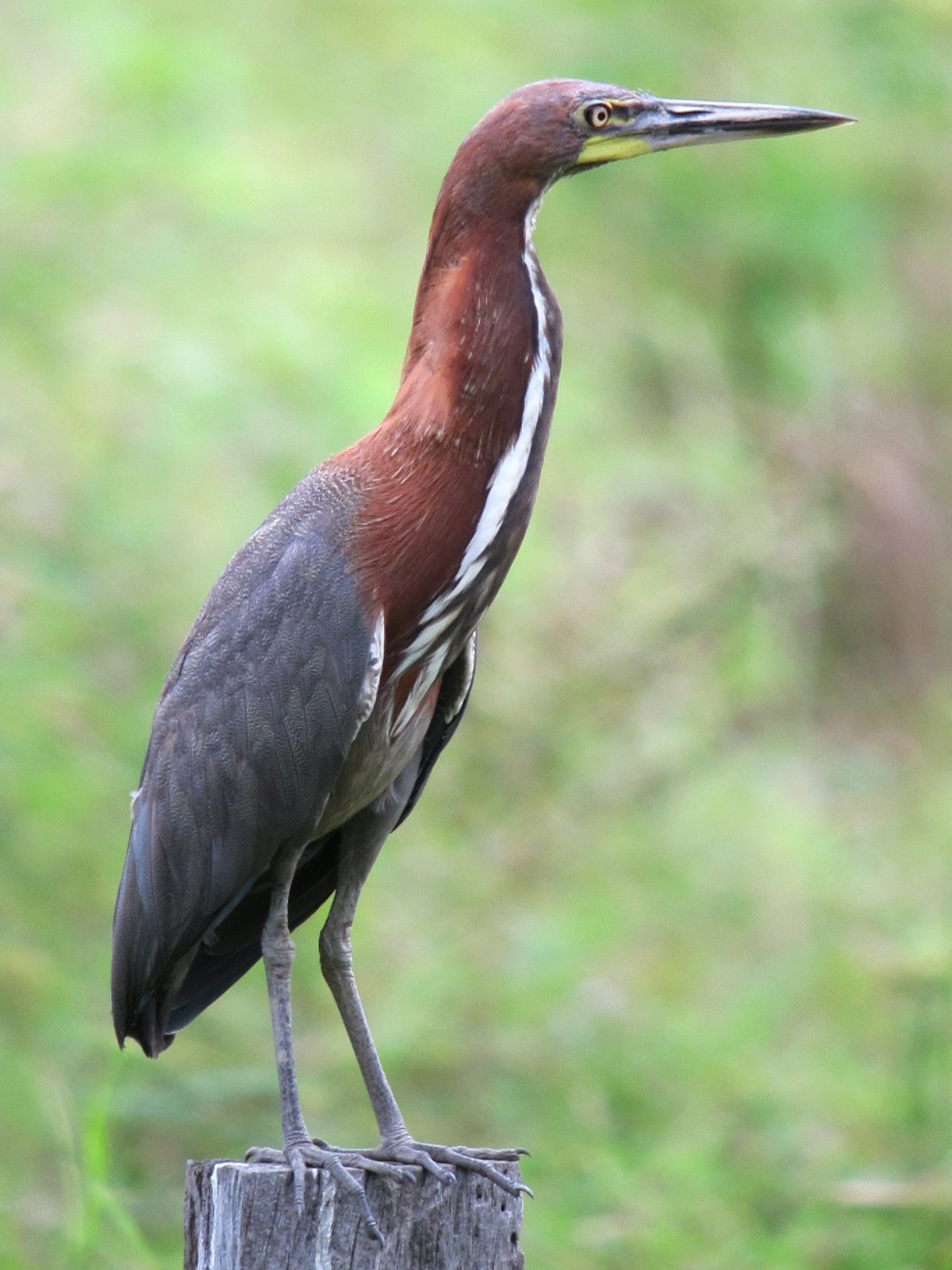
The Rufescent Tiger Heron is a large, stocky heron of the lowlands east and north of the Andes. Adults have a rufous head and neck; juveniles are entirely buff with black bars, the pattern that gives the tiger herons their name. It often stands motionless at the water's edge for long periods and, when alarmed, points its neck and bill straight up.
Voice
A series of low, hollow, roaring notes that first accelerate and then fade, heard mainly at dusk and at night. When flushed a hoarse kwok.
Recording: Jacob Wijpkema — CC BY-NC-SA 4.0 · xeno-canto
Identification
66–76 cm, with a thick neck, a fairly short, strong bill and short legs. In adults the head and neck are warm chestnut; a white central stripe with dark streaks runs down the foreneck. The back and wings are dark greyish brown with fine pale vermiculations, and the belly is brownish with white bars on the flanks. The throat is feathered. The bill is yellowish with a dark upper mandible, and the legs are greenish yellow. Juveniles are ochre-buff with broad black bars over the whole body; adult plumage is reached only after several years. In flight the white bars on the dark flight feathers show. The sexes are alike.
Confusion species
Fasciated Tiger Heron Tigrisoma fasciatum is smaller and greyer, with a black crown, a shorter bill and a finely barred grey neck, and lives along fast-flowing mountain rivers in the Andean foothills. Juveniles of the two species are very similar; Fasciated has a shorter, thicker bill and finer barring. Bare-throated Tiger Heron Tigrisoma mexicanum, in north-western Colombia, has a bare, yellow-green throat and a black crown. Pinnated Bittern Botaurus pinnatus resembles the juvenile, but has a streaked rather than barred neck and lives in reedy marshes.
Habitat
Marshes, wet grassland, the shores of lakes and oxbow lakes (cochas), flooded forest and wooded banks of slow-flowing rivers and streams in the lowlands, mostly below 500 m. It hunts standing or walking slowly, taking fish, frogs, crustaceans and large insects. The nest is a platform of sticks in a tree over or near water.
Where the bird is most at home, classified by the vegetation units of the Andes and the west coast.


Range and movements
In Colombia in the lowlands of the Caribbean region, the Magdalena Valley, the llanos and Amazonia, locally also on the Pacific side. In Ecuador mainly in the Amazonian lowlands. In Peru in the Amazonian lowlands. In Bolivia in the lowlands of the north and east. Absent from the Galápagos. Outside the guide area from Honduras to northern Argentina.
- Resident
- dark = core range, pale = thinly spread
How and when to look
Search the edges of cochas and marshes in the Amazonian lowlands or the llanos, especially on an early-morning boat trip. Juveniles often stand in the open at the edge of shallow water.
Conservation status
Least Concern. The species has a large range; locally it suffers from the loss of wetlands.
Scientific name
Tigrisoma lineatum | (Boddaert, 1783)
Boddaert described the species in 1783 as Ardea lineata; because it was later moved to another genus, the author and year stand in brackets. The genus Tigrisoma was introduced in 1827 by Swainson. The genus name comes from Greek tigris, 'tiger', and sōma, 'body', after the barred plumage. The species name is Latin lineatus, 'lined, striped', after the striped plumage. The specimen the first description was based on came from Cayenne, French Guiana.