All species › Passerines › Shrike-babblers, Erpornis and vireos › Rufous-browed Peppershrike
Rufous-browed Peppershrike | Cyclarhis gujanensis
Roodbrauwpeperklauwier | Vireón ceja rufa | Pitiguari
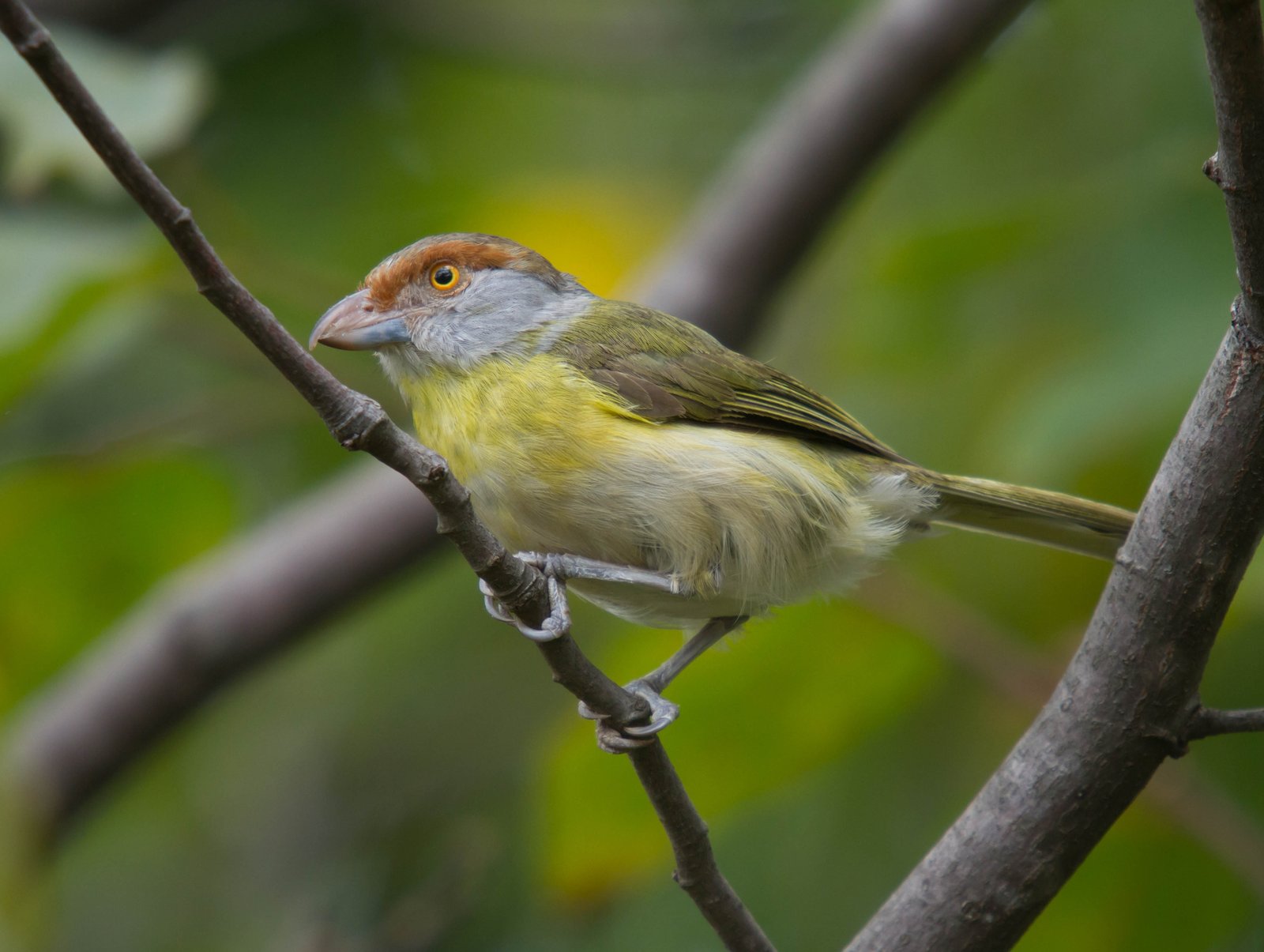
The Rufous-browed Peppershrike is a stocky bird with a large head and a heavy, pale, hooked bill, ranging from Mexico to Argentina. In the guide area it lives in a wide range of, often drier, woodlands, from Tumbesian dry forest to the Andean valleys and the Chaco. Its endlessly repeated whistled phrase is one of the constant forest sounds in those regions.
Voice
A loud, varied whistled phrase of three to seven notes, repeated many times and then replaced by a new phrase; each male has several phrases. Calls with a descending series of harsh notes.
Recording: Juan Freile — CC BY-NC-SA 4.0 · xeno-canto
Identification
14–16 cm, with a large head, a short tail and a heavy, laterally compressed, pinkish to horn-coloured bill with a hooked tip. A broad rufous supercilium, grey cheeks and an orange to reddish-brown eye. The upperparts are olive-green; the throat and breast are yellow, the belly whitish. The crown is grey, brownish or olive-green depending on subspecies, and the amount of yellow below also varies. The sexes are alike; young birds have a fainter supercilium.
Confusion species
Black-billed Peppershrike Cyclarhis nigrirostris of the northern Andes has a blackish bill, a short rufous stripe mainly above the lores and grey underparts without yellow. Slaty-capped Shrike-Vireo Vireolanius leucotis has a yellow supercilium and a grey crown and lives in humid forest. Vireos such as Red-eyed Vireo Vireo olivaceus are slimmer, with a fine bill and no rufous on the head.
Habitat
Dry forest, forest edges, scrub, gallery forest, secondary forest, plantations and parks, from sea level to about 3000 m in dry Andean valleys. It searches slowly through foliage for large insects and caterpillars, which it handles with its heavy bill. The nest is a loose, shallow cup in a fork.
Where the bird is most at home, classified by the vegetation units of the Andes and the west coast.


Range and movements
Colombia: widespread in the Caribbean lowlands, the Andean valleys and the llanos; absent from the humid Pacific lowlands and largely from Amazonia. Ecuador: in the west, mainly in dry forest and scrub, and in dry inter-Andean valleys; locally along rivers in the east. Peru: in the north-west, the Marañón valley, dry valleys on the eastern slope and locally in the Amazonian lowlands. Bolivia: widespread in the lowlands, the Yungas, the dry Andean valleys and the Chaco. Absent from the Galápagos. Outside the guide area from Mexico to Argentina.
- Resident
- dark = core range, pale = thinly spread
How and when to look
In Tumbesian dry forest in south-western Ecuador and north-western Peru, or in the dry valleys of Bolivia, listen for the repeated whistled phrase. The bird often sits for a long time on one branch in the foliage; follow the sound until you see movement.
Conservation status
Least Concern. The species has a very large range and tolerates forest edges, secondary forest and farmland with trees.
Scientific name
Cyclarhis gujanensis | (Gmelin, 1789)
Gmelin described the species in 1789 as Tanagra gujanensis; because it was later moved to another genus, the author and year stand in brackets. The genus Cyclarhis was introduced in 1824 by Swainson. The genus name comes from Greek kuklos, 'circle', and rhis, rhinos, 'nostrils', for the round nostrils. The species name refers to Guiana (the Guianas), not necessarily the type locality. The specimen the first description was based on came from French Guiana.