All species › Passerines › Shrike-babblers, Erpornis and vireos › Black-billed Peppershrike
Black-billed Peppershrike | Cyclarhis nigrirostris
Zwartsnavelpeperklauwier | Vireón piquinegro | Pitiguari-de-bico-preto
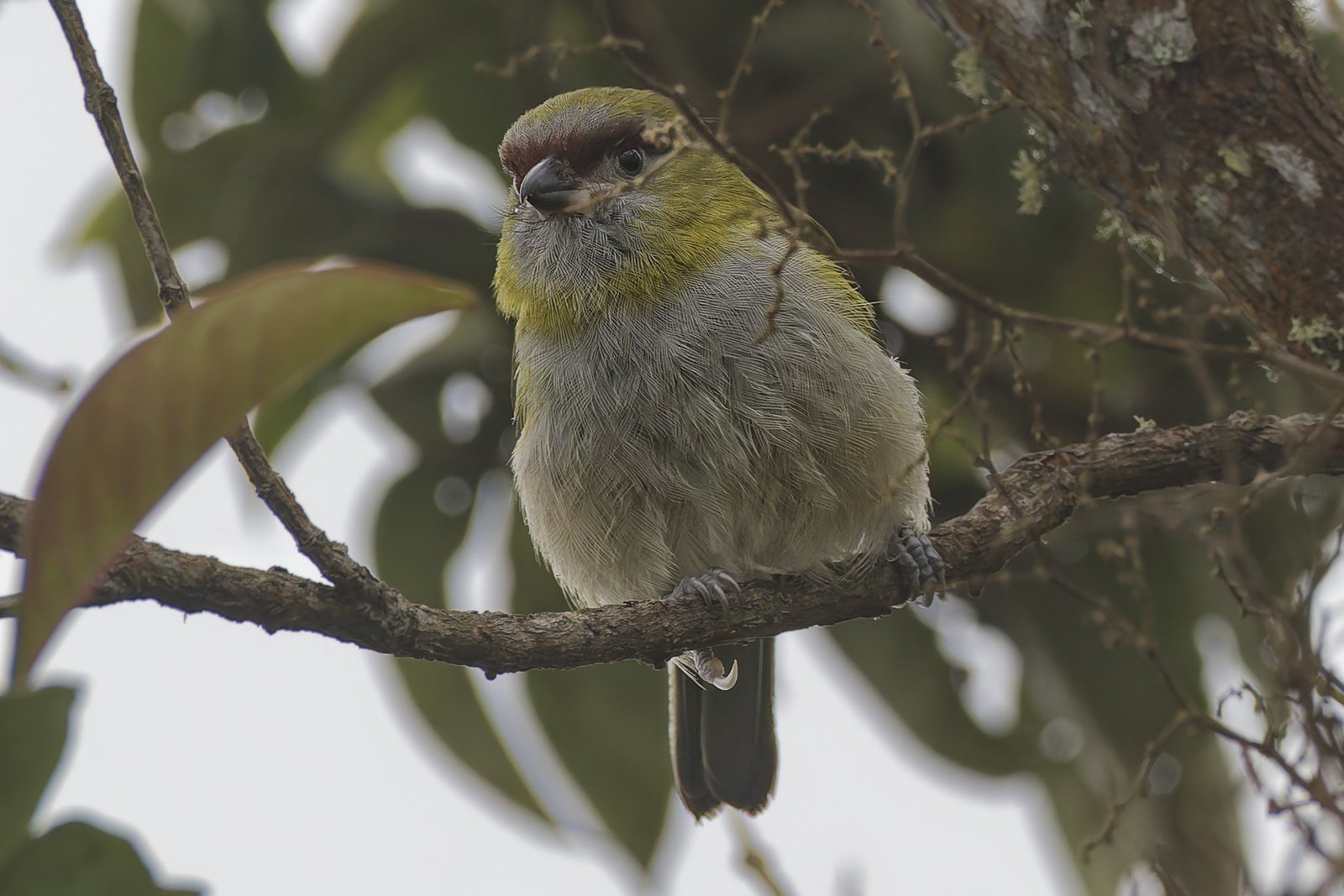
The Black-billed Peppershrike is a stocky bird with a heavy, hooked bill from the montane forests of Colombia and Ecuador. It lives high in the canopy and sings there for long periods from a single spot. The species occurs only in the northern Andes and is therefore endemic to the guide area.
Voice
A loud, clear whistled phrase of a few notes, repeated many times in succession and after a while replaced by another phrase. Also a series of short, descending call notes.
Recording: Zsombor Károlyi — CC BY-NC-SA 4.0 · xeno-canto
Identification
15 cm, with a large head and a heavy, laterally compressed, blackish bill with a hooked tip. The upperparts are olive-green, the head is grey, with a short rufous stripe above the lores that barely extends behind the eye. The throat and underparts are grey, with an olive wash on the breast and flanks. The sexes are alike; young birds are duller.
Confusion species
Rufous-browed Peppershrike Cyclarhis gujanensis has a pale, pinkish-horn bill, a broad rufous supercilium and a yellow throat and breast; it usually lives in drier, more open woodland and scrub. Slaty-capped Shrike-Vireo Vireolanius leucotis is brighter green, with a yellow supercilium and yellow underparts, and lives mainly lower on the slopes. Red-eyed Vireo Vireo olivaceus is slimmer, with a fine bill and a white supercilium.
Habitat
Humid montane forest, cloud forest, forest edges, old secondary forest and trees in semi-open country, roughly between 1200 and 2800 m. It searches slowly through the canopy for large insects and caterpillars. The nest is a loose, open cup in a fork, high in a tree.
Where the bird is most at home, classified by the vegetation units of the Andes and the west coast.


Range and movements
Colombia: in the Andes, mainly in the Western and Central Andes and locally in the Eastern Andes. Ecuador: mainly on the western slope of the Andes, south to the south of the country, and locally on the eastern slope in the north. Absent from Peru, Bolivia and the Galápagos. Does not occur outside the guide area.
- Resident
- dark = core range, pale = thinly spread
How and when to look
In montane forest on the western slope, for example around Mindo in Ecuador or in the montane forests of Antioquia and Valle del Cauca in Colombia, listen for the repeated whistled phrase from the canopy. Follow the song until you see the bird move; it often sits still on a branch for a long time.
Conservation status
Least Concern. The range is small, but the species tolerates forest edges and secondary forest; clearance of montane forest is the main threat.
Scientific name
Cyclarhis nigrirostris | de Lafresnaye, 1842
De Lafresnaye described the species in 1842 and placed it straight away in the genus where it still stands. The genus Cyclarhis was introduced in 1824 by Swainson. The genus name comes from Greek kuklos, 'circle', and rhis, rhinos, 'nostrils', for the round nostrils. The species name comes from Latin niger, 'black', and rostrum, 'bill': 'black-billed'. The specimen the first description was based on came from Bogotá, Colombia.