All species › Passerines › New World warblers › Rufous-capped Warbler
Rufous-capped Warbler | Basileuterus rufifrons
Roodkapzanger | Chipe gorra rufa | Pula-pula-de-boné-ruivo
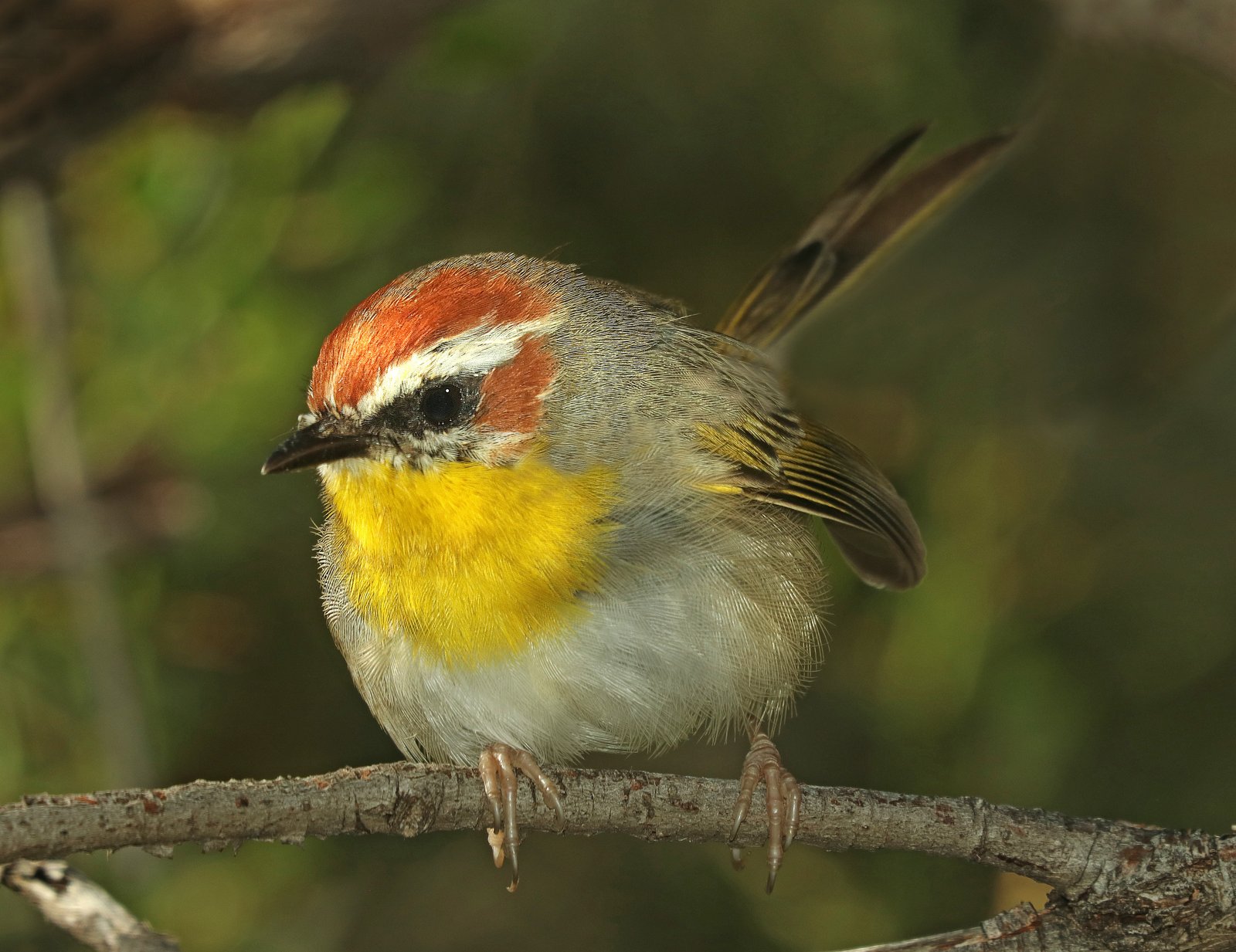
The Rufous-capped Warbler is a warbler of scrub and forest edge with a chestnut crown and cheek patch, a white supercilium and a bright yellow throat. It often holds its fairly long tail cocked and moves it constantly. In the guide area it occurs only in Colombia; the birds there belong to the southern group that some classifications treat as a separate species, Basileuterus delattrii.
Voice
The call is a dry chik or chep, often repeated. The song is a fast, slightly accelerating series of clear, chipping notes, roughly chip-chip-chewee-chewee-chew.
Recording: Manuel Grosselet — CC BY-NC-SA 4.0 · xeno-canto
Identification
13 cm, with a fairly long tail that is often held cocked. The crown and cheek patch are chestnut, separated by a broad white supercilium; a narrow dark line runs between eye and bill. The upperparts are olive-green, the throat and breast bright yellow, the belly and flanks olive-yellow. The sexes are alike. Juveniles are duller, with an olive-brown head and little chestnut.
Confusion species
Golden-crowned Warbler Basileuterus culicivorus has a yellow to orange crown stripe between two black stripes and no chestnut cheek patch. Russet-crowned Warbler Myiothlypis coronata has a rufous crown stripe bordered black and a grey head, and lives higher, in cloud forest. Three-striped Warbler Basileuterus tristriatus has a black-and-pale striped head and a black cheek patch.
Habitat
Scrub, forest edge, the understorey of dry to humid open woodland, overgrown farmland and shade coffee, mainly between 400 and 2000 m. It forages for insects in pairs or small groups low in the vegetation, sometimes in mixed flocks. The nest is a domed structure with a side entrance on or just above the ground, hidden in grass on a slope.
Where the bird is most at home, classified by the vegetation units of the Andes and the west coast.


Range and movements
Colombia: in the Sierra Nevada de Santa Marta, the Serranía de Perijá and on the Andean slopes in the north and centre of the country, also in the drier parts of the Cauca and Magdalena valleys. Absent from Ecuador, Peru, Bolivia and the Galápagos. Outside the guide area from Mexico through Central America to Panama and in northern Venezuela.
- Resident
- dark = core range, pale = thinly spread
How and when to look
Search scrub along roads and coffee plantations on the lower slopes around the Sierra Nevada de Santa Marta or in the Andean valleys; watch for a small yellow warbler moving low through the vegetation with its tail cocked and calling often.
Conservation status
Not evaluated in this species concept; the forms it comprises are considered Least Concern. The species tolerates disturbed, semi-open vegetation and is fairly common in suitable habitat.
Scientific name
Basileuterus rufifrons | (Swainson, 1838)
Swainson described the species in 1838 as Setophaga rufifrons; because it was later moved to another genus, the author and year stand in brackets. The genus Basileuterus was introduced in 1848 by Cabanis. The genus name is an Ancient Greek bird name, basileuteros, 'more kingly'. The species name comes from Latin rufus, 'rufous', and frons, 'forehead'. The specimen the first description was based on came from Mexico.