All species › Gamebirds › New World quail › Rufous-fronted Wood Quail
Rufous-fronted Wood Quail | Odontophorus erythrops
Bruinmaskertandkwartel | Corcovado frentirrojo | Uru-de-testa-ruiva
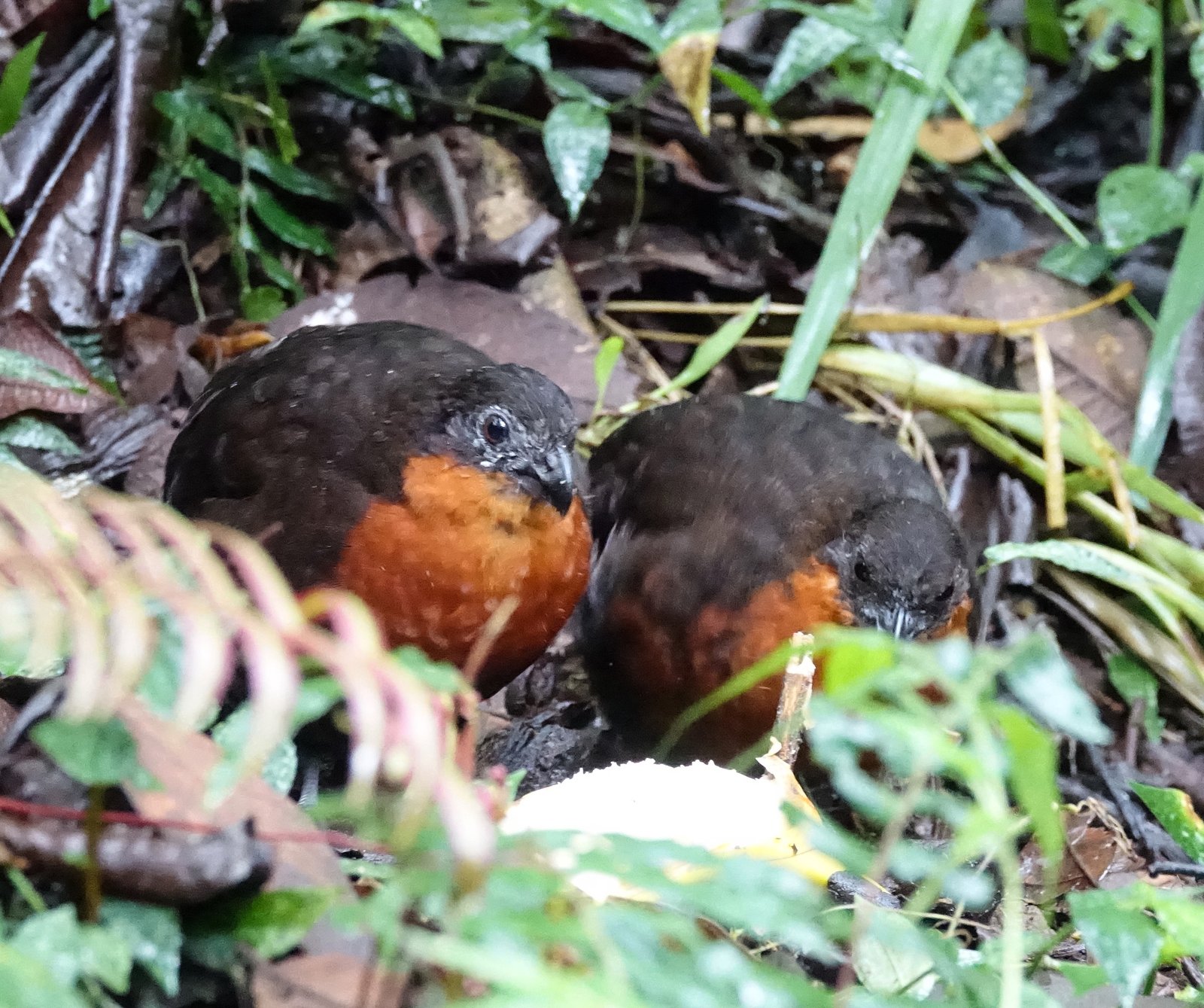
The Rufous-fronted Wood Quail is the wood quail of humid forest west of the Andes, from the Chocó to western Ecuador. The rufous forehead and black throat with a white band make it recognisable. Groups walk over the forest floor and sing loud duets at dawn.
Voice
A loud, fast and rhythmic duet of rolling, repeated notes, mainly at dawn and dusk, often sustained for a long time. Also soft contact notes within the group.
Recording: Daan van der Hoeven — CC BY-NC-SA 4.0 · xeno-canto
Identification
25–27 cm, compact, with a short tail and a short, dark crest. The forehead, eyebrow and side of the head are rufous; the chin and throat are black, with a white band across the lower throat. The upperparts are brown, finely mottled black, with pale spots on the wings. In the male the breast and belly are uniform rufous, in the female browner and duller. Juveniles are duller, with a less clearly marked head.
Confusion species
Dark-backed Wood Quail Odontophorus melanonotus, which occurs higher on the western slope, is darker, with a blackish back and a rufous throat and breast without a white band. Chestnut Wood Quail Odontophorus hyperythrus lives higher in the Colombian Andes and has a white stripe behind the eye. Tawny-faced Quail Rhynchortyx cinctus is much smaller and has no crest.
Habitat
The floor of humid lowland forest, foothill forest and lower montane forest, also old secondary forest, from sea level to about 1600 m. It lives in groups of a few birds that search the leaf litter for seeds, fruit and invertebrates. The nest is on the ground.
Where the bird is most at home, classified by the vegetation units of the Andes and the west coast.


Range and movements
In Colombia in the Pacific lowlands and on the western slope of the Western Andes, and locally in the northern Andes. In Ecuador in the west, in the lowlands and on the western slope, south to about El Oro. Absent from Peru, Bolivia and the Galápagos. Depending on taxonomy the species also occurs outside the guide area in Central America; the form melanotis from Honduras to Panama is often treated as a separate species.
- Resident
- dark = core range, pale = thinly spread
How and when to look
Listen at dawn for the duet in humid forest on the western slope of the Andes in north-western Ecuador or western Colombia. Groups move off at any noise; wait quietly on a forest trail.
Conservation status
Least Concern. Forest in western Ecuador and Colombia is heavily fragmented, and the species also suffers from hunting.
Scientific name
Odontophorus erythrops | Gould, 1859
Gould described the species in 1859 and placed it straight away in the genus where it still stands. The genus Odontophorus was introduced in 1816 by Vieillot. The genus name comes from Greek odous, odontos, 'tooth', and -phoros, 'bearing', after the serrated edge of the bill. The species name comes from Greek eruthros, 'red', and ōps, 'face'. The specimen the first description was based on came from Pallatanga, Chimborazo, Ecuador.