All species › Gamebirds › New World quail › Black-fronted Wood Quail
Black-fronted Wood Quail | Odontophorus atrifrons
Zwartmaskertandkwartel | Corcovado carinegro | Uru-de-testa-preta
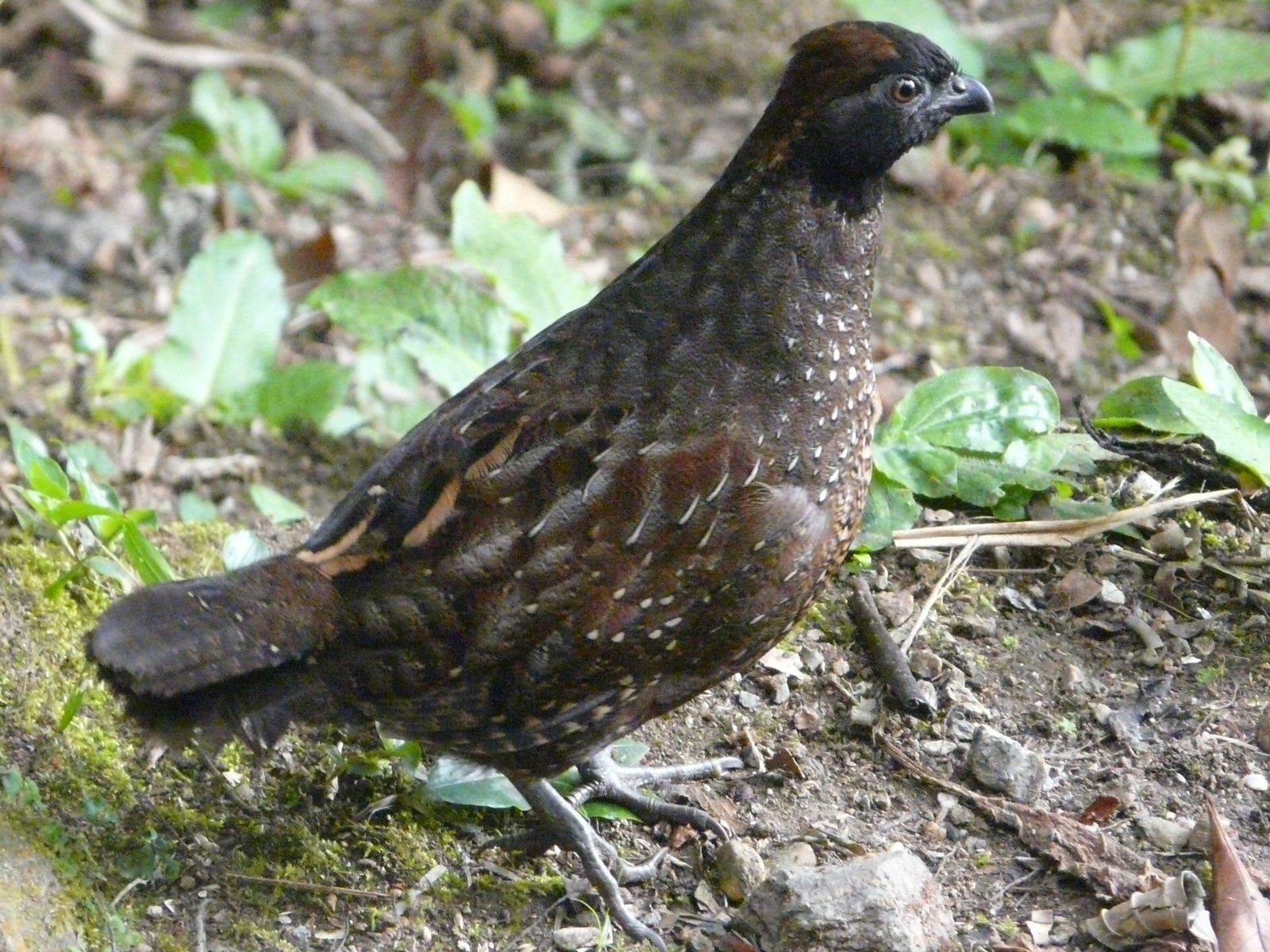
The Black-fronted Wood Quail is a wood quail of montane forest at the far northern end of the Andes and in the Sierra Nevada de Santa Marta. The black face and throat distinguish it from the other wood quails of the guide area. It lives in groups on the forest floor and has a small range.
Voice
A fast, rhythmic duet of repeated, rolling notes, similar to that of other wood quails, mainly at dawn and dusk. Also soft contact notes within the group.
Recording: Niels Krabbe — CC BY-NC-SA 4.0 · xeno-canto
Identification
26–28 cm, compact, with a short tail and a short crest. The forehead, face, chin and throat are black; the crown and crest are dark brown. The upperparts are brown, finely mottled black and ochre, with pale spots on the wings. The underparts are greyish brown to ochre-brown, finely barred dark, with small pale spots. The sexes are similar; the three subspecies differ in the tone of the back and belly.
Confusion species
Marbled Wood Quail Odontophorus gujanensis occurs lower, in lowland and foothill forest, and has a brown face with orange-red skin around the eye. Other wood quails of the guide area lack a black mask and do not live in the same mountains.
Habitat
The floor of humid montane forest and cloud forest, also old secondary forest, roughly between 1200 and 3000 m. It lives in groups that walk over the forest floor and search the leaf litter for seeds, fruit and invertebrates. The nest is on the ground.
Where the bird is most at home, classified by the vegetation units of the Andes and the west coast.


Range and movements
Within the guide area only in Colombia: in the Sierra Nevada de Santa Marta, the Serranía de Perijá and the northern part of the Eastern Andes. Absent from Ecuador, Peru, Bolivia and the Galápagos. Outside the guide area in the adjacent mountains of western Venezuela.
- Resident
- dark = core range, pale = thinly spread
How and when to look
Look for the species in montane forest of the Sierra Nevada de Santa Marta, where forest trails and undisturbed slopes give the best chance. Listen for the duet at dawn and wait quietly on a trail.
Conservation status
Least Concern, but the range is small. Threats are clearance of forest for agriculture and local hunting.
Scientific name
Odontophorus atrifrons | Allen, 1900
Allen described the species in 1900 and placed it straight away in the genus where it still stands. The genus Odontophorus was introduced in 1816 by Vieillot. The genus name comes from Greek odous, odontos, 'tooth', and -phoros, 'bearing', after the serrated edge of the bill. The species name comes from Latin ater, 'black', and frons, 'forehead'. The specimen the first description was based on came from Valparaíso, Sierra Nevada de Santa Marta, Colombia.