All species › Gamebirds › New World quail › Marbled Wood Quail
Marbled Wood Quail | Odontophorus gujanensis
Gemarmerde tandkwartel | Corcovado común | Uru-corcovado
The Marbled Wood Quail is the most widespread wood quail of the Amazonian lowlands. Groups of five to ten birds walk close together over the forest floor. At dawn and dusk pairs sing a fast, rhythmic duet that carries far through the forest.
Voice
A fast, rhythmic and loud duet, in which two birds interlock their calls so that it sounds like one continuous rollicking series, something like corcorovado-corcorovado, often repeated for minutes. Also soft, squeaky contact notes within the group.
Recording: Jose Martin — CC BY-NC-SA 4.0 · xeno-canto
Identification
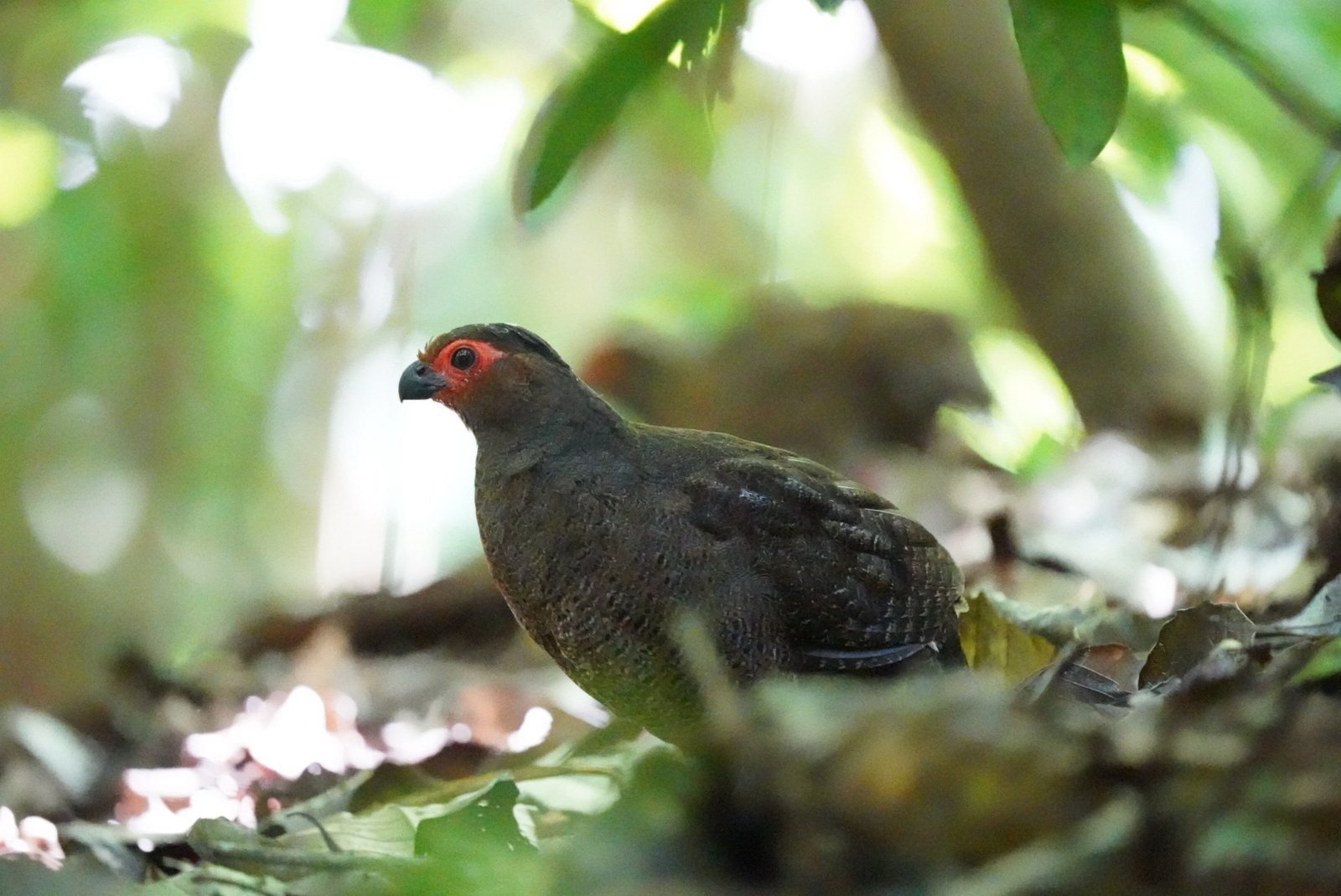
25–28 cm, compact, with a short tail, a short, thick bill and a short, rounded crest. The plumage is almost uniformly dark brown, finely marbled and barred black and ochre, with pale shaft streaks on the back and wings. Around the eye is bare skin that is orange-red. The underparts are greyish brown, finely barred dark. The sexes are alike; juveniles are duller, with less bare skin around the eye.
Confusion species
Starred Wood Quail Odontophorus stellatus, which partly shares the same forest in western Amazonia, has a rufous crest, a grey nape and a rusty breast with small white spots. Rufous-breasted Wood Quail Odontophorus speciosus lives higher, in montane forest on the eastern slope, and has a rufous breast and belly. Tinamous such as Variegated Tinamou Crypturellus variegatus have a thin bill, no crest and almost no tail.
Habitat
The floor of humid terra firme lowland forest and foothill forest, also old secondary forest, up to about 1200 m. Groups walk slowly over the forest floor, scratch in the leaf litter and eat seeds, fallen fruit, insects and other invertebrates. It roosts on a branch above the ground. The nest is on the ground, sometimes partly roofed over.
Where the bird is most at home, classified by the vegetation units of the Andes and the west coast.


Range and movements
In Colombia in the lowlands and foothills east of the Andes, and with a separate subspecies in the north. In Ecuador in the eastern lowlands and foothills. In Peru in the Amazonian lowlands and on the lower eastern slope. In Bolivia in the northern and central lowlands. Absent from the Galápagos. Outside the guide area from Costa Rica and Panama to Venezuela, the Guianas and Brazilian Amazonia.
- Resident
- dark = core range, pale = thinly spread
How and when to look
Listen at dawn or dusk for the rollicking duet in Amazonian lowland forest. Groups move away as soon as they hear something; waiting quietly on a forest trail yields more than following them.
Conservation status
Least Concern. The population is declining through deforestation and hunting, but the species still occurs over a very large area.
Scientific name
Odontophorus gujanensis | (Gmelin, 1789)
Gmelin described the species in 1789 as Tetrao gujanensis; because it was later moved to another genus, the author and year stand in brackets. The genus Odontophorus was introduced in 1816 by Vieillot. The genus name comes from Greek odous, odontos, 'tooth', and -phoros, 'bearing', after the serrated edge of the bill. The species name refers to Guiana, the Guianas. The specimen the first description was based on came from Cayenne, French Guiana.