All species › Gamebirds › New World quail › Crested Bobwhite
Crested Bobwhite | Colinus cristatus
Kuifbobwhite | Colín crestudo | Uru-do-campo
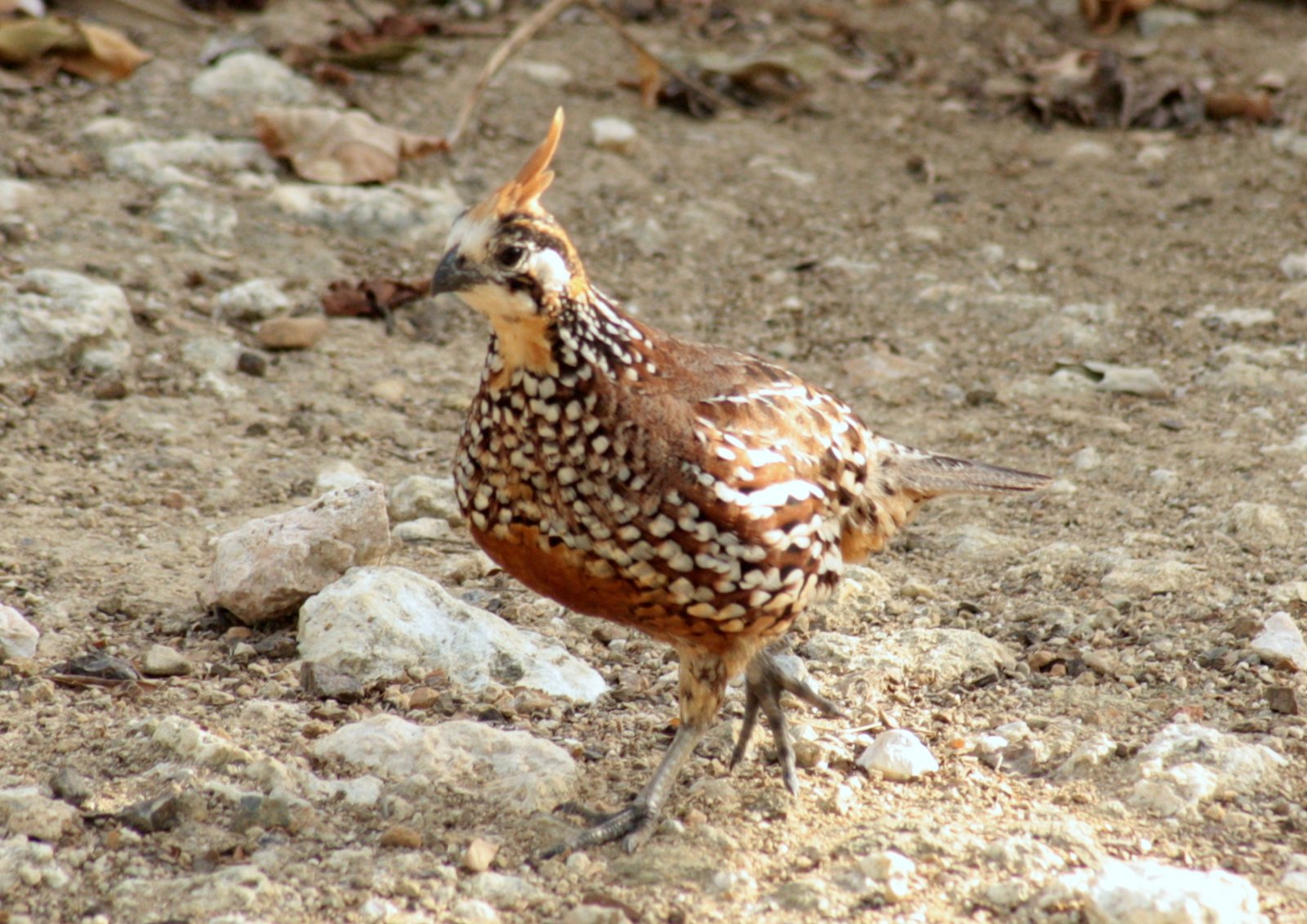
The Crested Bobwhite is a small, compact quail of open, dry country in northern Colombia, with a long, pointed crest. It lives in coveys that walk together over the ground and flush simultaneously with whirring wings when disturbed. The species benefits from deforestation and is common in pasture and shrubby farmland.
Voice
A clear, rising whistle of two or three notes, the last loudest, something like bob-bob-white, mainly given from a post or shrub in the morning and evening. Coveys keep in contact with soft chirping and clucking notes.
Recording: Mauricio Cuellar Ramirez (@Birding.travel) — CC BY-NC-SA 4.0 · xeno-canto
Identification
20–23 cm, round and short-tailed, with a short, thick bill. The male has a long, pointed crest, which varies by subspecies from whitish to rufous, an ochre to rufous face and throat, and often a pale eyebrow bordered by a dark stripe above or through the eye. The underparts are brown to rufous with numerous white and black spots; the upperparts are greyish brown, finely mottled black and brown. The female has a shorter, browner crest and a duller, streaked face. Juveniles are duller and more streaked.
Confusion species
No other bobwhite occurs in the guide area. Marbled Wood Quail Odontophorus gujanensis is larger, darker brown, with a short, rounded crest and orange-red skin around the eye, and lives in humid forest. Little Tinamou Crypturellus soui has a thin bill, no crest and almost no tail, and lives in forest and second growth.
Habitat
Dry and semi-humid savanna, grassland with shrubs, pasture, field edges, dry scrub and the edges of dry forest, mainly in the lowlands, locally higher in Andean valleys. It walks over the ground in coveys and feeds on seeds, shoots, berries and insects. The nest is a scrape on the ground under cover of grass or a shrub.
Where the bird is most at home, classified by the vegetation units of the Andes and the west coast.


Range and movements
Within the guide area only in Colombia: in the Caribbean lowlands, the Magdalena and Cauca valleys and the Llanos east of the Andes. Absent from Ecuador, Peru, Bolivia and the Galápagos. Outside the guide area in western Panama, Venezuela, the Guianas, extreme northern Brazil and on Aruba and Curaçao.
- Resident
- dark = core range, pale = thinly spread
How and when to look
Listen early in the morning for the whistled bob-bob-white along roads through pasture and scrub in the Caribbean lowlands or the Llanos. Coveys often walk along road verges and flush only at close range.
Conservation status
Least Concern. The species is widespread and benefits from the conversion of forest to pasture, but is hunted locally.
Scientific name
Colinus cristatus | (Linnaeus, 1766)
Linnaeus described the species in 1766 as Tetrao cristatus; because it was later moved to another genus, the author and year stand in brackets. The genus Colinus was introduced in 1820 by Goldfuss. The genus name comes from Nahuatl zolin, 'quail'. The species name is Latin cristatus, 'crested'. The specimen the first description was based on came from Curaçao.