All species › Gamebirds › New World quail › Tawny-faced Quail
Tawny-faced Quail | Rhynchortyx cinctus
Langpootkwartel | Codorniz carirrufa | Uru-de-cara-ruiva
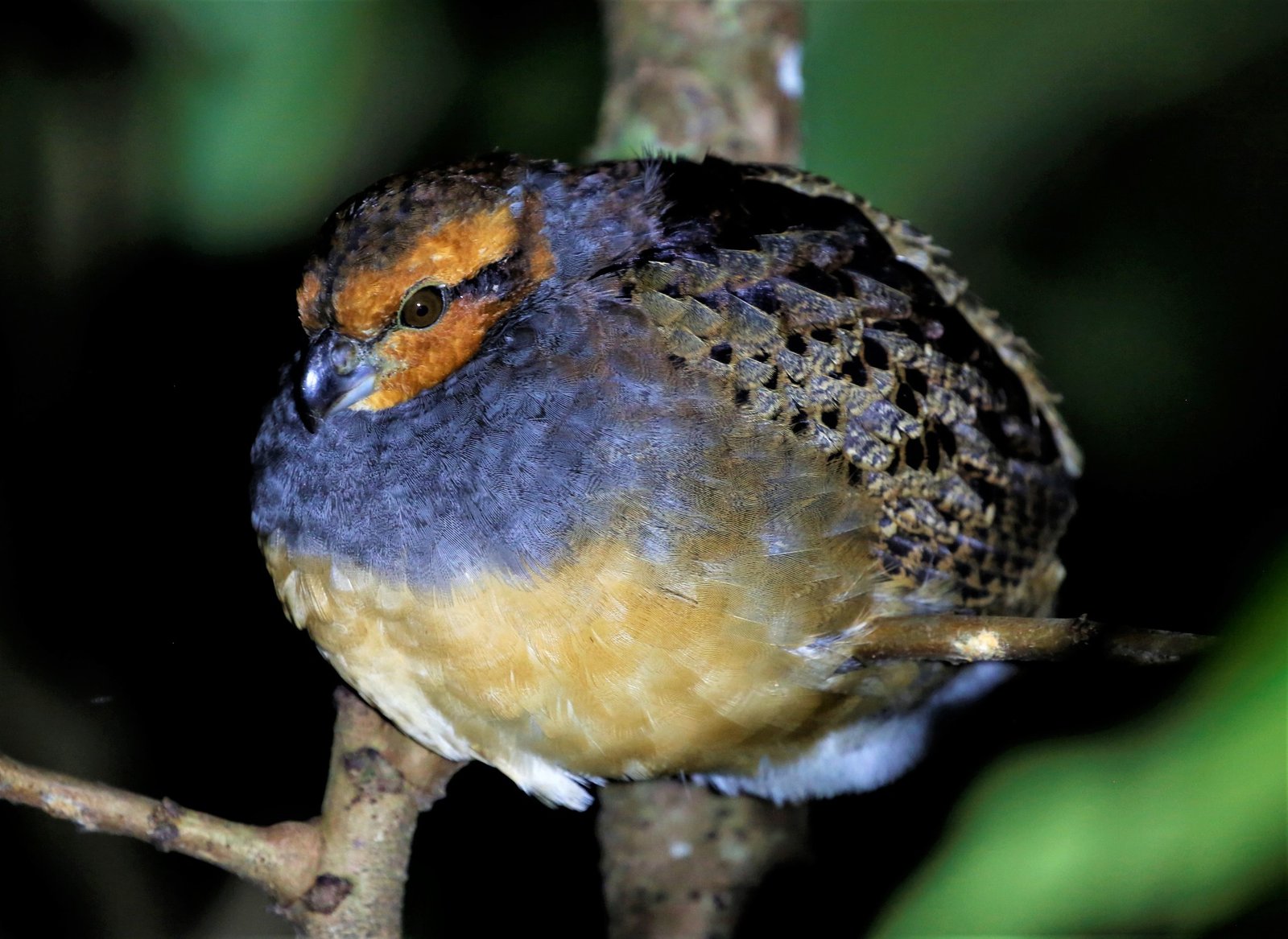
The Tawny-faced Quail is a small, relatively long-legged quail of the floor of humid lowland forest. It lives in pairs or small groups on the forest floor and is the only species in its genus. Male and female differ clearly in plumage.
Voice
A slowly repeated, hollow and somewhat plaintive whistle, mainly in the early morning and at dusk. When disturbed, soft, scratchy contact notes.
Recording: rudy gelis — CC BY-NC-SA 4.0 · xeno-canto
Identification
17–19 cm, with a short tail, a fairly stout, dark bill and, for a quail, long greyish legs. The male has an orange-brown head with a dark grey stripe through the eye, a grey neck and breast and a pale, ochre belly; the flanks are finely barred dark. The upperparts are brown, with small black spots and pale streaks. The female has a brown head with a pale eyebrow and a white throat, a brown breast and a whitish belly barred with black. Juveniles resemble the female.
Confusion species
Rufous-fronted Wood Quail Odontophorus erythrops, which partly shares the same forests, is much larger and heavier, with a short crest, a rufous forehead and a black throat with a white band. Little Tinamou Crypturellus soui and Choco Tinamou Crypturellus kerriae have a thin, slightly decurved bill, a plain head and almost no tail.
Habitat
The floor of humid, tall lowland forest and old secondary forest in hilly country, with dense undergrowth, mostly below 900 m. It walks over the forest floor in pairs or groups of a few birds, searching the leaf litter for seeds, fruit, insects and other invertebrates. The nest is on the ground; little is known about its breeding biology.
Where the bird is most at home, classified by the vegetation units of the Andes and the west coast.


Range and movements
In Colombia in the Pacific lowlands of the Chocó and in the north, east to the Sinú valley, the lower Cauca and the middle Magdalena Valley. In Ecuador only in the north-west, mainly in Esmeraldas. Absent from Peru, Bolivia and the Galápagos. Outside the guide area from Honduras to Panama.
- Resident
- dark = core range, pale = thinly spread
How and when to look
Walk slowly along quiet trails in lowland forest of the Chocó or north-western Ecuador early in the morning. Birds usually run off before flushing; watch for movement and soft rustling in the leaf litter.
Conservation status
Near Threatened (NT). The species depends on little-disturbed lowland forest and is declining through deforestation; hunting also plays a role locally.
Scientific name
Rhynchortyx cinctus | (Salvin, 1876)
Salvin described the species in 1876 as Odontophorus cinctus; because it was later moved to another genus, the author and year stand in brackets. The genus Rhynchortyx was introduced in 1893 by Ogilvie-Grant. The genus name comes from Greek rhunkhos, 'bill', and ortux, 'quail'. The species name is Latin cinctus, 'girdled', after the band across the breast. The specimen the first description was based on came from Veraguas, Panama.