All species › Gamebirds › Guans, curassows and chachalacas › Little Chachalaca
Little Chachalaca | Ortalis motmot
Kleine chachalaca | Guacharaca enana | Aracuã-pequeno
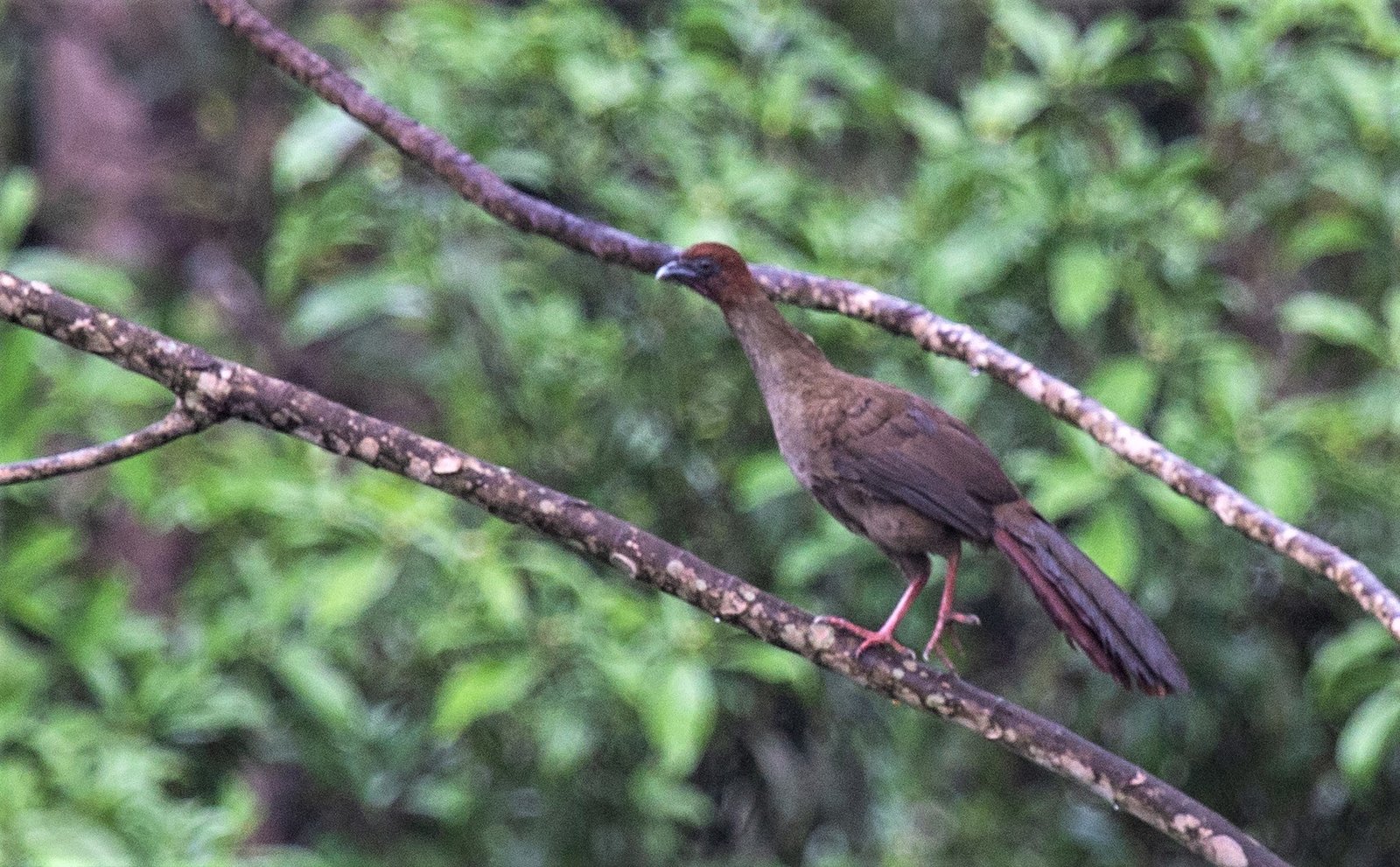
The Little Chachalaca is a fairly small chachalaca with a rufous head and neck, of north-eastern South America. Its range lies largely outside the guide area, in southern Venezuela, the Guianas and northern Brazil. In the guide area it occurs at most in the far east of Colombia.
Voice
A loud, hoarse chorus by pairs and groups, a repeated, rasping phrase of a few syllables, mainly at dawn and dusk. Also soft, scratchy calls.
Recording: Geoffrey Monchaux — CC BY-NC-SA 4.0 · xeno-canto
Identification
43–48 cm, slender, with a small head, a long neck and a long tail. The head and neck are rufous, with a patch of bare red skin on the throat. The upperparts are greyish olive-brown, the breast greyish brown without spots, and the belly buff to dull white. The tail is dark, the outer feathers tipped rufous. The sexes are alike.
Confusion species
Speckled Chachalaca Ortalis guttata is slightly larger, has white spots and scaling on the neck and breast and only a rufous crown, and lives in Amazonia east of the Andes. Rufous-vented Chachalaca Ortalis ruficauda has a grey head and lives in northern Colombia and Venezuela. Spix's Guan Penelope jacquacu is much larger and darker, with a red dewlap.
Habitat
Forest edge, secondary forest, scrub, gallery forest, savanna woodland and the edges of riverine forest in the lowlands, mostly below 1000 m. It lives in small groups in the trees and feeds on fruit, leaves and buds. The nest is a loose cup of twigs in a tree or shrub.
Where the bird is most at home, classified by the vegetation units of the Andes and the west coast.


Range and movements
In Colombia at most in the far east, along the border with Venezuela and Brazil; its occurrence there is poorly documented. Absent from Ecuador, Peru, Bolivia and the Galápagos. Outside the guide area in southern Venezuela, in Guyana, Suriname and French Guiana and in northern Brazil north of the Amazon.
- Resident
- dark = core range, pale = thinly spread
How and when to look
In the guide area the species can only be expected in forest edge and riverine forest in the far east of Colombia. Outside the guide area it occurs along forest edges and in secondary forest in the Guianas and northern Brazil, where the groups call mainly in the early morning.
Conservation status
Not Evaluated as a separate species; the Red List includes this form in a more broadly defined species that is listed as Least Concern. The species tolerates secondary forest and forest edge, but is hunted locally.
Scientific name
Ortalis motmot | (Linnaeus, 1766)
Linnaeus described the species in 1766 as Phasianus Motmot; because it was later moved to another genus, the author and year stand in brackets. The genus Ortalis was introduced in 1786 by Merrem. The genus name comes from Ancient Greek ortalis, 'pullet' or 'hen'. The species name is an Aztec bird name that Albertus Seba misapplied to a chachalaca in 1734. The specimen the first description was based on came from Cayenne, French Guiana.