All species › Gamebirds › Guans, curassows and chachalacas › Speckled Chachalaca
Speckled Chachalaca | Ortalis guttata
Gevlekte chachalaca | Chachalaca jaspeada | Aracuã-pintado
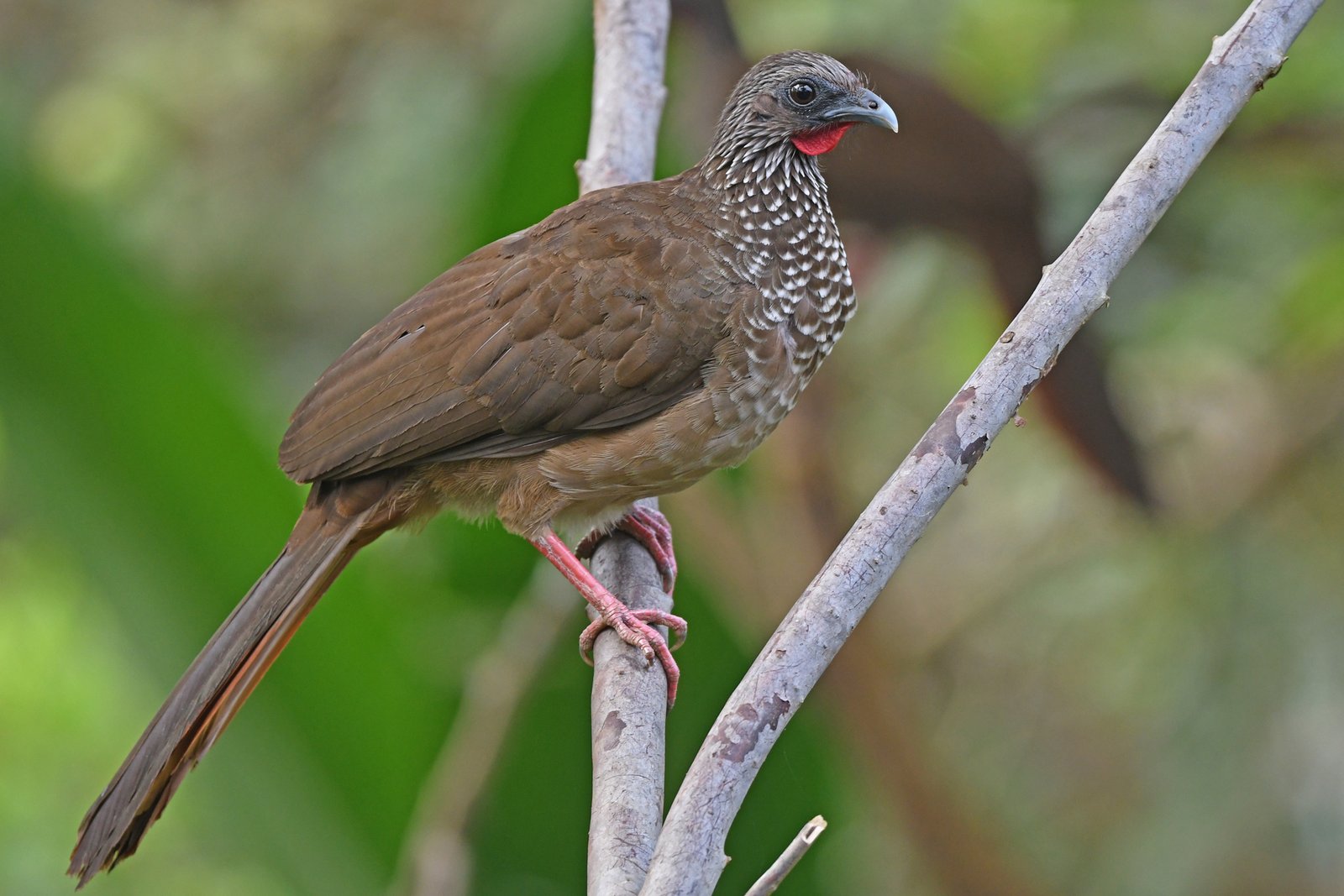
The Speckled Chachalaca is the chachalaca of western Amazonia and the foothills of the east slope of the Andes, from Colombia to Bolivia. It lives mainly along rivers, on river islands and in forest edge and secondary forest. The white spots on the neck and breast give it its name.
Voice
A loud, hoarse chorus by pairs and groups, a rapidly repeated, rasping phrase, mainly at dawn and dusk, often answered by groups further away. Also soft, scratchy contact calls.
Recording: JAYRSON ARAUJO DE OLIVEIRA — CC BY-NC-SA 4.0 · xeno-canto
Identification
48–53 cm, slender, with a small head, a long neck and a long tail. The crown and nape are rufous, the face greyish brown, with a patch of bare red skin on the throat. The neck and breast are dark brownish grey with white spots and edges that form a scaled pattern. The back is olive-brown, the belly greyish buff. The tail is dark, the outer feathers tipped rufous. The sexes are alike.
Confusion species
Little Chachalaca Ortalis motmot lacks the white spots and has an entirely rufous head and neck; in the guide area at most in the far east of Colombia. Chaco Chachalaca Ortalis canicollis has an unspotted grey head and a rufous belly and lives in the Chaco of south-eastern Bolivia. Colombian Chachalaca Ortalis columbiana is very similar but lacks the rufous crown and lives west of the Eastern Andes. Spix's Guan Penelope jacquacu is much larger and darker, with a red dewlap and white-streaked breast, and lives more in the forest interior.
Habitat
Forest edge, secondary forest, várzea, young growth on river islands, bamboo and wooded clearings in the lowlands and foothills, up to about 1500 m, locally higher. It avoids the closed interior of terra firme forest. It lives in small groups in the trees and feeds on fruit, leaves and buds. The nest is a loose cup of twigs in a tree or in dense vegetation.
Where the bird is most at home, classified by the vegetation units of the Andes and the west coast.


Range and movements
In Colombia east of the Andes, in the foothills and the Amazonian lowlands. In Ecuador and Peru in the east, in the lowlands and on the lower east slope. In Bolivia in the north and centre, in the lowlands and foothills of Pando, Beni, La Paz, Cochabamba and Santa Cruz. Absent from the Galápagos. Outside the guide area in western Brazil.
How and when to look
Search riverbanks, river islands, forest edges and clearings in the lowlands and foothills of the east slope, for example along the Napo, the Madre de Dios or the lower parts of the Manu road. The birds call mainly in the early morning from treetops.
Conservation status
Least Concern. The species has a large range and tolerates secondary forest and forest edge; it is hunted locally.
Scientific name
Ortalis guttata | (Spix, 1825)
Spix described the species in 1825 as Penelope guttata; because it was later moved to another genus, the author and year stand in brackets. The genus Ortalis was introduced in 1786 by Merrem. The genus name comes from Ancient Greek ortalis, 'pullet' or 'hen'. The species name comes from Latin guttatus, 'spotted', for the spots on neck and breast. The specimen the first description was based on came from Rio Solimões, Amazonas, Brazil.