All species › Gamebirds › Guans, curassows and chachalacas › Colombian Chachalaca
Colombian Chachalaca | Ortalis columbiana
Colombiaanse chachalaca | Guacharaca colombiana | Aracuã-colombiano
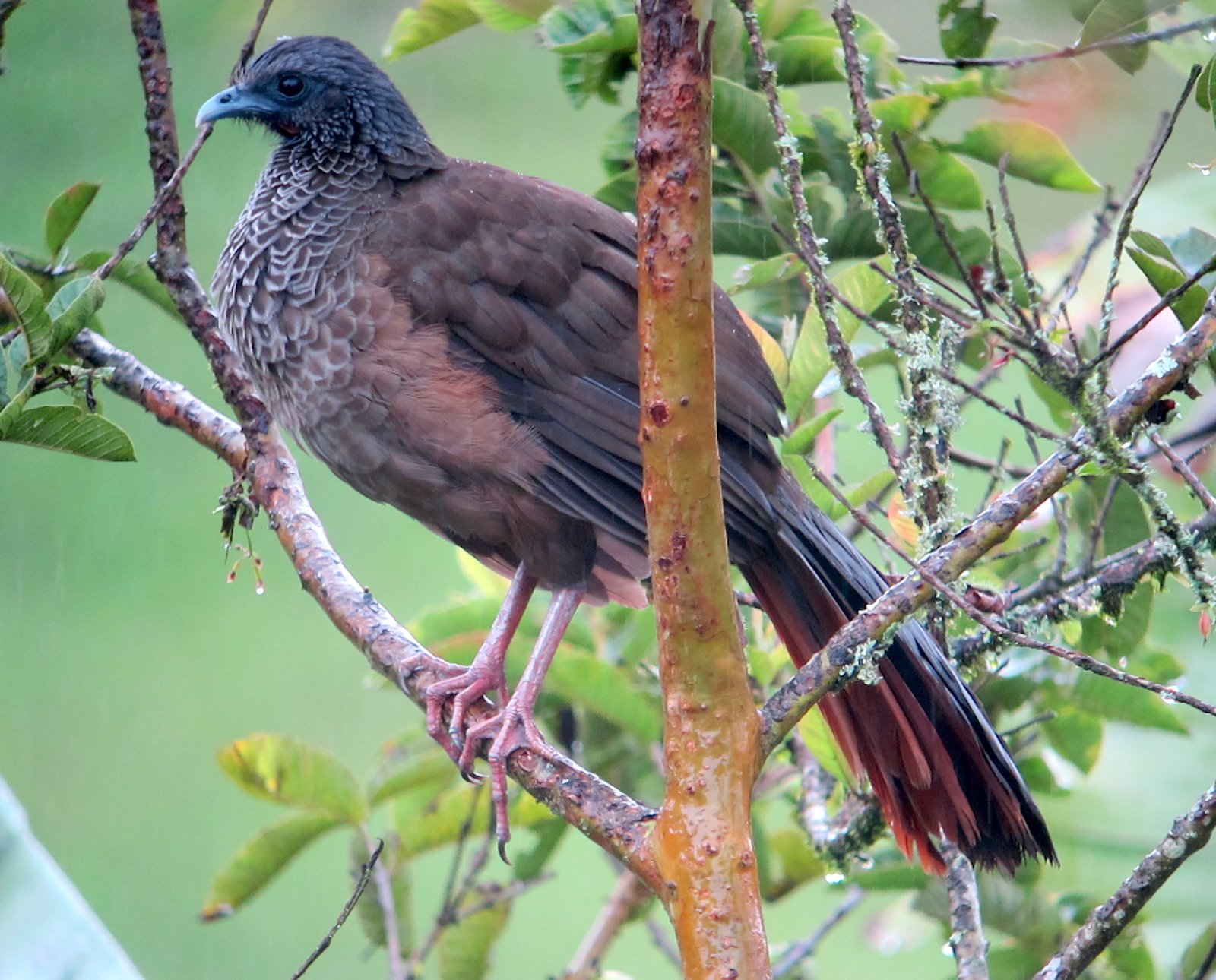
The Colombian Chachalaca occurs only in Colombia, in the Magdalena and Cauca valleys and on the slopes above them. It was formerly included in Speckled Chachalaca and, like that species, has a white-scaled neck and breast. It also lives in secondary forest, coffee plantations and parks, right up to the edges of towns.
Voice
A loud, rhythmic chorus by pairs and groups, a repeated, hoarse four-syllabled phrase, roughly gua-cha-ra-ka, mainly at dawn and dusk. Also scratchy contact calls.
Recording: Yair Guillermo Molina Martínez. — CC BY-NC-SA 4.0 · xeno-canto
Identification
50–56 cm, slender, with a small head, a long neck and a long tail. The head and upper neck are greyish brown, with a patch of bare red skin on the throat. The neck, mantle and breast are dark greyish brown, with distinct white feather edges that give a scaled look. The back is olive-brown, the belly buff to dull white. The tail is dark olive-brown, the outer feathers tipped rufous. The sexes are alike.
Confusion species
Chestnut-winged Chachalaca Ortalis garrula has a rufous head, rufous primaries and a white belly, lacks the scaling and lives in the Caribbean lowlands of the north. Rufous-vented Chachalaca Ortalis ruficauda has an unscaled grey head and lives in north-eastern Colombia. Speckled Chachalaca Ortalis guttata is very similar but has a rufous crown and lives east of the Andes. Band-tailed Guan Penelope argyrotis is larger, with a silvery face and a red dewlap, and lives in montane forest.
Habitat
Forest edge, secondary forest, scrub, gallery forest, coffee plantations, wooded gardens and parks, in humid and drier areas, from the valley lowlands up to about 2500 m. It lives in small groups in the trees and feeds on fruit, leaves, buds and flowers. The nest is a loose cup of twigs in a tree or shrub.
Where the bird is most at home, classified by the vegetation units of the Andes and the west coast.


Range and movements
Only in Colombia: in the Magdalena and Cauca valleys and on the adjacent slopes of the Central and Western Andes and the western slope of the Eastern Andes. Absent from Ecuador, Peru, Bolivia and the Galápagos. It does not occur outside the guide area.
- Resident
- dark = core range, pale = thinly spread
How and when to look
Search forest edges, parks and coffee areas in the Magdalena and Cauca valleys, for example around Medellín, Cali, Ibagué and in the coffee zone of Caldas and Risaralda. The groups call mainly early in the morning and then feed in fruiting trees.
Conservation status
Least Concern. The species occurs only in Colombia but tolerates secondary forest and farmland with trees; it is hunted locally.
Scientific name
Ortalis columbiana | Hellmayr, 1906
Hellmayr described the species in 1906 and placed it straight away in the genus where it still stands. The genus Ortalis was introduced in 1786 by Merrem. The genus name comes from Ancient Greek ortalis, 'pullet' or 'hen'. The species name refers to Colombia. The specimen the first description was based on came from Colombia.