All species › Gamebirds › Guans, curassows and chachalacas › Chaco Chachalaca
Chaco Chachalaca | Ortalis canicollis
Chacochachalaca | Charata | Aracuã-do-pantanal
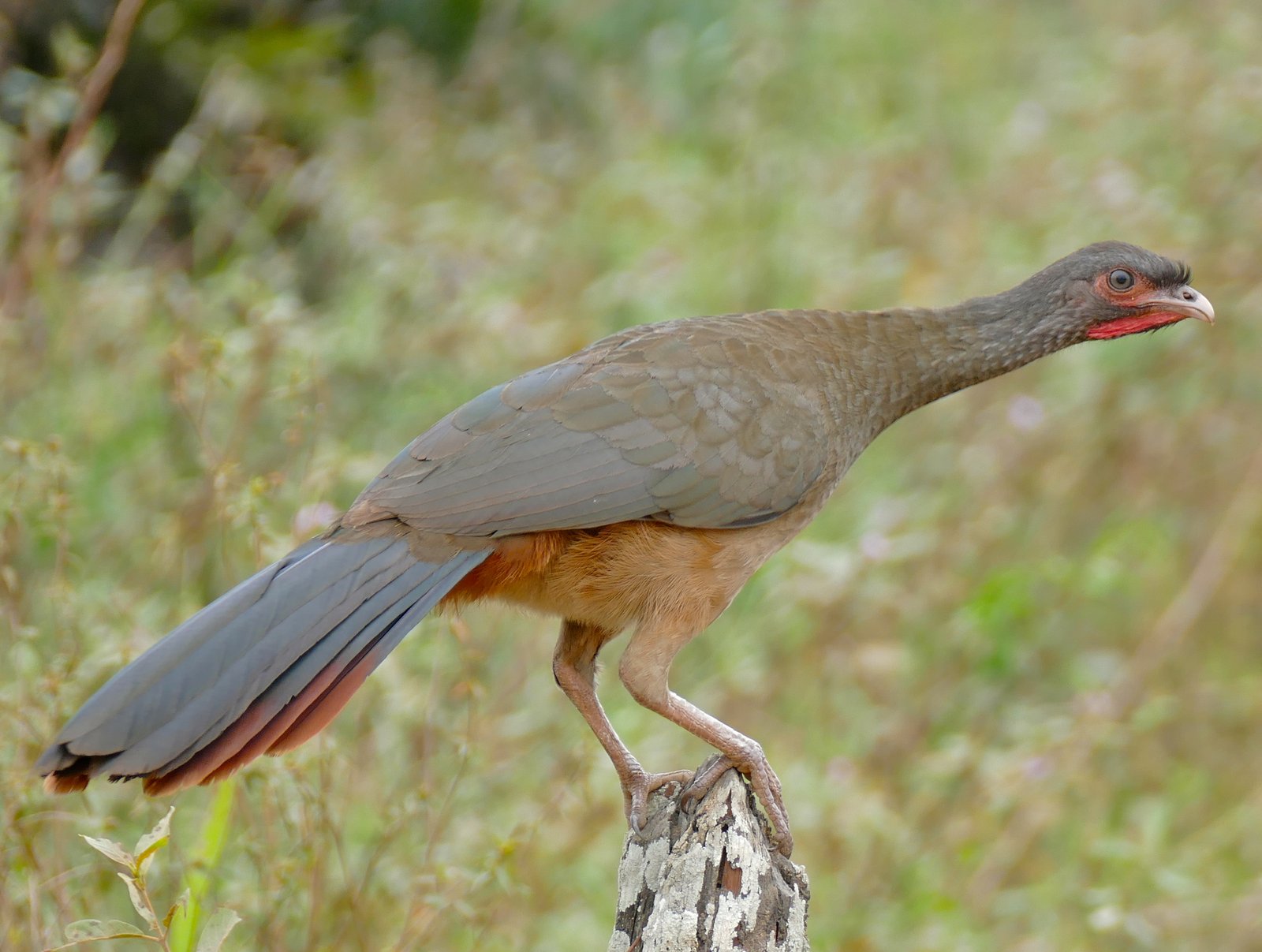
The Chaco Chachalaca is the chachalaca of the dry Chaco forests of south-eastern Bolivia and the adjacent lowlands of Paraguay, Argentina and Brazil. It has a grey head and neck and rufous undertail coverts. Pairs and groups call so loudly in chorus that they can be heard over long distances.
Voice
A very loud, rhythmic chorus in which birds answer each other with a repeated, hoarse three-syllabled phrase, roughly cha-ra-ta, mainly at dawn and dusk. Also soft, scratchy calls.
Recording: Niels Krabbe — CC BY-NC-SA 4.0 · xeno-canto
Identification
48–56 cm, slender, with a small head, a long neck and a long tail. The head and neck are grey, with a patch of bare red skin on the throat and dark bare skin around the eye. The upperparts are olive-brown, the breast greyish brown, and the belly and undertail coverts buff to rufous. The tail is dark, glossed green, with broad rufous tips to the outer feathers. The legs are greyish to pink. The sexes are alike.
Confusion species
Speckled Chachalaca Ortalis guttata lives further north in Bolivia, has a rufous crown and a white-spotted neck and breast, and a paler belly. Dusky-legged Guan Penelope obscura is larger and darker, with a red dewlap and white-streaked breast, and lives in the montane forest of the Yungas. Red-faced Guan Penelope dabbenei has bare red facial skin and lives in the higher montane forest of southern Bolivia.
Habitat
Dry Chaco forest, thorn scrub, gallery forest along rivers, forest edge and wooded farmland in the lowlands and low hills, up to about 1000 m, locally higher. It lives in pairs and small groups in the trees and also comes to the ground. It feeds on fruit, leaves, buds and flowers. The nest is a loose cup of twigs in a tree or shrub.
Where the bird is most at home, classified by the vegetation units of the Andes and the west coast.


Range and movements
In Bolivia in the south-east, in the Chaco of Santa Cruz, Chuquisaca and Tarija, and in the east into the transition to the Pantanal. Absent from Colombia, Ecuador, Peru and the Galápagos. Outside the guide area in western Paraguay, northern Argentina and south-western Brazil.
- Resident
- dark = core range, pale = thinly spread
How and when to look
Search the Bolivian Chaco, for example around Villamontes and Boyuibe or in Kaa-Iya National Park, along forest edges and rivers. In the early morning the groups give themselves away by their chorus; they then often also walk across roads and clearings.
Conservation status
Least Concern. The species tolerates degraded forest and wooded farmland, but is hunted, and deforestation of the Chaco is reducing numbers locally.
Scientific name
Ortalis canicollis | (Wagler, 1830)
Wagler described the species in 1830 as Penelope canicollis; because it was later moved to another genus, the author and year stand in brackets. The genus Ortalis was introduced in 1786 by Merrem. The genus name comes from Ancient Greek ortalis, 'pullet' or 'hen'. The species name comes from Latin canus, 'grey', and collum, 'neck', for the grey neck. The specimen the first description was based on came from Paraguay.