All species › Gamebirds › Guans, curassows and chachalacas › Rufous-headed Chachalaca
Rufous-headed Chachalaca | Ortalis erythroptera
Roodkopchachalaca | Chachalaca cabecirrufa | Aracuã-de-cabeça-ruiva
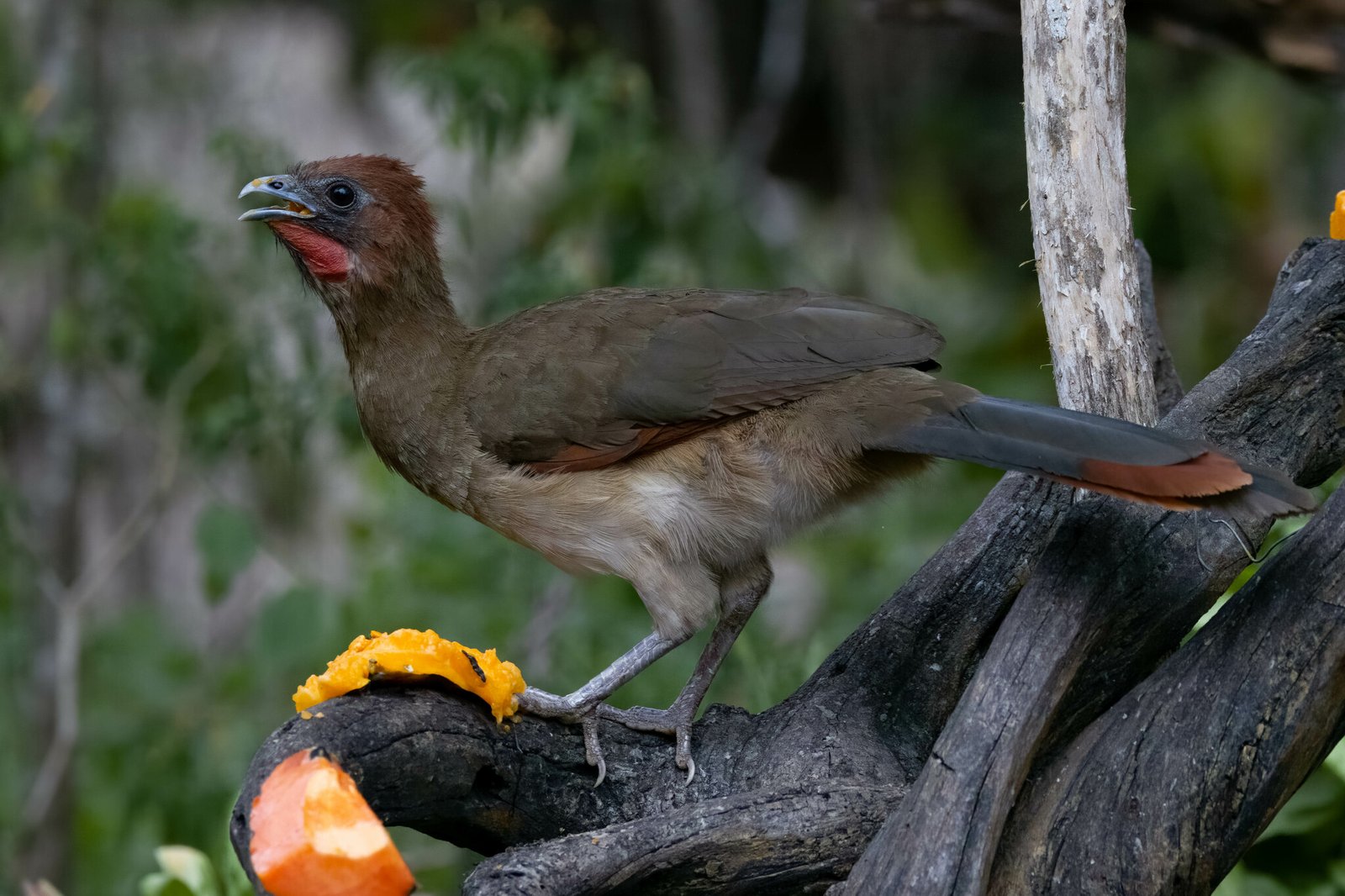
The Rufous-headed Chachalaca is a slender, long-tailed chachalaca of the dry and semi-humid forests of western Ecuador and north-western Peru, a region to which it is restricted. It is the only chachalaca there and stands out by its rufous head and neck. Groups call loudly in chorus from the treetops in the early morning.
Voice
A loud, rasping chorus of repeated, hoarse notes, given by several birds at once, mainly at dawn and dusk. Also softer, scratchy contact calls.
Recording: Juan Freile — CC BY-NC-SA 4.0 · xeno-canto
Identification
56–66 cm, with a small head, a long neck and a long, broad tail. The head and neck are bright rufous; the throat has a small patch of bare red skin. The upperparts are olive-brown, the breast greyish brown and the belly paler, almost white. The primaries are rufous, which shows mainly in flight. The tail is dark olive-brown, the outer feathers tipped rufous. The legs are greyish. The sexes are alike; juveniles are duller.
Confusion species
Crested Guan Penelope purpurascens is much larger and darker, with a crest, white streaks on the neck and breast and a large red dewlap, and lives in wetter forest. Bearded Guan Penelope barbata is larger and dark brown, with a pale eyebrow, and lives higher in the montane forest of southern Ecuador and northern Peru. Colombian Chachalaca Ortalis columbiana has a greyish-brown head and a white-scaled breast and lives far to the north, in the valleys of Colombia.
Habitat
Dry deciduous forest, semi-humid forest, forest edge, scrub and riparian woodland, from the lowlands up to about 2000 m, mainly in hills and on the lower mountain slopes. It lives in small groups in the lower and middle storeys and feeds on fruit, berries, leaves and flowers. The nest is a loose cup of twigs in a shrub or tree.
Where the bird is most at home, classified by the vegetation units of the Andes and the west coast.


Range and movements
In Ecuador in the west, from Manabí and the western hills south to El Oro and Loja. In Peru in the north-west, mainly in Tumbes and Piura, locally further south. Absent from Colombia, Bolivia and the Galápagos. It does not occur outside the guide area.
- Resident
- dark = core range, pale = thinly spread
How and when to look
Search the protected dry forests of western Ecuador and north-western Peru, such as Machalilla National Park, the Jorupe reserve in Loja and the Cerros de Amotape area in Tumbes. The birds call mainly early in the morning and then feed in fruiting trees.
Conservation status
Vulnerable. The dry and semi-humid forest in which the species lives has largely been cleared or converted to fields and pasture, and the birds are hunted. The remaining population is fragmented over small forest remnants.
Scientific name
Ortalis erythroptera | Sclater & Salvin, 1870
Sclater & Salvin described the species in 1870 and placed it straight away in the genus where it still stands. The genus Ortalis was introduced in 1786 by Merrem. The genus name comes from Ancient Greek ortalis, 'pullet' or 'hen'. The species name comes from Greek eruthros, 'red', and pteron, 'wing', for the rufous wings. The specimen the first description was based on came from Babahoyo and Guayaquil, Ecuador.