All species › Passerines › Tyrant flycatchers and allies › Rufous-headed Pygmy Tyrant
Rufous-headed Pygmy Tyrant | Pseudotriccus ruficeps
Roodkopdwergtiran | Tirano enano cabecirrufo | Maria-de-cabeça-ruiva
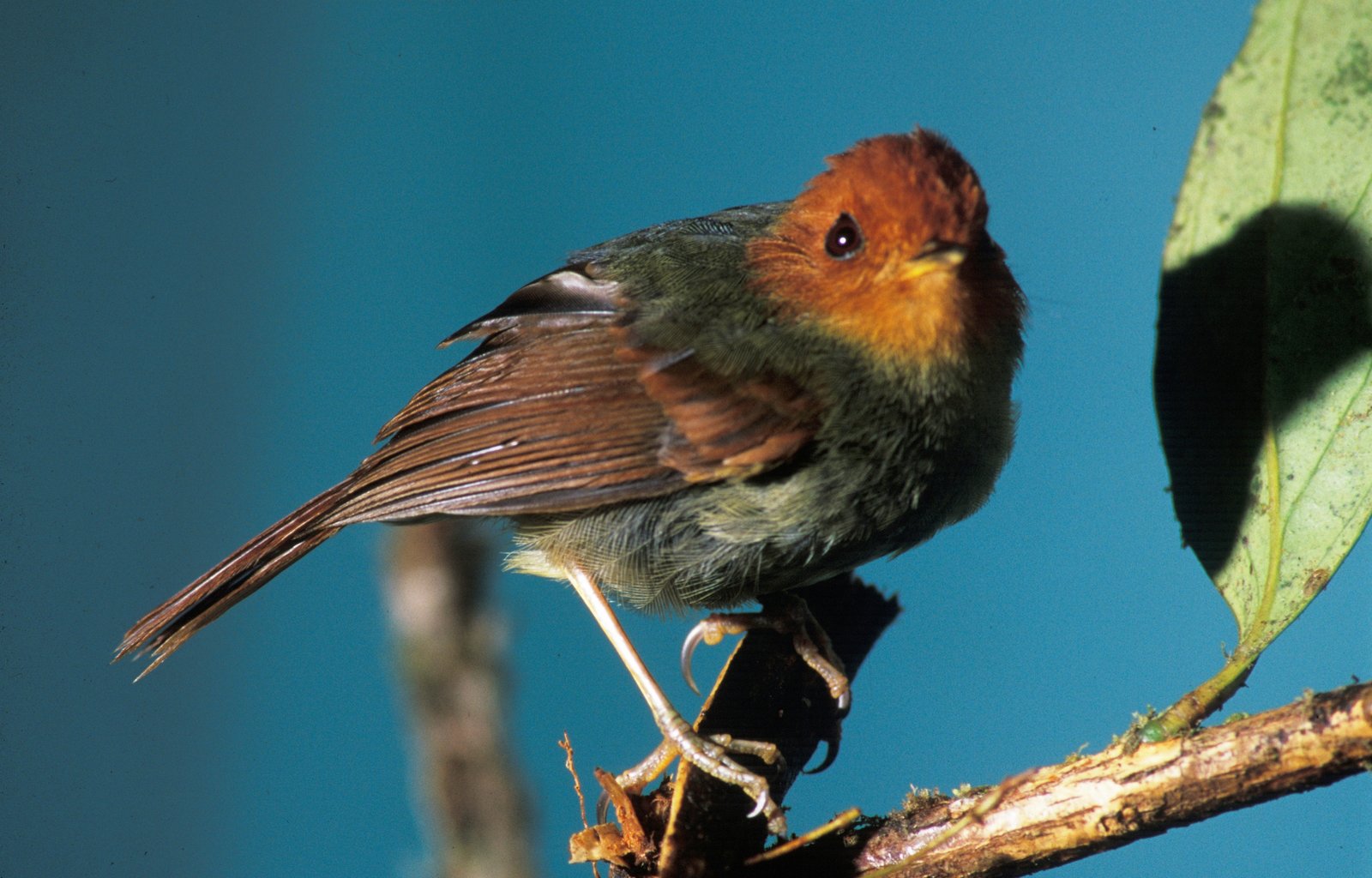
The Rufous-headed Pygmy Tyrant is a small tyrant flycatcher of the understorey of higher montane forest, with an entirely orange-rufous head that contrasts sharply with the olive-green body. It lives low in dense vegetation, often among bamboo, and gives a dry trill and whirring wing sounds.
Voice
A dry, insect-like trill lasting several seconds, first rising and then falling. Also a whirring wing sound and bill snaps.
Recording: Bram Vogels — CC BY-NC-SA 4.0 · xeno-canto
Identification
11 cm, with a short, flat bill and a rather long tail. The whole head, including crown, face and throat, is orange-rufous to rufous-brown. The back and rump are olive-green, the wings and tail dusky with rufous-brown edges; the tail looks rufous-brown. The breast and flanks are greyish olive, the belly yellowish. The sexes are alike; juveniles have a duller, browner head.
Confusion species
Hazel-fronted Pygmy Tyrant Pseudotriccus simplex has only the forehead and face rufous-brown, with an olive-green crown, and lives lower in south-eastern Peru and Bolivia. Bronze-olive Pygmy Tyrant Pseudotriccus pelzelni has no rufous on the head and lives lower. Rufous-crowned Tody-Flycatcher Poecilotriccus ruficeps has a rufous crown with a black border, a grey nape and a pale throat and belly, and lives in scrub and forest edges.
Habitat
The understorey of cloud forest and upper montane forest up to the treeline, often with Chusquea bamboo, roughly between 1900 and 3400 m. It catches small insects with short sallies to leaves and twigs, usually alone or in pairs, sometimes at the edge of mixed flocks. The nest has been little described.
Where the bird is most at home, classified by the vegetation units of the Andes and the west coast.


Range and movements
Colombia: in all three Andean ranges. Ecuador: on both slopes of the Andes. Peru: on the east slope along the whole length of the country. Bolivia: in the Yungas of La Paz and Cochabamba. Absent from the Galápagos. Does not occur outside the guide area.
- Resident
- dark = core range, pale = thinly spread
How and when to look
Listen in cloud forest above 2200 m, especially where bamboo grows, for the dry trill and the whirring wing sound; then search low in the understorey for the orange-rufous head.
Conservation status
Least Concern. The species is tied to montane forest with a dense understorey and loses habitat where that forest is cleared or burned.
Scientific name
Pseudotriccus ruficeps | (de Lafresnaye, 1843)
De Lafresnaye described the species in 1843 as Musicapa [Todirostrum?] ruficeps; because it was later moved to another genus, the author and year stand in brackets. The genus Pseudotriccus was introduced in 1885 by Taczanowski & Berlepsch. The genus name comes from Greek pseudos, 'false', and trikkos, a small unidentified bird, used in ornithology for tyrant flycatchers. The species name comes from Latin rufus, 'rufous', and -ceps, 'headed', for the rufous head. The specimen the first description was based on came from Bogotá, Colombia.