All species › Passerines › Tyrant flycatchers and allies › Cliff Flycatcher
Cliff Flycatcher | Hirundinea ferruginea
Kliftiran | Birro común | Gibão-de-couro
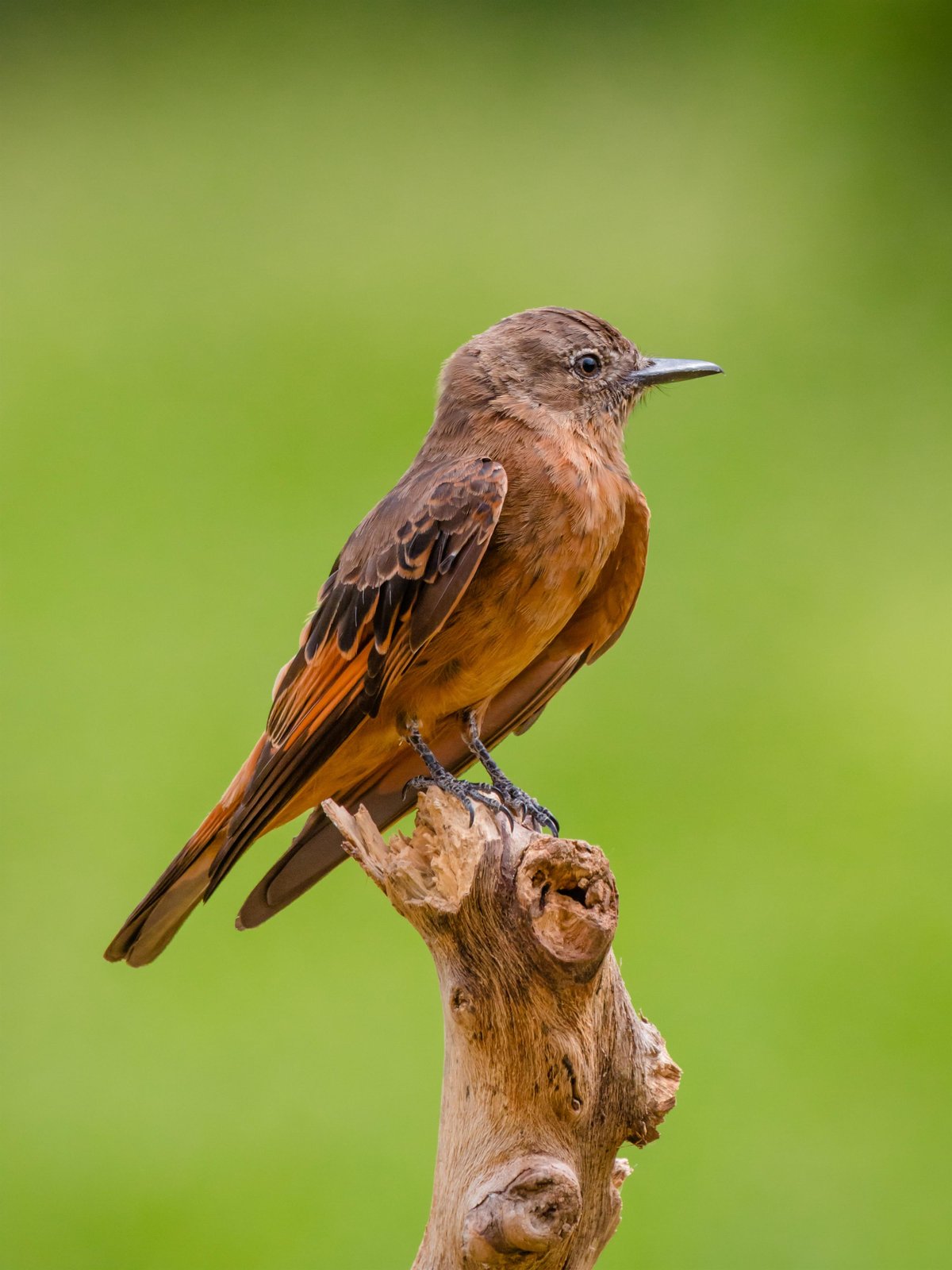
The Cliff Flycatcher is a tyrant flycatcher of rock faces, cliffs and road cuts that catches insects in long, swallow-like flights and keeps returning to the same ledge. With its cinnamon-rufous underparts and large rufous wing patches it stands apart from the other tyrant flycatchers of the guide area. Pairs often sit together on the rock.
Voice
Loud, shrill, rapid series of chattering notes, often given in duet by the two birds of a pair, and sharp single calls.
Recording: JAYRSON ARAUJO DE OLIVEIRA — CC BY-NC-SA 4.0 · xeno-canto
Identification
18 cm, with long, pointed wings and a broad, flat bill. The upperparts are dark greyish brown, the head with a grey-mottled face. The underparts are warm cinnamon-rufous. In flight large rufous patches in the wings stand out; the tail is dark with a rufous base. The sexes are alike; juveniles are duller with pale edges to the upperparts.
Confusion species
Cinnamon Flycatcher Pyrrhomyias cinnamomeus also has cinnamon underparts but is much smaller, olive-brown above and lives at forest edges. Streak-throated Bush Tyrant Myiotheretes striaticollis also shows rufous in the wings but is larger, has a streaked throat and perches on shrubs in open montane country. Swallows have a smaller bill and rarely perch upright on rocks.
Habitat
Rock faces, cliffs, gorges, quarries and road cuts in forested mountains, also buildings and bridges, mostly between 500 and 2500 m, locally higher; also on isolated rock outcrops in the lowlands. It catches flying insects in long, gliding flights from a ledge. The nest is a cup of plant material in a rock crevice or on a ledge.
Where the bird is most at home, classified by the vegetation units of the Andes and the west coast.


Range and movements
Colombia: in the Andean ranges, the Sierra Nevada de Santa Marta and on rock formations in the east. Ecuador: on both slopes of the Andes, mainly on the east side. Peru: mainly on the east slope, locally on the west side. Bolivia: on the east slope of the Andes and on rock outcrops in the eastern lowlands. Absent from the Galápagos. Outside the guide area in Venezuela, the Guianas and through Brazil to Paraguay, Uruguay and northern Argentina.
- Resident
- dark = core range, pale = thinly spread
How and when to look
Search along mountain roads on the east slope of the Andes for steep road cuts and rock faces; the bird sits upright on a ledge and makes conspicuous circling flights over the road.
Conservation status
Not evaluated in the species limits followed here. The species occurs over a very large area and locally benefits from road cuts, quarries and buildings.
Scientific name
Hirundinea ferruginea | (Gmelin, 1788)
Gmelin described the species in 1788 as [Todus] ferrugineus; because it was later moved to another genus, the author and year stand in brackets. The genus Hirundinea was introduced in 1837 by D'Orbigny, ACVMD & de Lafresnaye. The genus name comes from Latin hirundo, hirundinis, 'swallow', and means 'of swallows', for its swallow-like hunting flight. The species name comes from Latin ferrugineus, 'rust-coloured'. The specimen the first description was based on came from Cayenne, French Guiana.