All species › Passerines › Tyrant flycatchers and allies › Streak-throated Bush Tyrant
Streak-throated Bush Tyrant | Myiotheretes striaticollis
Streepkeelstruiktiran | Alinaranja golilistada | Tirano-arbustivo-de-garganta-estriada
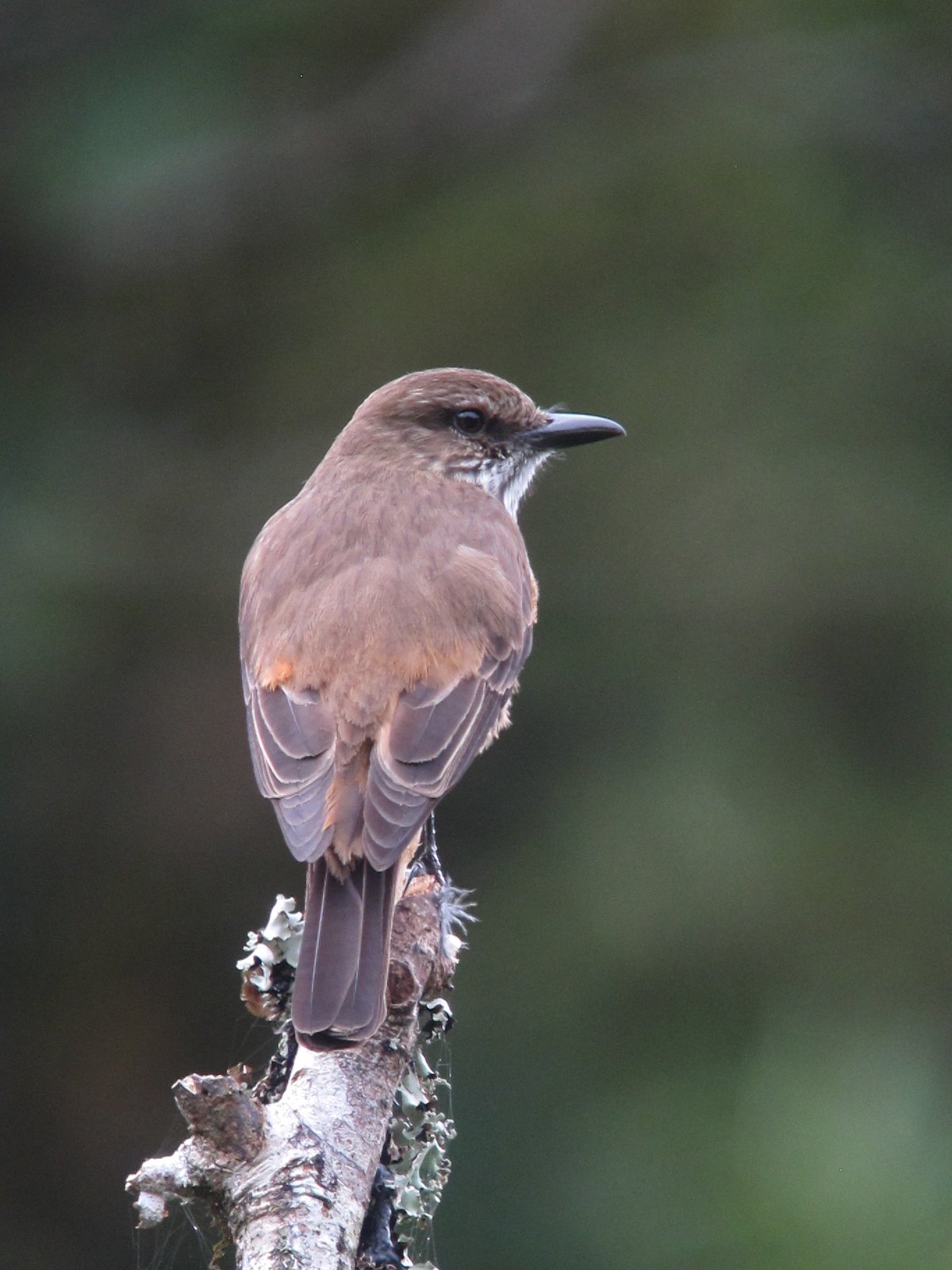
The Streak-throated Bush Tyrant is a large, brown and cinnamon flycatcher of forest edges and semi-open country in the Andes. It perches upright, often for long periods, on a bare branch or a wire and shows much cinnamon in the wings in flight. Of the bush tyrants of the guide area it has the widest range.
Voice
A clear, drawn-out, rising whistle, tuuuiie, often repeated from a lookout, also in the middle of the day.
Recording: Simon Mills — CC BY-NC-SA 4.0 · xeno-canto
Identification
23 cm, with a fairly long, black bill with a small hook. The upperparts are plain brown; the throat and upper breast are white with dense black streaks. The rest of the underparts are cinnamon. The wings are dark, with cinnamon inner webs that form a broad cinnamon patch in flight; the underwing is also cinnamon. The tail is cinnamon with dark central feathers and a dark tip. The sexes are alike.
Confusion species
Santa Marta Bush Tyrant Myiotheretes pernix is smaller and darker and lives only in the Sierra Nevada de Santa Marta. Smoky Bush Tyrant Myiotheretes fumigatus is plain dark smoky brown, without a streaked throat, and lives more inside the forest. Rufous-bellied Bush Tyrant Myiotheretes fuscorufus is smaller, with cinnamon wing bars, and lives in Peru and Bolivia. Red-rumped Bush Tyrant Cnemarchus erythropygius has a white forecrown, a grey breast and a rufous rump.
Habitat
Forest edges, semi-open slopes with shrubs and scattered trees, pastures and fields with hedges and ravines in the Andes, mostly between 2000 and 3600 m, locally lower. It perches on a high lookout and sallies out to catch large insects in the air or on the ground. The nest is a cup in a crevice in a rock face or steep bank.
Where the bird is most at home, classified by the vegetation units of the Andes and the west coast.


Range and movements
Colombia: in all three Andean ranges, the Serranía del Perijá and the Sierra Nevada de Santa Marta. Ecuador: along both slopes of the Andes and in the inter-Andean valleys. Peru: along the Andes from north to south. Bolivia: in the Andes from La Paz to Tarija. Absent from the Galápagos. Outside the guide area in western Venezuela and north-western Argentina.
- Resident
- dark = core range, pale = thinly spread
How and when to look
Search mountain roads with scattered trees and wires, for example around Papallacta or along the old road to Mindo in Ecuador; the whistle is often the first sign of the bird.
Conservation status
Least Concern. The species also occurs in man-made landscapes with forest remnants and hedges.
Scientific name
Myiotheretes striaticollis | (Sclater, 1853)
Sclater described the species in 1853 as Taenioptera striaticollis; because it was later moved to another genus, the author and year stand in brackets. The genus Myiotheretes was introduced in 1850 by Reichenbach. The genus name comes from Greek muia, 'fly', and thērētēs, 'hunter': a fly-hunter. Latin striatus, 'striped', and collis, 'neck', for the streaked throat. The specimen the first description was based on came from Ecuador.