All species › Swifts › Hummingbirds › Rufous-tailed Hummingbird
Rufous-tailed Hummingbird | Amazilia tzacatl
Roodstaartamazilia | Amazilia colirrufa | Beija-flor-de-cauda-ruiva
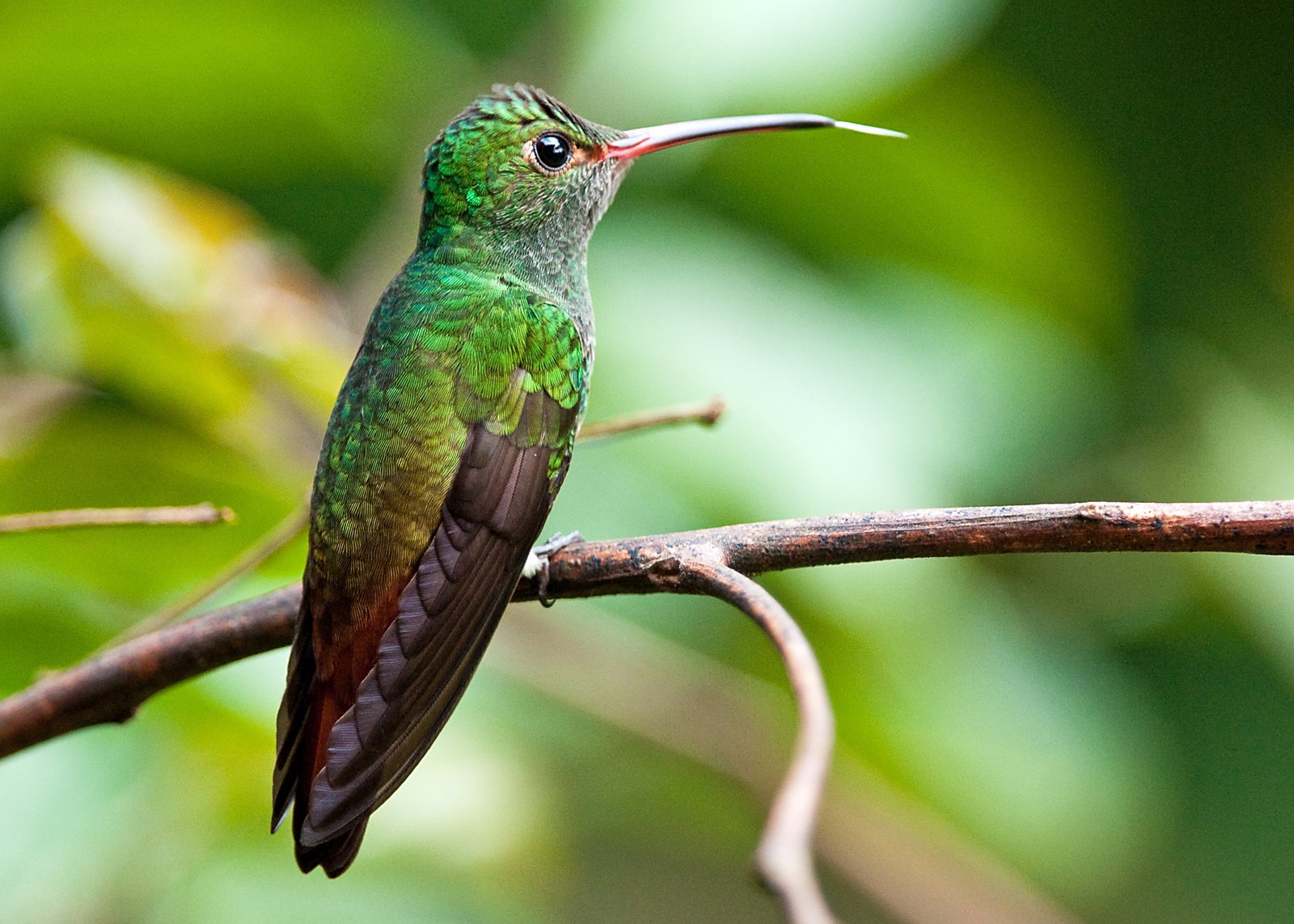
The Rufous-tailed Hummingbird is a medium-sized hummingbird with a green breast, a grey belly, a rufous tail and a red bill with a dark tip. It is widespread from Mexico to western Ecuador and in Colombia is one of the commonest hummingbirds of gardens, forest edges and plantations. At flowers and feeders it vigorously defends its spot against other hummingbirds.
Voice
A dry tsip or tchik, which during chases turns into a rattling, chattering series. The song is a series of high, squeaky notes.
Recording: José María Loaiza B. — CC BY-NC-SA 4.0 · xeno-canto
Identification
9–11 cm, with a straight, medium-length, red bill with a blackish tip; in the female the upper mandible is often darker. The upperparts are bronze-green, the rump and uppertail coverts rufous. The throat and breast are glittering green, the belly is grey and the undertail coverts are cinnamon. The tail is rufous, with narrow dark edges at the tips. The female has a less glittering throat with pale feather edges and a paler belly. Young birds resemble the female, with rufous edges to the feathers of the upperparts.
Confusion species
Amazilia Hummingbird Amazilis amazilia has a rufous belly, often with a white throat or white centre to the belly, and lives in dry country in western Ecuador and Peru. Chestnut-bellied Hummingbird Saucerottia castaneiventris is smaller, has a chestnut belly and a mostly black bill, and lives only in the dry valleys of the Magdalena valley. Indigo-capped Hummingbird Saucerottia cyanifrons and Green-bellied Hummingbird Saucerottia viridigaster have a blue tail. Brown Violetear Colibri delphinae is larger and brown, with a straight black bill.
Habitat
Semi-open country, forest edges, clearings, secondary forest, plantations, shade coffee, gardens and parks, from sea level to about 1800 m, locally higher. It avoids the interior of closed forest. It takes nectar from flowers of heliconias, bananas and ornamental plants, among others, and catches small insects. The cup nest of plant fibres and cobweb, with lichen on the outside, is placed on a twig or branch at low to medium height; the female alone incubates two white eggs.
Where the bird is most at home, classified by the vegetation units of the Andes and the west coast.


Range and movements
In Colombia widespread in the Caribbean and Pacific lowlands, in the Magdalena and Cauca valleys and on the slopes of the Andes, locally also at the foot of the eastern slope. In Ecuador west of the Andes, in the lowlands and on the western slope. In Peru only scarce in the far north-west, in Tumbes. Absent from Bolivia and the Galápagos. Outside the guide area from Mexico through Central America to western Venezuela.
- Resident
- dark = core range, pale = thinly spread
How and when to look
In gardens, parks and along forest edges in western Colombia and Ecuador, watch flowering shrubs and feeders; the species often chases other hummingbirds away there.
Conservation status
Least Concern. The species has a large range and benefits from man-made habitats.
Scientific name
Amazilia tzacatl | (de la Llave, 1833)
De la Llave described the species in 1833 as Trochilus Tzacatl; because it was later moved to another genus, the author and year stand in brackets. The genus Amazilia was introduced in 1843 by Lesson. The genus name refers to Amazili, an Inca heroine in Jean-François Marmontel's novel Les Incas (1777). The species name comes from Aztec mythology: Tzacatl was a warrior chief. The specimen the first description was based on came from Mexico.