All species › Swifts › Hummingbirds › Amazilia Hummingbird
Amazilia Hummingbird | Amazilis amazilia
Lessons amazilia | Amazilia costeña | Beija-flor-amazília
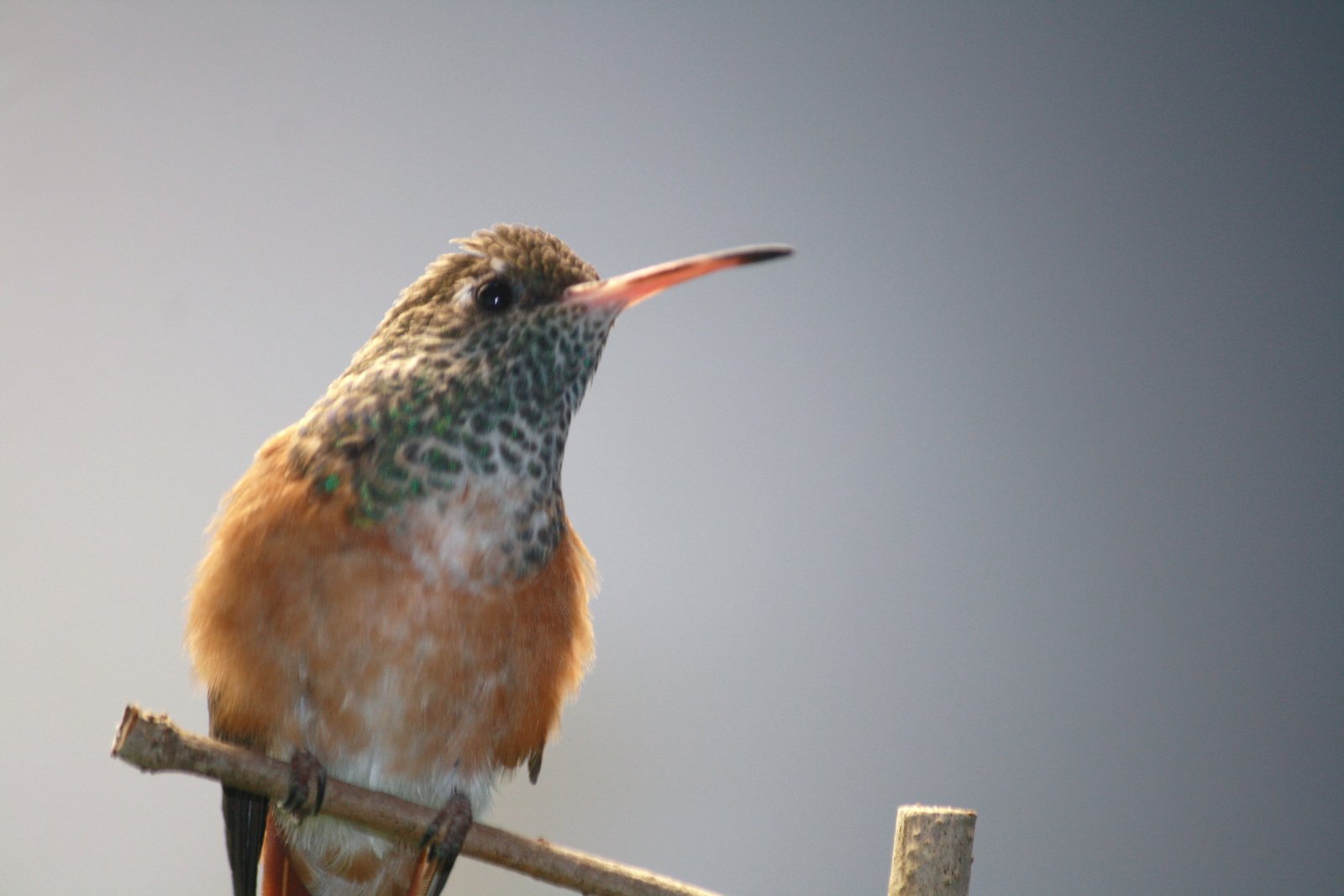
The Amazilia Hummingbird is the hummingbird of the dry coastal belt of Ecuador and Peru, with a rufous belly, a rufous tail and a red bill with a black tip. In cities, gardens and irrigated valleys along the Peruvian coast it is one of the most frequently seen hummingbirds. The species is highly variable: six subspecies are recognised, differing in the colour of the throat, belly and tail.
Voice
The song is a variable, usually descending series of four to ten squeaky notes, repeated at intervals. Calls are a tsip and a dry zrrt, sometimes extended into a stuttering rattle.
Recording: Paul Molina Abril — CC BY-NC-SA 4.0 · xeno-canto
Identification
9–11 cm, with a straight, medium-length, pinkish-red bill with a black tip. The male of the nominate form has golden-green upperparts with rufous uppertail coverts, a glittering golden-green to turquoise-green throat, a rufous lower breast and belly and a mostly rufous tail. In the north (south-western Ecuador and north-western Peru) birds have a white chin, throat and belly centre; in the Jubones valley in Ecuador the belly is almost white, and in the Nazca valley the male has a violet-blue throat. The female has white on the chin and throat and a paler rufous belly. Young birds have brownish edges to the feathers of the upperparts.
Confusion species
Rufous-tailed Hummingbird Amazilia tzacatl has a grey belly and lives mainly to the north and north-east of this species' range; they overlap locally in western Ecuador. Spot-throated Hummingbird Thaumasius taczanowskii is larger, greyish white below with a spotted throat and a greenish tail. White-bellied Hummingbird Elliotomyia chionogaster is pure white below. Oasis Hummingbird Rhodopis vesper has a long, decurved bill.
Habitat
Open, semi-arid to arid country: scrub, thorn forest, desert with shrubs, farmland, city parks and gardens; rarely deep inside forest. The northern forms also live in savanna and at forest edges in the lower mountains. From sea level to about 1000 m in the south, in the north mainly between 1000 and 2200 m, locally up to 2700 m. It takes nectar from flowers and catches small insects. The cup nest of soft plant fibres and cobweb is placed on a flat branch, 1–2.5 m above the ground; the female alone incubates two eggs.
Where the bird is most at home, classified by the vegetation units of the Andes and the west coast.


Range and movements
In Ecuador in the dry west and south-west and in the Andean valleys of El Oro, Loja, Azuay and Zamora-Chinchipe. In Peru along the whole coast and on the lower western slope, from Tumbes and Piura through Lambayeque, La Libertad, Ancash and Lima to Ica and the Nazca valley, locally also in Cajamarca and Amazonas. Absent from Colombia (apart from a few stray records), Bolivia and the Galápagos.
- Resident
- dark = core range, pale = thinly spread
How and when to look
Look in parks and gardens in Lima and other coastal cities, and at flowering shrubs in the irrigated valleys along the Peruvian coast.
Conservation status
Least Concern. The species benefits from built-up areas and irrigated farmland in the coastal belt.
Scientific name
Amazilis amazilia | (Lesson & Garnot, 1827)
Lesson & Garnot described the species in 1827 as Orthorhynchus Amazilia; because it was later moved to another genus, the author and year stand in brackets. The genus Amazilis was introduced in 1855 by Gray. The genus name is a variant of Amazilia and likewise refers to Amazili, the Inca heroine in Jean-François Marmontel's novel Les Incas. The species name refers to Amazili, an Inca heroine in Jean-François Marmontel's novel Les Incas. The specimen the first description was based on came from Callao, Peru.