All species › Swifts › Hummingbirds › Andean Emerald
Andean Emerald | Uranomitra franciae
Andesamazilia | Amazilia andina | Esmeralda-andina
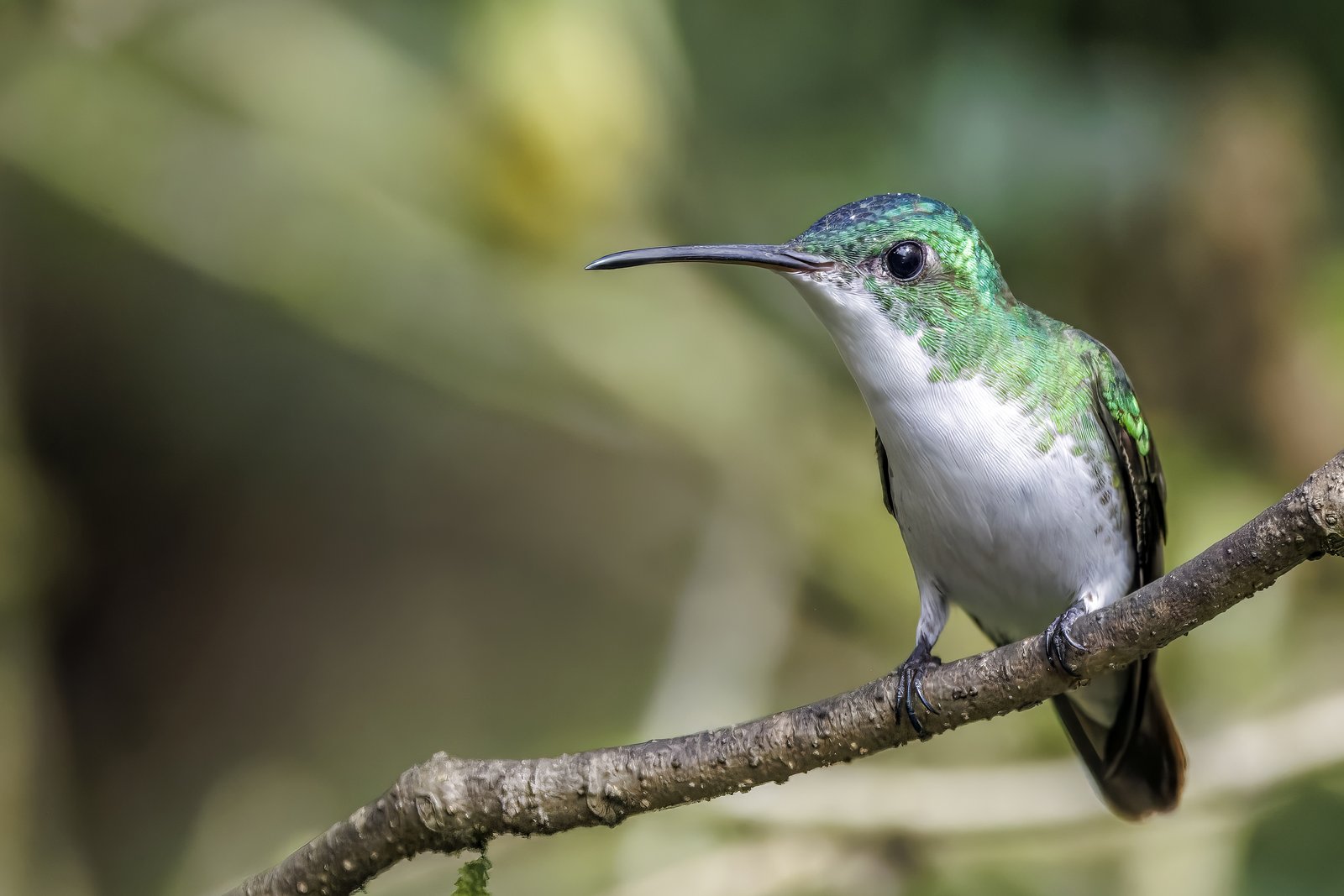
The Andean Emerald is a hummingbird of the slopes of the northern Andes, with a white belly, glittering green flanks and a red lower mandible. The male of the nominate form in Colombia has a glittering violet-blue crown. The species often comes to feeders and lives at forest edges and in secondary forest.
Voice
The song is variable, with high, squeaky whistles, trills and scratchy notes. The call is a high tsip; during encounters with other individuals a scratchy, squeaky chatter.
Recording: Jerome Fischer — CC BY-NC-SA 4.0 · xeno-canto
Identification
9–11 cm, with a straight to slightly decurved, medium-length bill: the upper mandible blackish, the lower mandible coral red with a dark tip. The male of the nominate form has a glittering violet-blue crown, glittering golden to emerald-green cheeks and sides of the neck, light green to golden-green upperparts and flanks, a coppery tinge to the uppertail coverts, a white central stripe down the throat and belly and a bronze-green to coppery tail. In western Ecuador the crown is green; in northern Peru and south-eastern Ecuador the blue of the crown extends onto the nape. The female has a turquoise to greenish, less glittering crown. Young birds resemble the female, with brownish feather edges above and greyish-brown flanks.
Confusion species
White-bellied Hummingbird Elliotomyia chionogaster has a green crown, entirely white underparts without green flanks and white inner webs to the tail feathers. Indigo-capped Hummingbird Saucerottia cyanifrons also has a blue crown in the male, but green underparts and a steel-blue tail. Glittering-throated Emerald Chionomesa fimbriata has a green throat and breast with only a white stripe down the belly, and lives in the lowlands east of the Andes. Rufous-tailed Hummingbird Amazilia tzacatl has a grey belly and a rufous tail.
Habitat
Secondary forest, forest edges and clearings in humid montane forest, gardens and coffee plantations; in Peru also in drier scrub. From 600 to 2100 m, most numerous above 1000 m. It takes nectar from flowers at low and middle levels and catches small insects. It breeds almost year-round. The cup nest of tree-fern scales and plant fibres, bound with cobweb and with lichen on the outside, is placed 1.5–2.5 m above the ground; the female alone incubates two eggs.
Where the bird is most at home, classified by the vegetation units of the Andes and the west coast.


Range and movements
In Colombia in the Andes of the north-west and centre, with the green-crowned form in Nariño. In Ecuador on the western slope of the Andes south to Loja, and in the south-east in Zamora-Chinchipe. In Peru in the north, in and around the Marañón valley in Amazonas and Cajamarca, south to La Libertad. Absent from Bolivia and the Galápagos.
- Resident
- dark = core range, pale = thinly spread
How and when to look
Look at feeders in cloud-forest reserves on the western slope in northern Ecuador, such as around Mindo, and in northern Peru in the Marañón area.
Conservation status
Least Concern. The species tolerates secondary forest and man-made habitats.
Scientific name
Uranomitra franciae | (Bourcier & Mulsant, 1846)
Bourcier & Mulsant described the species in 1846 as Trochilus Franciae; because it was later moved to another genus, the author and year stand in brackets. The genus Uranomitra was introduced in 1854 by Reichenbach. The genus name probably comes from Greek ouranos, 'heaven', and mitra, 'headband, turban', after the blue crown of some species. The specific name honours Francia Bourcier, daughter of the French hummingbird specialist Jules Bourcier. The specimen the first description was based on came from Bogotá, Colombia.