All species › Swifts › Hummingbirds › Versicolored Emerald
Versicolored Emerald | Chrysuronia versicolor
Regenboogamazilia | Amazilia versicolor | Beija-flor-de-banda-branca
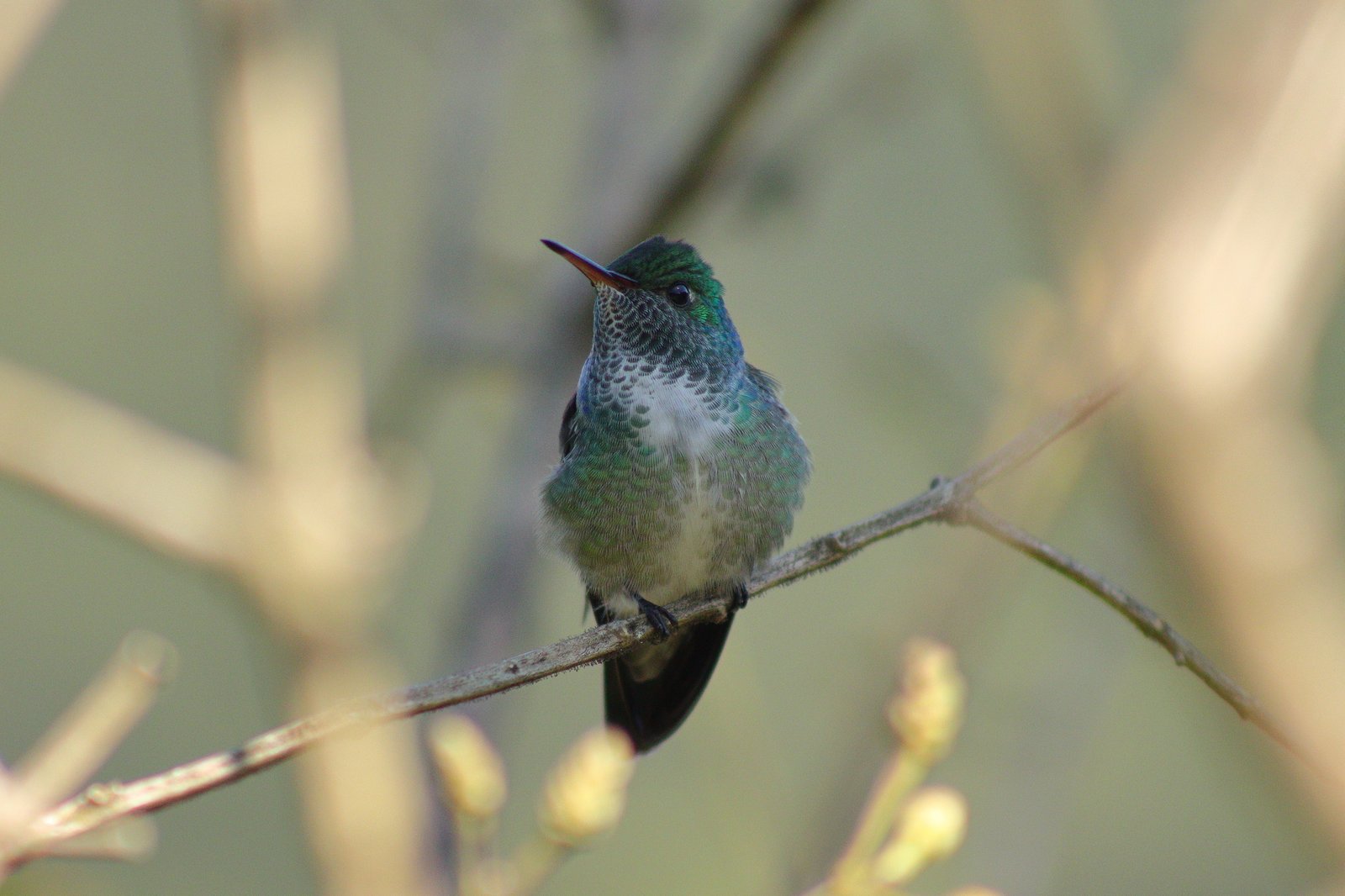
The Versicolored Emerald is a small hummingbird of semi-open country over much of eastern South America. It is coppery green above with a white belly centre; the colour of the head and throat varies strongly between subspecies, from green or turquoise to blue or white. In the guide area it lives in eastern Colombia and in northern and eastern Bolivia.
Voice
High, thin calls such as tsip, sometimes in series, and a soft, high twittering.
Recording: JAYRSON ARAUJO DE OLIVEIRA — CC BY-NC-SA 4.0 · xeno-canto
Identification
8–10 cm, with a fairly long, slightly decurved, black bill with a flesh-coloured, occasionally orange base to the lower mandible. The upperparts and flanks are coppery green, the belly centre and undertail coverts white. The tail is coppery green with a dark subterminal band. The crown is usually green, in some forms turquoise to azure blue; the throat is green or turquoise in the inland forms and white in other forms, including the birds of eastern Colombia. The female has white edges to the throat feathers.
Confusion species
Glittering-throated Emerald Chionomesa fimbriata is larger, with a glittering green throat and breast, a narrower white belly stripe and a bronze-green tail without a dark band. Sapphire-spangled Emerald Chionomesa lactea has a blue throat and breast. White-chinned Sapphire Chlorestes cyanus has a violet-blue head in the male and a red lower mandible. Blue-tailed Emerald Chlorostilbon mellisugus is entirely green below, with a blue-black tail.
Habitat
All kinds of semi-open landscape with trees: savanna, cerrado, gallery forest, forest edges, dry woodland, gardens and parks. It avoids the interior of humid primary forest and in forested regions occurs mainly in open patches and along large rivers. Mostly in the lowlands. It takes nectar from flowers of shrubs and trees and catches small insects; nest and breeding biology resemble those of related species, with a small cup nest and two eggs.
Where the bird is most at home, classified by the vegetation units of the Andes and the west coast.


Range and movements
In Colombia in the east, in the llanos and the northern Amazon region (including Meta, Casanare, Vichada, Guainía, Guaviare and Vaupés); this population may be isolated from the main range. In Bolivia in the north and east, in Beni and Santa Cruz. In Peru only a single old record from Ucayali. Absent from Ecuador and the Galápagos. Outside the guide area in southern Venezuela, western Guyana, much of Brazil, Paraguay and north-eastern Argentina.
- Resident
- dark = core range, pale = thinly spread
How and when to look
Look at flowering trees and shrubs at forest edges and in gallery forest in the llanos of Meta and Vichada, or in the savannas of Beni and around Santa Cruz in Bolivia.
Conservation status
Least Concern. The species has a large range and tolerates man-made habitats, including towns.
Scientific name
Chrysuronia versicolor | (Vieillot, 1818)
Vieillot described the species in 1818 as Trochilus versicolor; because it was later moved to another genus, the author and year stand in brackets. The genus Chrysuronia was introduced in 1850 by Bonaparte. The genus name is a blend of two old species names of the Golden-tailed Sapphire: chrysura (Greek khrusos, 'gold', and oura, 'tail') and oenone. The species name comes from Latin versicolor, 'changing colour' or 'variegated', for the iridescent plumage. The specimen the first description was based on came from Brazil.