All species › Swifts › Hummingbirds › Rufous-vented Whitetip
Rufous-vented Whitetip | Urosticte ruficrissa
Roodbuikwittipkolibrie | Puntiblanca pechiverde | Ponta-branca-de-crisso-ferrugíneo
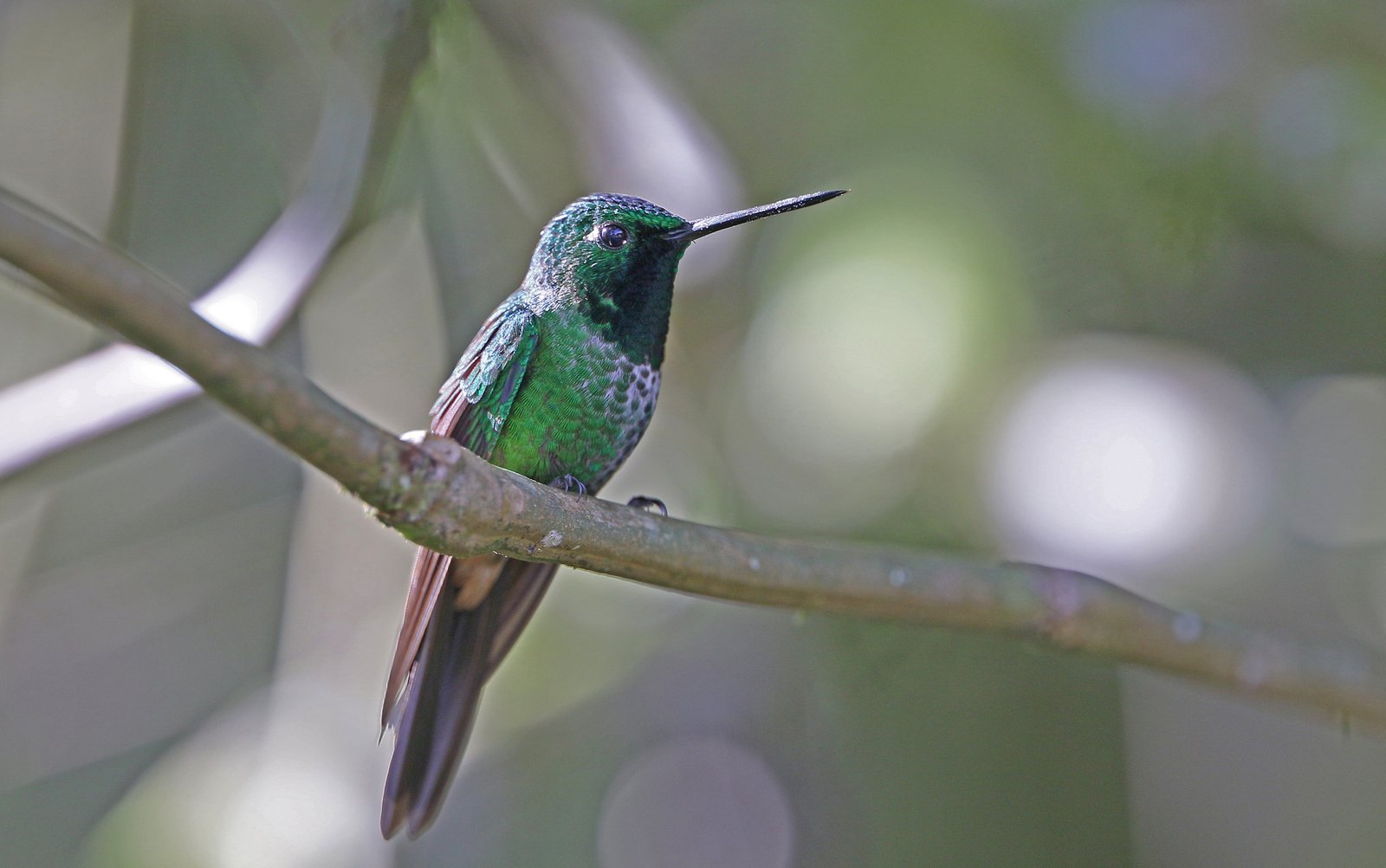
The Rufous-vented Whitetip is the eastern counterpart of the Purple-bibbed Whitetip, on the Amazonian side of the Andes from southern Colombia to northern Peru. The male is green, with white tips to the central tail feathers and rufous undertail coverts. It lives mainly in the understorey and at the edges of montane forest.
Voice
A high, thin tsit, sometimes rapidly repeated.
Recording: Niels Krabbe — CC BY-SA 4.0 · xeno-canto
Identification
8–9 cm, with a straight black bill and a white spot or stripe behind the eye. The male is green, with a glittering green throat without a purple spot, rufous to buff undertail coverts and a dark, slightly forked tail whose central feathers have broad white tips. The female is green above and white spotted green below, also has rufous undertail coverts, and has white tips to the outer tail feathers.
Confusion species
Purple-bibbed Whitetip Urosticte benjamini lives on the western slope; the male has a purple spot below the throat. The female Peruvian Racket-tail Ocreatus peruanus has buff leg puffs and no rufous undertail coverts. Speckled Hummingbird Adelomyia melanogenys is browner, with a dark ear patch.
Habitat
Humid montane forest and cloud forest on the eastern slope, forest edges and older secondary forest, roughly between 1300 and 2500 m. It feeds low to mid-level at small flowers and catches small insects. Little is known about its nest and breeding biology.
Where the bird is most at home, classified by the vegetation units of the Andes and the west coast.


Range and movements
In Colombia on the eastern slope of the Andes in the south of the country. In Ecuador on the eastern slope of the Andes along its whole length. In Peru on the eastern slope in the north. Absent from Bolivia and the Galápagos. Does not occur outside the guide area.
- Resident
- dark = core range, pale = thinly spread
How and when to look
At feeders and along forest edges at lodges on the eastern slope of Ecuador, where it often feeds briefly and inconspicuously among other hummingbirds. Look for the rufous undertail coverts and the white tail tips.
Conservation status
Least Concern. The species is local and occurs at low densities; deforestation affects its habitat locally.
Scientific name
Urosticte ruficrissa | Lawrence, 1864
Lawrence described the species in 1864 and placed it straight away in the genus where it still stands. The genus Urosticte was introduced in 1853 by Gould. The genus name comes from Greek oura, 'tail', and stiktos, 'spotted', after the white tail tips. The specific name comes from Latin rufus, 'red, rufous', and crissum, 'vent': rufous-vented. The specimen the first description was based on came from Quito, Ecuador.