All species › Swifts › Hummingbirds › White-booted Racket-Tail
White-booted Racket-Tail | Ocreatus underwoodii
Vlagstaartwitpluimbroekje | Colibrí de raquetas | Rabo-de-raquete-de-botas-brancas
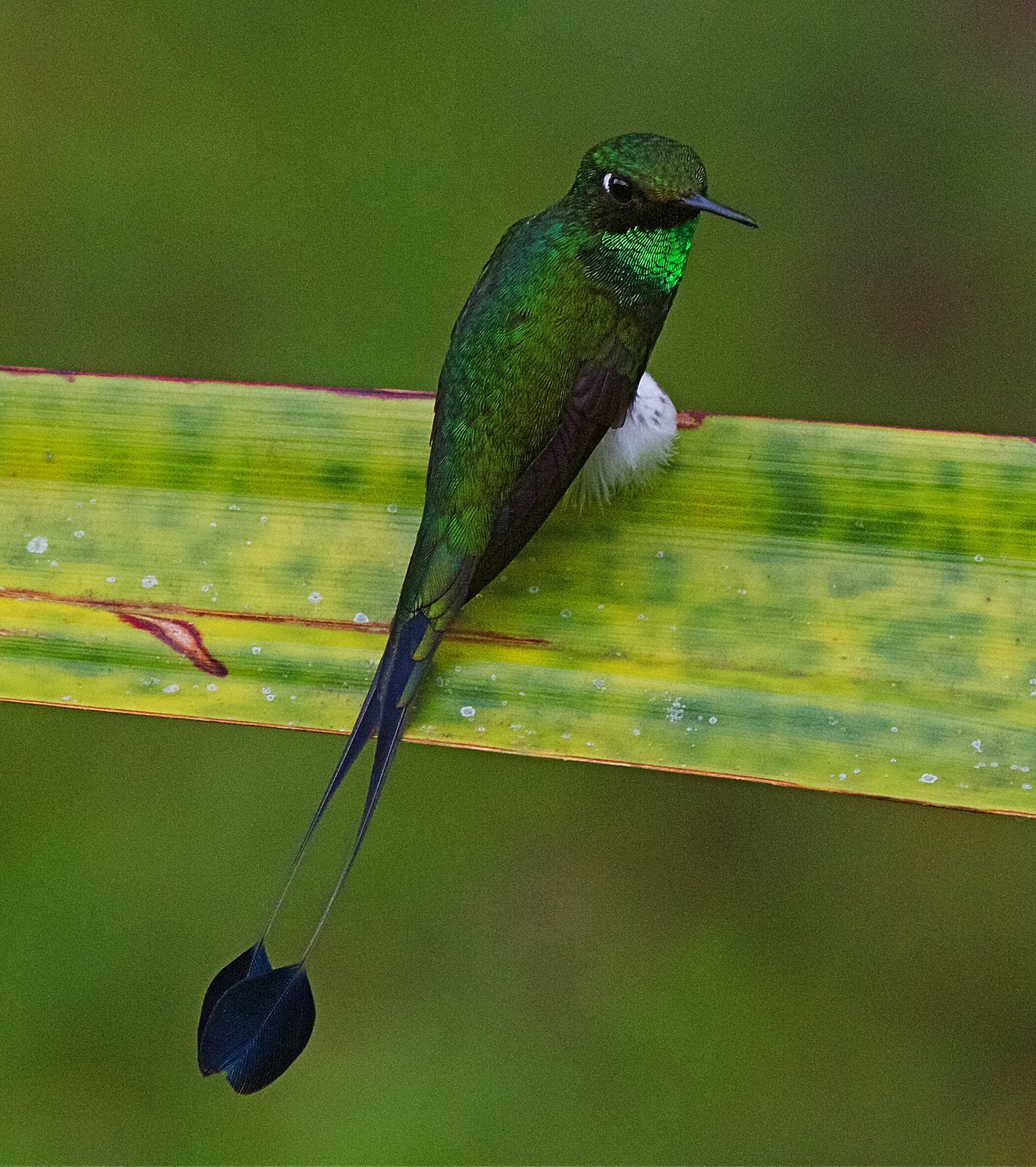
The White-booted Racket-tail is a very small hummingbird of montane forest in the northern Andes. The male has two long, bare outer tail feathers ending in a blue-black racket, and thick white puffs around the legs. It was formerly treated as one species together with the buff-booted forms of Peru and Bolivia.
Voice
Usually silent. A high, thin tsit and a dry twitter; the wings hum like those of a large insect.
Recording: rudy gelis — CC BY-NC-SA 4.0 · xeno-canto
Identification
Male 11–15 cm including the long tail feathers, female 7–9 cm; the bill is short, straight and black. The male is glossy green, with a glittering green throat, white leg puffs and a deeply forked tail whose outer feathers are long and bare-shafted, ending in a blue-black, paddle-shaped racket. The female is green above and white spotted green below, with a white stripe behind the eye, white leg puffs and a short, forked tail with white tips. Young males have shorter rackets.
Confusion species
Peruvian Racket-tail Ocreatus peruanus has buff instead of white leg puffs and lives further south. Green Thorntail Discosura conversii has a white band across the rump and a long, wire-like tail without rackets. Females resemble female whitetips Urosticte, but these have no leg puffs and a longer bill.
Habitat
Edges of humid montane forest and cloud forest, clearings, secondary forest, shade coffee and gardens, roughly between 850 and 2500 m. It feeds at all levels at small flowers, often with the flight of a large bee, and visits feeders. In display the male hovers in front of the female, waving the rackets.
Where the bird is most at home, classified by the vegetation units of the Andes and the west coast.


Range and movements
In Colombia in all three ranges of the Andes. In Ecuador on both slopes of the Andes. Absent from Peru and Bolivia, where related buff-booted forms live, and from the Galápagos. Outside the guide area in the mountains of Venezuela.
- Resident
- dark = core range, pale = thinly spread
How and when to look
At feeders and flowering shrubs in the cloud forest of Colombia and Ecuador, for example around Mindo. The male can often be recognised by the rackets swinging to and fro as it hovers.
Conservation status
Not Evaluated in this circumscription. The species is widespread, tolerates forest edges and secondary forest, and is common.
Scientific name
Ocreatus underwoodii | (Lesson, 1832)
Lesson described the species in 1832 as Ornismya underwoodii; because it was later moved to another genus, the author and year stand in brackets. The genus Ocreatus was introduced in 1846 by Gould. The genus name comes from Latin ocreatus, 'wearing greaves', after the conspicuous leg puffs. The species name probably honours the English watercolourist and geologist Thomas Richard Underwood (1772–1835); Lesson received a drawing of this bird from him. The specimen the first description was based on came from Bogotá, Colombia.