All species › Cuckoos › Cuckoos › Rufous-winged Ground Cuckoo
Rufous-winged Ground Cuckoo | Neomorphus rufipennis
Roodvleugelgrondkoekoek | Cuco hormiguero alirrufo | Jacu-estalo-de-asa-vermelha
The Rufous-winged Ground Cuckoo is a large ground cuckoo of the forests of the Guiana Shield, north of the Amazon. In the guide area it is known only from a few records in the far east of Colombia, at the edge of its range. Like the other ground cuckoos it walks on the forest floor and follows army ants and peccaries.
Voice
A low, dull hoo, sometimes in short series, and a loud, dry bill-clacking when excited.
Recording: Allen T. Chartier — CC BY-NC-SA 3.0 · xeno-canto
Identification
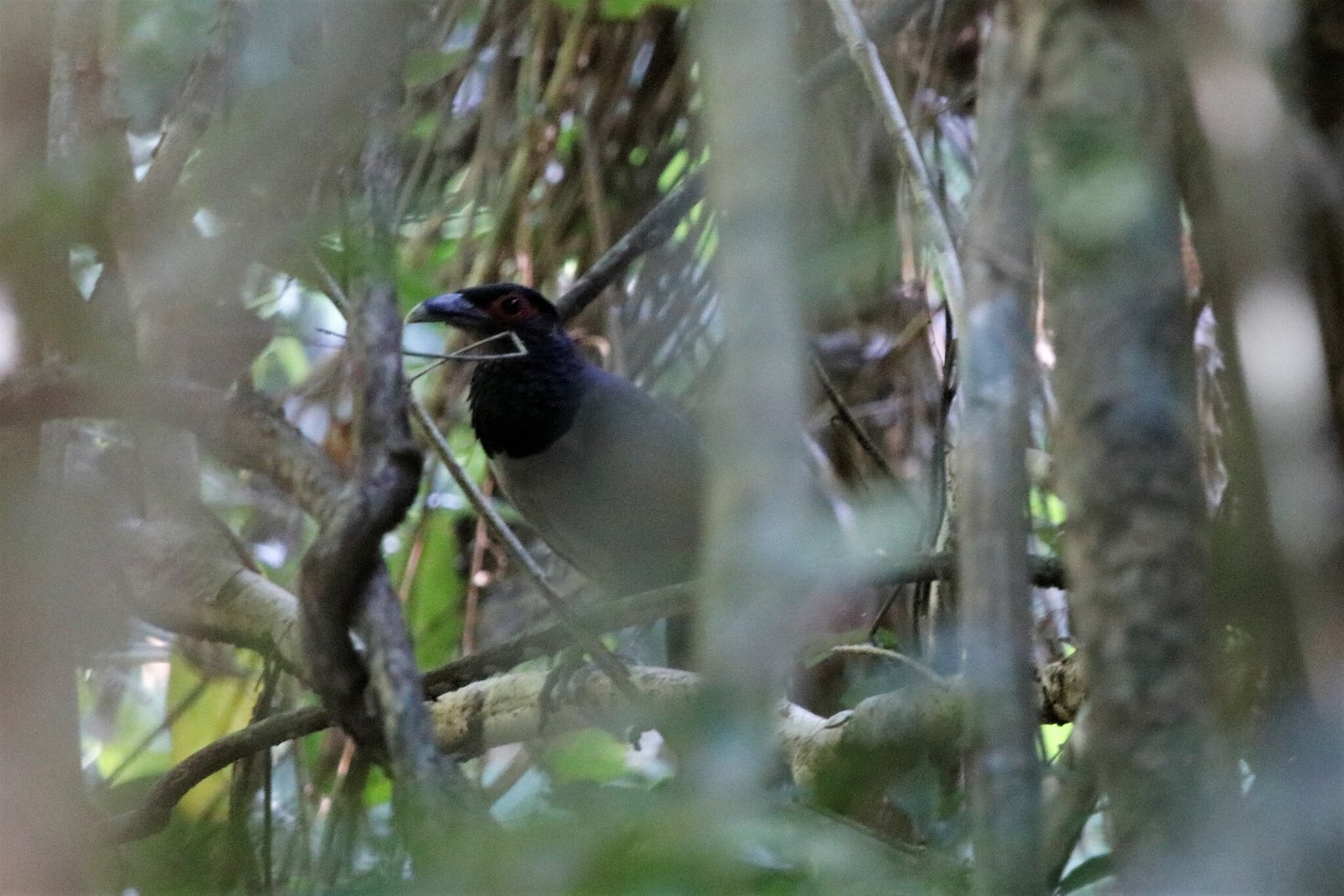
48–51 cm, with a long tail and a heavy, yellowish to greenish bill. Head, crest and neck are dark blue-black; around the eye is a patch of bare red skin. Mantle and tail are dark with a green to purple gloss. The primaries are bright rufous, visible mainly in flight and when the bird spreads its wings. Throat and breast are grey, the belly paler grey to dirty white. The sexes are alike.
Confusion species
Red-billed Ground Cuckoo Neomorphus pucheranii, which lives to the west of this area, has a red bill and red legs, a browner back, a scaled breast and no rufous primaries. Rufous-vented Ground Cuckoo Neomorphus geoffroyi has a brown back, a narrow black breast band and a rufous vent.
Habitat
Humid terra firme lowland forest with an open understory, up to about 1000 m in the hills of the Guiana Shield. Forages on the ground at army ant swarms and with groups of peccaries, and eats large insects and small vertebrates. Little is known about the nest.
Where the bird is most at home, classified by the vegetation units of the Andes and the west coast.

Range and movements
In the guide area only a rare vagrant or borderline case in the far east of Colombia (Guainía and Vaupés), with only a few records. Absent from Ecuador, Peru, Bolivia and the Galápagos. Outside the guide area in southern Venezuela, Guyana and northern Brazil, north of the Amazon.
How and when to look
Not a species to search for specifically in the guide area. In the forests of the far east of Colombia, listen for bill-clacking at army ant swarms.
Conservation status
Least Concern, although scarce everywhere. Most of its habitat lies in extensive, little-disturbed forest; locally it suffers from deforestation and mining.
Scientific name
Neomorphus rufipennis | (Gray, 1849)
Gray described the species in 1849 as Cultrides rufipennis; because it was later moved to another genus, the author and year stand in brackets. The genus Neomorphus was introduced in 1827 by Gloger. The genus name comes from Greek neos, 'new', and morphē, 'form': 'new form'. The species name rufipennis comes from Latin rufus, 'rufous', and penna, 'feather, wing': 'rufous-winged'. The specimen the first description was based on came from Lower Orinoco River, Venezuela.