All species › Pigeons and doves › Doves and pigeons › Blue Ground Dove
Blue Ground Dove | Claravis pretiosa
Blauwe grondduif | Tórtola azul | Pararu-azul
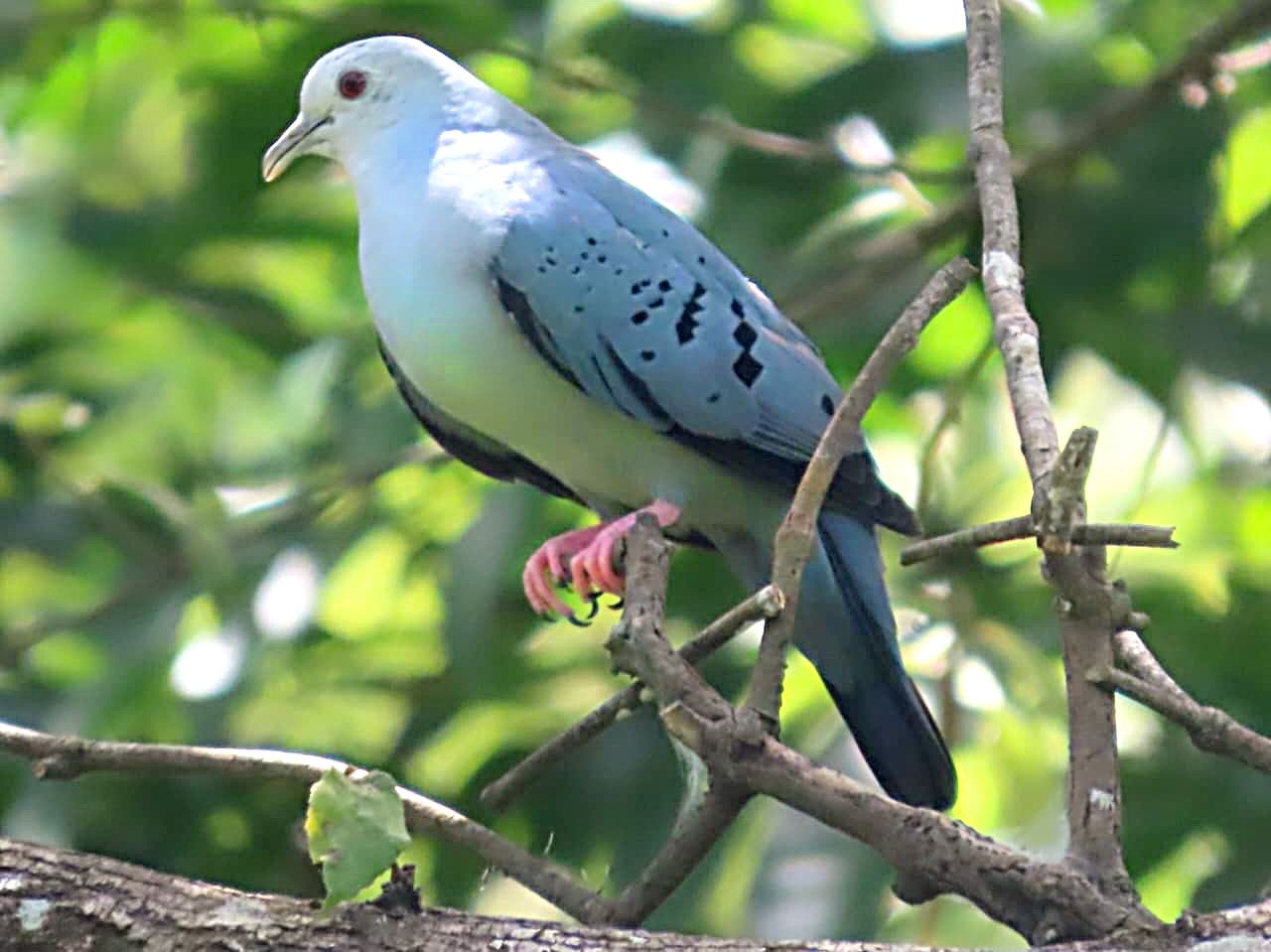
The Blue Ground Dove is a medium-sized dove of forest edges and secondary forest in the tropical lowlands. Male and female differ strongly: the male is blue-grey, the female brown. Unlike most ground doves it feeds not only on the ground but also in shrubs and low trees, and it often sits hidden in dense foliage.
Voice
A short, deep, single note, boop or woop, repeated at regular intervals, often from cover.
Recording: Richard E. Webster — CC BY-NC-SA 4.0 · xeno-canto
Identification
20–23 cm, with a fairly long tail. The male is uniform blue-grey, paler on the head and underparts, with a few black spots on the wing coverts and black outer tail feathers. The female is warm brown, with rufous to chestnut spots on the wing, a rufous rump and rufous central tail feathers; the outer tail feathers are blackish. The eye is dark and the legs are pink. Young birds resemble the female, with pale feather fringes.
Confusion species
Maroon-chested Ground Dove Paraclaravis mondetoura lives higher in the Andes, in bamboo; the male has a purplish-maroon breast and white in the tail, the female dark purple wing bars and pale tail corners. The female Ruddy Ground Dove Columbina talpacoti is smaller and shorter-tailed, with black spots on the wing. Plain-breasted Ground Dove Columbina minuta is much smaller and shows rufous primaries in flight.
Habitat
Forest edges, secondary forest, riparian woodland, open woodland and semi-open country with shrubs and scattered trees, also coffee and cacao plantations, mainly in the lowlands and foothills up to about 1000 m, locally higher. It eats seeds and small fruits on the ground and in low vegetation. The nest is a flimsy platform of twigs in a shrub or tree.
Where the bird is most at home, classified by the vegetation units of the Andes and the west coast.


Range and movements
In Colombia widespread in the lowlands west and east of the Andes, also in the Magdalena Valley. In Ecuador in the western lowlands and in Amazonia. In Peru in the Amazonian lowlands and foothills, and in the dry north-west. In Bolivia in the lowlands of the north and east. Absent from the Galápagos. Outside the guide area from southern Mexico through Central America to Venezuela, the Guianas, Brazil, Paraguay and north-eastern Argentina.
- Resident
- dark = core range, pale = thinly spread
How and when to look
Listen for the deep, repeated call along forest edges and in riverside woodland; the birds often sit quietly in dense foliage and fly off fast and low.
Conservation status
Least Concern (LC). The species is widespread and tolerates secondary forest and semi-open farmland.
Scientific name
Claravis pretiosa | (Ferrari-Pérez, 1886)
Ferrari-Pérez described the species in 1886 as Peristera pretiosa; because it was later moved to another genus, the author and year stand in brackets. The genus Claravis was introduced in 1899 by Oberholser. The genus name combines Latin clarus, 'clear, distinct', with avis, 'bird'. The species name comes from Latin pretiosus, 'precious'. The specimen the first description was based on came from Brazil.