All species › Pigeons and doves › Doves and pigeons › Long-tailed Ground Dove
Long-tailed Ground Dove | Uropelia campestris
Campoduif | Columbina colilarga | Rolinha-vaqueira
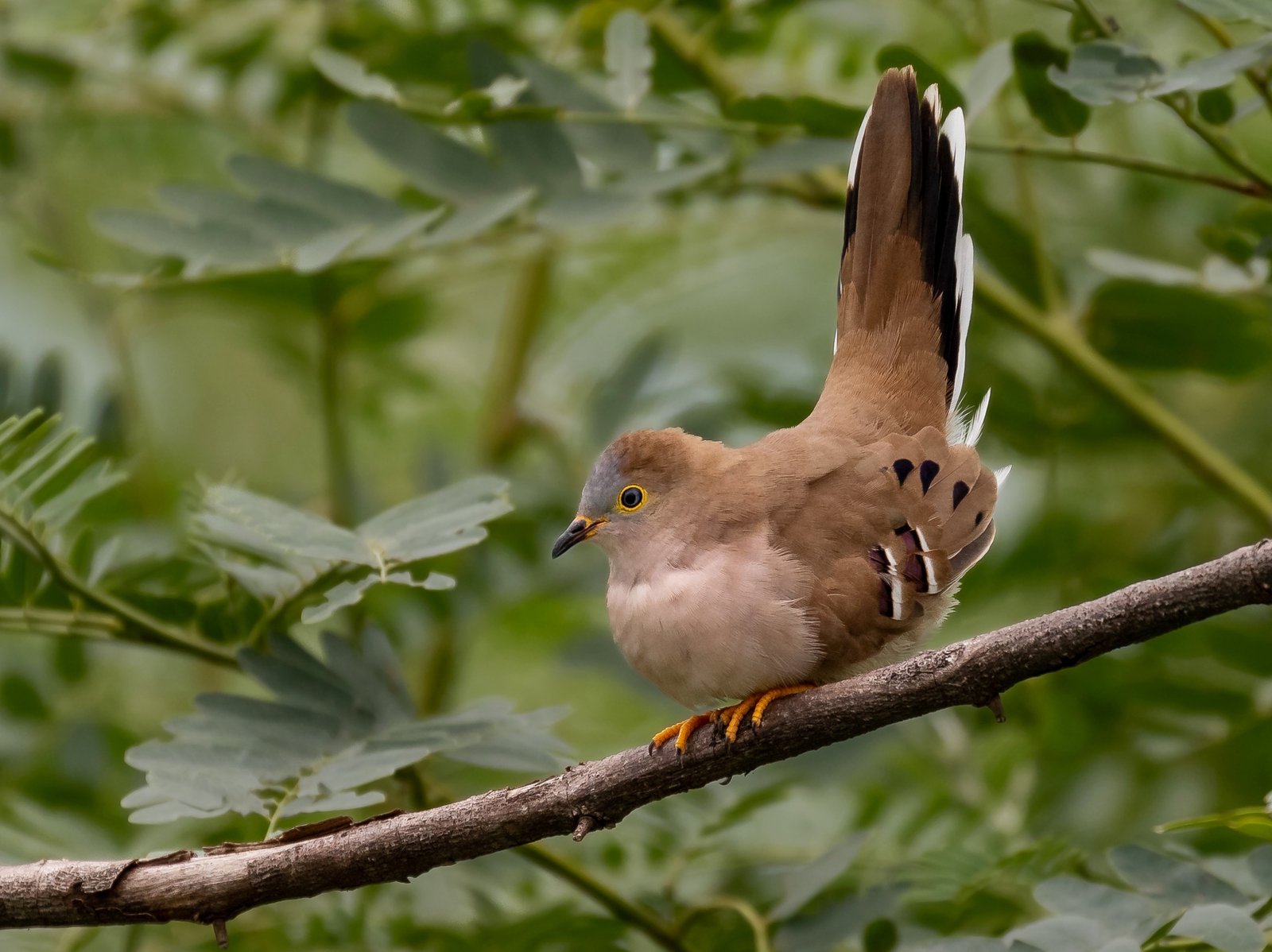
The Long-tailed Ground Dove is a small ground dove of the open savannas of central South America, with a long, pointed tail for a ground dove. It is the only member of its genus. In the guide area it occurs only in the lowlands of Bolivia.
Voice
A soft, high cooing and short, thin calls; the vocalisations are poorly studied. The wings make a light rustle on take-off.
Recording: Glauko Corrêa — CC BY-NC-SA 4.0 · xeno-canto
Identification
16–18 cm, a good part of which is tail; the tail is long and graduated. The head is greyish, the upperparts greyish brown and the underparts pinkish brown, paler on the belly. The wing coverts show conspicuous bars, black with a white edge. The outer tail feathers are dark with white tips. Around the eye is a small bare ring, yellow to orange; the legs are pink to orange. The sexes are similar; young birds are browner and less marked.
Confusion species
Plain-breasted Ground Dove Columbina minuta and Ruddy Ground Dove Columbina talpacoti have a shorter tail, rufous primaries in flight and no black-and-white wing bars. Scaled Dove Columbina squammata is also long-tailed, but scaled all over. Picui Ground Dove Columbina picui is paler grey, with a white wing stripe in flight.
Habitat
Open savanna and cerrado with short grass and bare patches, often among termite mounds, and also grazing land and burnt ground. In the guide area only in the lowlands, below about 500 m. It feeds on seeds on the ground, usually in pairs or small groups. The nest is low in a shrub.
Where the bird is most at home, classified by the vegetation units of the Andes and the west coast.


Range and movements
In Bolivia in the savannas of the Beni and in northern and eastern Santa Cruz. Absent from Colombia, Ecuador and Peru, and from the Galápagos. Outside the guide area in the cerrado and savannas of central and north-eastern Brazil.
- Resident
- dark = core range, pale = thinly spread
How and when to look
Search the short, open savannas of the Beni and eastern Santa Cruz, especially on recently burnt patches and along sandy tracks, where pairs feed on the ground.
Conservation status
Least Concern (LC). The species is locally common, but conversion of savanna and cerrado to cropland reduces its habitat.
Scientific name
Uropelia campestris | (Spix, 1825)
Spix described the species in 1825 as Columbina campestris; because it was later moved to another genus, the author and year stand in brackets. The genus Uropelia was introduced in 1855 by Bonaparte. The genus name comes from Greek oura, 'tail', and peleia, 'dove', after the long tail. The species name is Latin campestris, 'of the open fields', after the habitat. The specimen the first description was based on came from Bahia, Brazil.