All species › Pigeons and doves › Doves and pigeons › Maroon-chested Ground Dove
Maroon-chested Ground Dove | Paraclaravis mondetoura
Purperborstgrondduif | Tórtola pecho morado | Pararu-de-peito-vinho
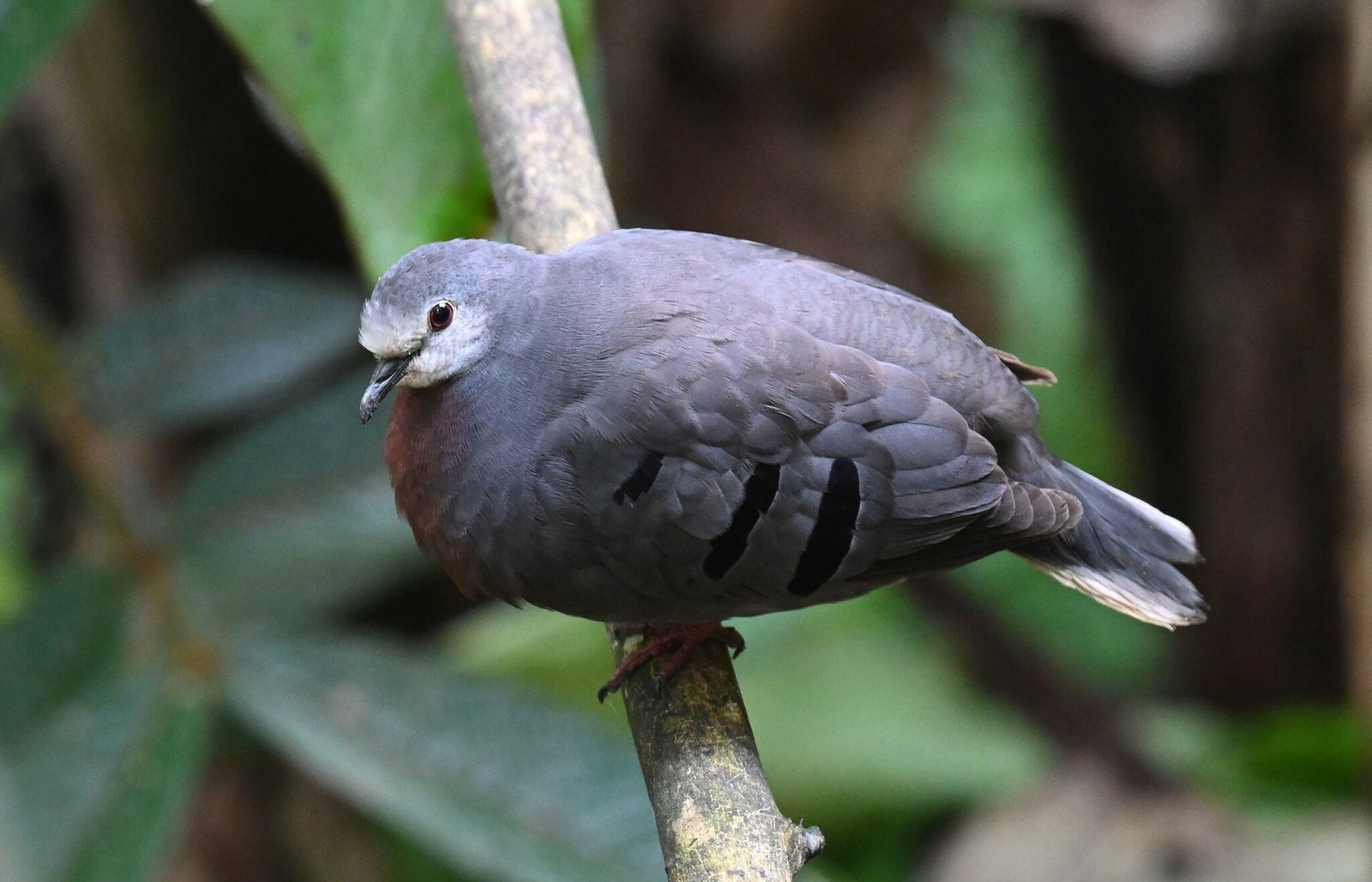
The Maroon-chested Ground Dove is a dove of bamboo stands in Andean montane forest. It depends heavily on mass seeding of bamboo (especially Chusquea) and then appears locally in numbers, only to go unrecorded for years afterwards. In most places it is scarce and irregular.
Voice
A deep, repeated two-note call, hoo-woop, and a single woop, given at regular intervals from cover.
Recording: Manuel Espejo — CC BY-NC-SA 4.0 · xeno-canto
Identification
20–22 cm, with a fairly long tail. The male is blue-grey, with a whitish forehead and face, a purplish-maroon to chestnut breast and a paler belly; the wing coverts have dark purple bars and the outer tail feathers are white. The female is brown, with a paler face, dark purple wing bars and pale tips to the outer tail feathers. The legs are pink. Young birds resemble the female.
Confusion species
Blue Ground Dove Claravis pretiosa lives lower, in the lowlands; the male lacks the maroon breast and has black outer tail feathers, the female has rufous wing spots and a rufous rump. Quail-doves such as White-throated Quail-Dove Zentrygon frenata are larger and heavier, with a striped or patterned head, and walk on the forest floor.
Habitat
Bamboo stands in humid montane forest, cloud forest and at forest edges, especially where bamboo is seeding, mostly between 1500 and 3000 m, sometimes lower. It eats mainly bamboo seed, also other seeds, on the ground and in the bamboo. The nest is a platform of twigs low in the vegetation.
Where the bird is most at home, classified by the vegetation units of the Andes and the west coast.


Range and movements
In Colombia very local in the Andes and in the Sierra Nevada de Santa Marta. In Ecuador rare on both slopes of the Andes. In Peru on the eastern slope of the Andes. In Bolivia in the Yungas. Absent from the Galápagos. Outside the guide area in the mountains of Mexico, Central America and Venezuela. Because of its nomadic behaviour its occurrence varies from year to year.
- Resident
- Summer visitor (c. Apr–Sep)
- Winter visitor (c. Oct–Mar)
- Passage (Mar–Apr, Oct–Nov)
- dark = core range, pale = thinly spread
How and when to look
Keep track of reports of flowering and seeding bamboo on the eastern slope of the Andes; that is where the birds appear temporarily. Listen for the deep, repeated call in dense bamboo.
Conservation status
Least Concern (LC), but scarce and irregular. The species depends on bamboo in montane forest and is therefore sensitive to deforestation.
Scientific name
Paraclaravis mondetoura | (Bonaparte, 1856) (GBIF: Claravis mondetoura)
Bonaparte described the species in 1856 as Peristera mondetoura; because it was later moved to another genus, the author and year stand in brackets. The genus Paraclaravis was introduced in 2018 by Sangster, Sweet & Johnson. The genus name combines Greek para, 'beside, related to', with the genus name Claravis, in which these species were formerly placed; Claravis comes from Latin clarus, 'bright', and avis, 'bird'. The species name honours Pauline Louise Jeanne Angélique Geoffroy Saint-Hilaire, née Brière de Mondétour (1785–1876), wife of the French zoologist Étienne Geoffroy Saint-Hilaire. The specimen the first description was based on came from Caracas, Venezuela.