All species › Pigeons and doves › Doves and pigeons › Bare-faced Ground Dove
Bare-faced Ground Dove | Metriopelia ceciliae
Naaktoogpunaduif | Tortolita moteada | Rolinha-de-cara-nua
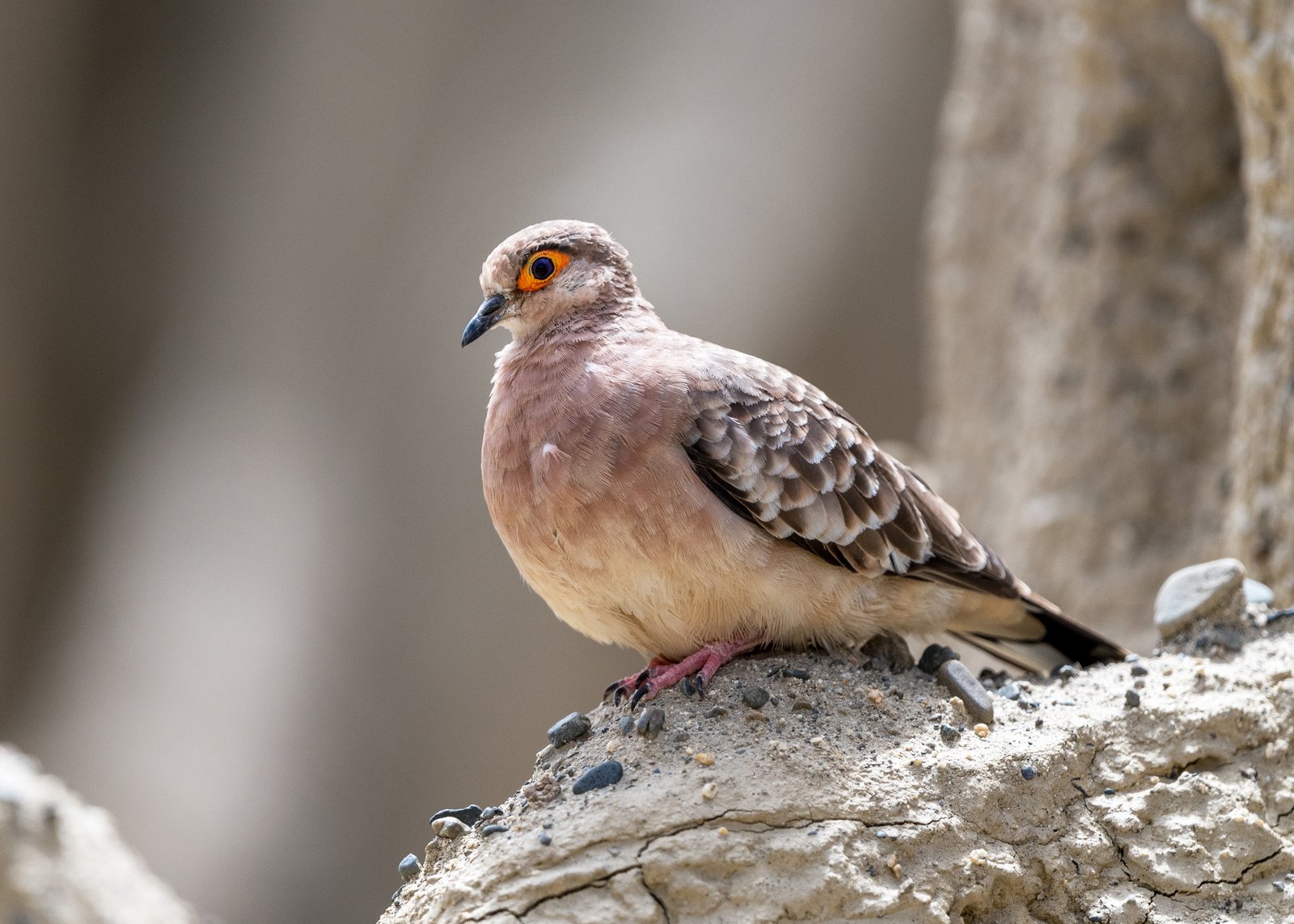
The Bare-faced Ground Dove is a small, stocky dove of the dry Andes of Peru and Bolivia, with bare yellow-orange skin around the eye. It often lives close to people, in villages, farmyards and on terraced fields, and readily breeds in walls and under roofs. It is the ground dove of the middle and upper valleys.
Voice
A soft, somewhat husky cooing, often in short series. On take-off the wings make a distinct rattling or whirring sound.
No recording with a suitable Creative Commons licence is available for this species yet.
Identification
16–18 cm, compact, with a fairly short tail. The upperparts are greyish brown, with pale, creamy spots and fringes on the back and wing coverts, giving a speckled look. The underparts are pinkish buff. Around the eye is conspicuous bare skin, yellow to orange. The primaries are blackish, and the tail is dark with pale tips to the outer feathers. The sexes are alike; young birds are duller, with a smaller bare eye patch.
Confusion species
Golden-spotted Ground Dove Metriopelia aymara lives higher on the puna, lacks the yellow-orange eye patch and has golden-bronze spots on the wing. Black-winged Ground Dove Metriopelia melanoptera is larger and plainer greyish brown, with a white patch at the bend of the wing and a black tail. Croaking Ground Dove Columbina cruziana on the coast has a yellow base to the bill, a purple wing stripe and rufous primaries in flight.
Habitat
Fields and terraces, dry shrubby slopes, rock faces, villages and small towns in the Andes, roughly between 2000 and 4000 m, locally lower on the western slope. It eats seeds picked up from the ground, often in pairs or small groups. The nest is in a crevice in a rock or wall, or under a roof.
Where the bird is most at home, classified by the vegetation units of the Andes and the west coast.


Range and movements
In Peru in the Andes from north to south, mainly on the western slope and in the dry valleys. In Bolivia in the Andes and the dry valleys. Absent from Colombia and Ecuador, and from the Galápagos. Outside the guide area in northern Chile and north-western Argentina.
- Resident
- dark = core range, pale = thinly spread
How and when to look
In villages and farmyards in the Andes of Peru and Bolivia, for example around Cusco and Arequipa, pairs feed on the ground along paths and walls.
Conservation status
Least Concern (LC). Common; it benefits from small-scale farming and settlement.
Scientific name
Metriopelia ceciliae | (Lesson, 1845)
Lesson described the species in 1845 as Columba (Chamoepelia) Ceciliae; because it was later moved to another genus, the author and year stand in brackets. The genus Metriopelia was introduced in 1855 by Bonaparte. The genus name combines Greek metrios, 'modest', with peleia, 'dove'. The species name honours Cécile Estelle Atala Gautrau, née Lesson (1819–1845), the eldest daughter of the French naturalist René Lesson. The specimen the first description was based on came from Peru.