All species › Pigeons and doves › Doves and pigeons › Black-winged Ground Dove
Black-winged Ground Dove | Metriopelia melanoptera
Grote punaduif | Tortolita alinegra | Rolinha-de-asa-preta
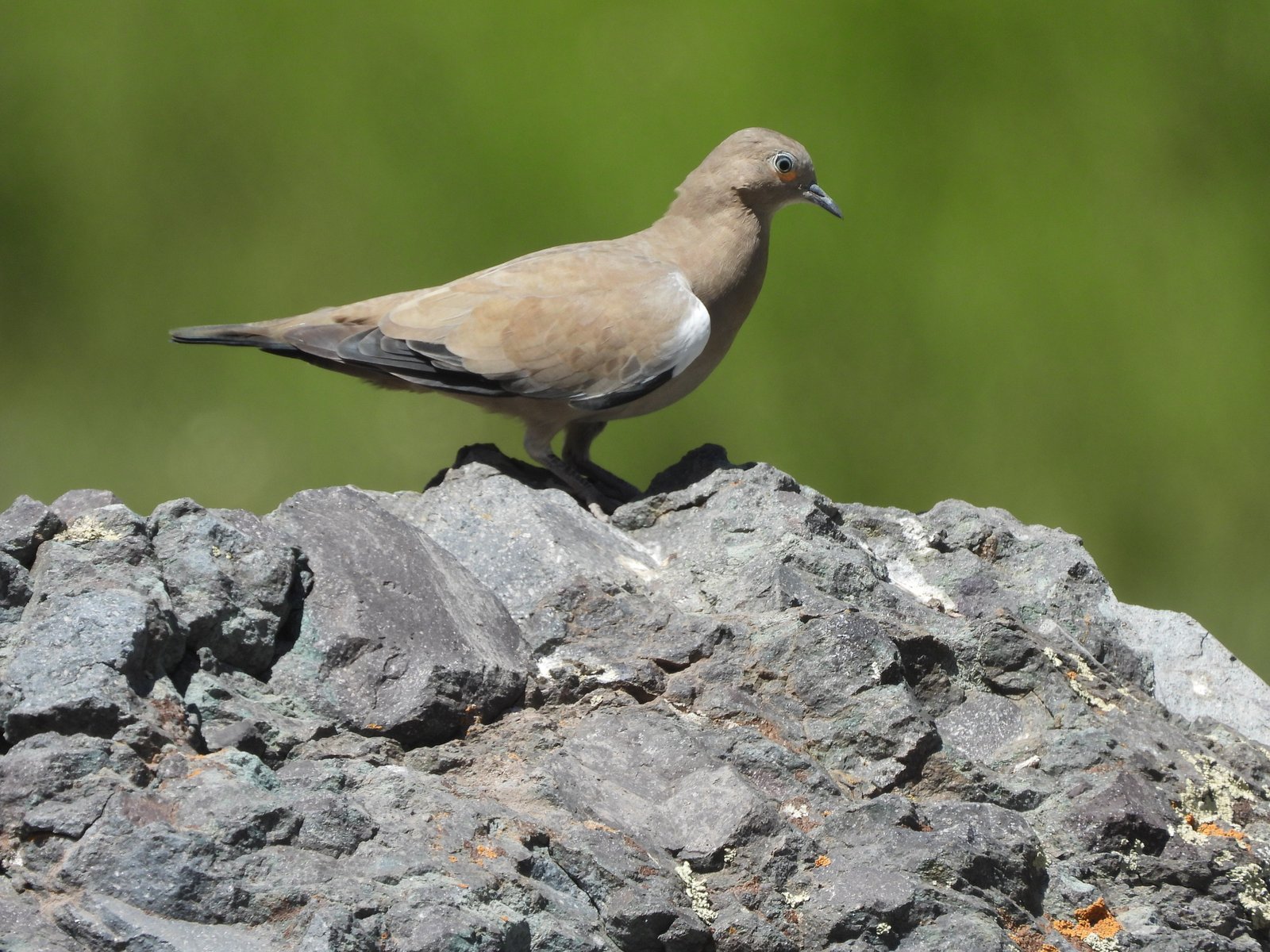
The Black-winged Ground Dove is the largest of the Metriopelia ground doves and the most widespread, from southern Colombia far into the south of the continent. It is a greyish-brown dove of open high mountains, with black wings and tail and a white patch at the bend of the wing. It often lives in flocks and flushes on loudly whistling wings.
Voice
A soft, somewhat hoarse cooing, mainly in the breeding season. On take-off the wings whistle loudly.
Recording: Fabrice Schmitt — CC BY-NC-SA 4.0 · xeno-canto
Identification
21–23 cm, fairly large and heavy for a ground dove. The upperparts are greyish brown, the underparts paler, pinkish grey. The primaries and secondaries are black, and at the bend of the wing there is a white patch that is often visible on the perched bird too. The tail is black. In front of and around the eye is a small area of bare skin, yellow to orange. The sexes are alike; young birds have pale feather fringes.
Confusion species
Golden-spotted Ground Dove Metriopelia aymara is smaller, lacks the white wing bend and has golden-bronze spots on the wing coverts. Bare-faced Ground Dove Metriopelia ceciliae is smaller, with pale spots on the upperparts and a larger yellow-orange eye patch. Eared Dove Zenaida auriculata is slimmer, with black spots on the wing, black marks on the head and no white at the bend of the wing.
Habitat
Páramo and puna with low shrubs and rocks, edges of Polylepis woodland, shrubby slopes, ravines and the surroundings of high fields and villages, roughly between 2500 and 5000 m, lower in the south of the range. It eats seeds on the ground. The nest is in a shrub, a rock crevice or among stones.
Where the bird is most at home, classified by the vegetation units of the Andes and the west coast.


Range and movements
In Colombia only in the far south, in Nariño. In Ecuador in the páramo throughout the Andes. In Peru in the Andes from north to south. In Bolivia in the Andes. Absent from the Galápagos. Outside the guide area in Chile and Argentina, south into Patagonia.
- Resident
- dark = core range, pale = thinly spread
How and when to look
In open páramo and puna with shrubs and rocks, for example around the volcanoes of Ecuador and in the high valleys of Peru and Bolivia; small groups flush on whistling wings, showing the black wings with the white bend.
Conservation status
Least Concern (LC). Widespread and locally common in the high Andes.
Scientific name
Metriopelia melanoptera | (Molina, 1782)
Molina described the species in 1782 as Columba Melanoptera; because it was later moved to another genus, the author and year stand in brackets. The genus Metriopelia was introduced in 1855 by Bonaparte. The genus name combines Greek metrios, 'modest', with peleia, 'dove'. The species name combines Greek melas, 'black', with pteron, 'wing'. The specimen the first description was based on came from Chile.