All species › Pigeons and doves › Doves and pigeons › Golden-spotted Ground Dove
Golden-spotted Ground Dove | Metriopelia aymara
Bronsvleugelpunaduif | Tortolita de puntos dorados | Rolinha-de-pintas-douradas
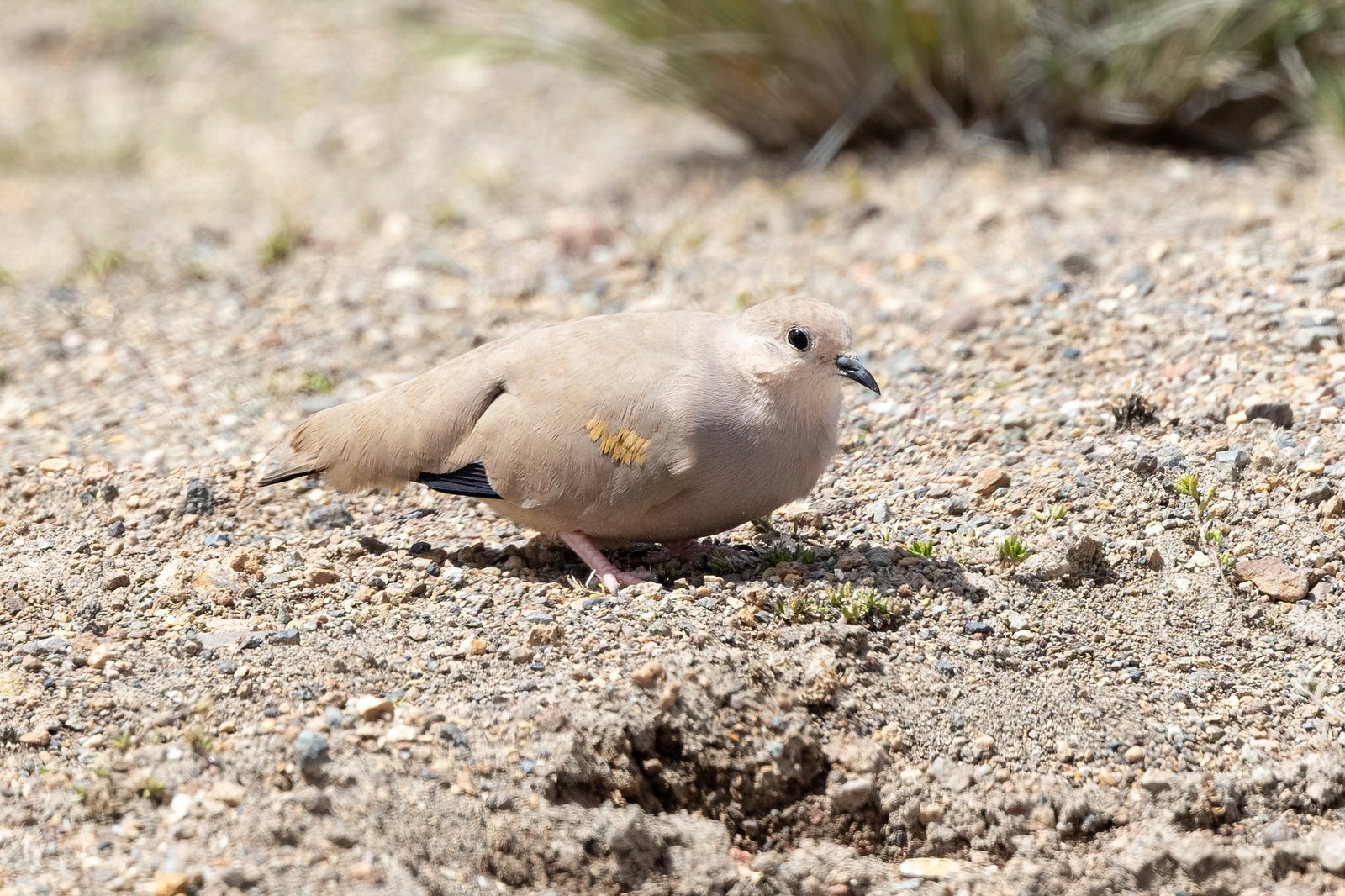
The Golden-spotted Ground Dove is a small, plain pinkish-brown dove of the high puna of southern Peru and Bolivia. It is named for the golden-bronze spots on the wing. It often lives in flocks on bare ground around villages, corrals and along roads on the high plateau.
Voice
A soft, short cooing, not often heard. On take-off the wings make a whirring or rattling sound.
Recording: Cristian Pinto — CC BY-NC-SA 4.0 · xeno-canto
Identification
17–19 cm, stocky, with a short tail. The plumage is plain greyish brown to pinkish brown, paler and pinker on the underparts. The wing coverts have small spots with a golden-bronze to coppery gloss. The primaries and tail are black; there is no white in the wing or tail. The eye is dark, with a narrow, inconspicuous bare ring. The sexes are alike; young birds have pale feather fringes.
Confusion species
Black-winged Ground Dove Metriopelia melanoptera is larger and greyer, with a white patch at the bend of the wing. Bare-faced Ground Dove Metriopelia ceciliae has yellow-orange bare skin around the eye and pale spots on the upperparts, and usually lives lower. Eared Dove Zenaida auriculata is slimmer and longer-tailed, with black spots on the wing.
Habitat
Open puna and altiplano with short grass, bare ground and stones, the edges of fields, corrals and villages, roughly between 3000 and 5000 m. It feeds on seeds on the ground in pairs and flocks. The nest is in a rock crevice, a stone wall or a hole in a bank.
Where the bird is most at home, classified by the vegetation units of the Andes and the west coast.


Range and movements
In Peru in the high Andes of the south, locally north to the centre. In Bolivia on the altiplano and in the western Andes. Absent from Colombia and Ecuador, and from the Galápagos. Outside the guide area in northern Chile and north-western Argentina.
- Resident
- dark = core range, pale = thinly spread
How and when to look
On the altiplano around Lake Titicaca and in the puna of southern Peru and western Bolivia, especially at corrals, villages and along roads, where small groups feed on bare ground.
Conservation status
Least Concern (LC). Locally common on the puna.
Scientific name
Metriopelia aymara | (Prévost, 1840)
Prévost described the species in 1840 as Columba Aymara; because it was later moved to another genus, the author and year stand in brackets. The genus Metriopelia was introduced in 1855 by Bonaparte. The genus name combines Greek metrios, 'modest', with peleia, 'dove'. The species name refers to the Aymara, the Indigenous people of the highlands around Lake Titicaca. The specimen the first description was based on came from Tacora, Chile.