All species › Pigeons and doves › Doves and pigeons › Common Ground Dove
Common Ground Dove | Columbina passerina
Musduif | Tortolita común | Rolinha-cinzenta
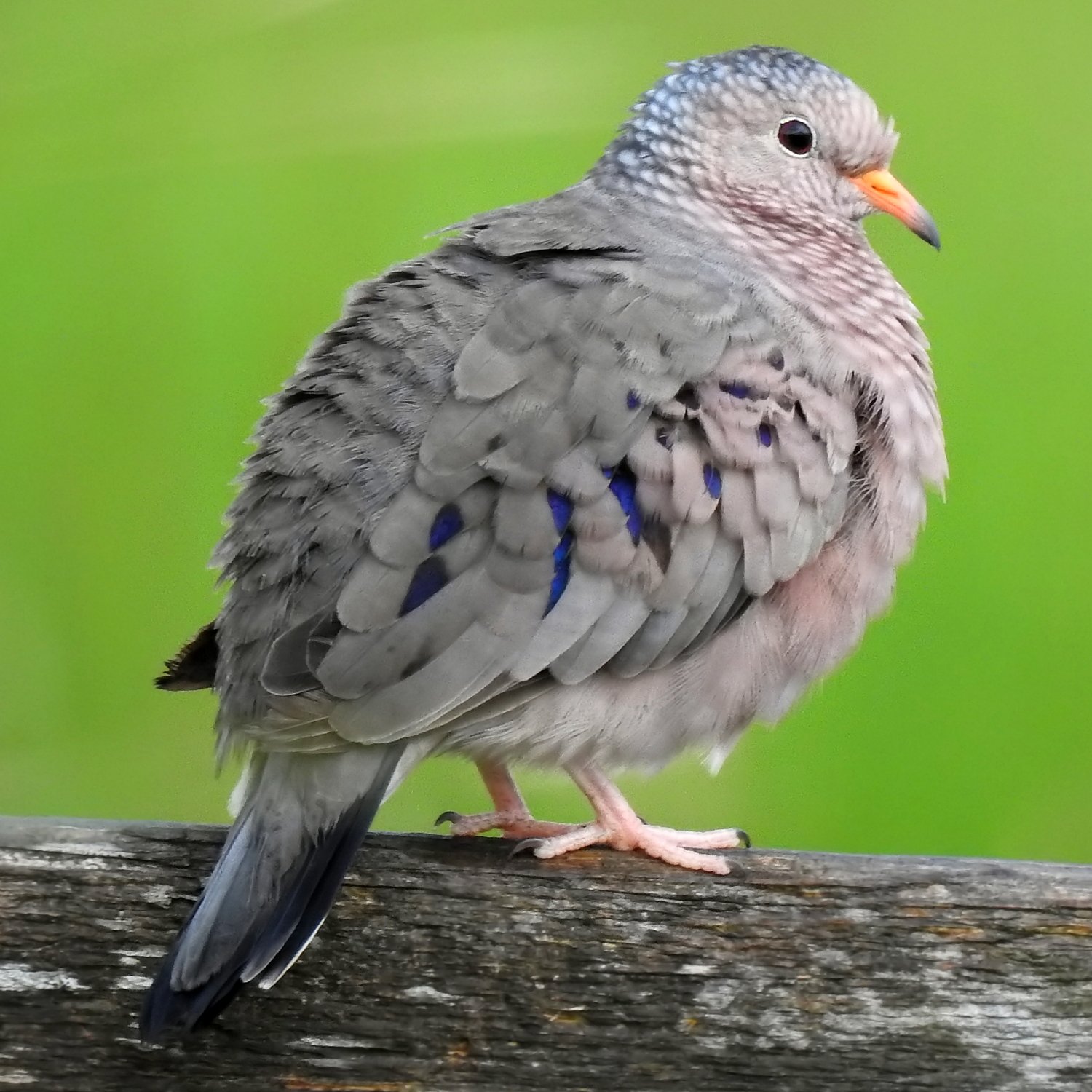
The Common Ground Dove is one of the smallest doves in the guide area, barely larger than a sparrow. It lives in dry, open country and in the guide area occurs mainly in the north, in Colombia. The scaled head and breast set it apart from the other small ground doves.
Voice
A soft, repeated, slightly rising hoo-oop or woop, often kept up for long periods at regular intervals.
Recording: JAYRSON ARAUJO DE OLIVEIRA — CC BY-NC-SA 4.0 · xeno-canto
Identification
15–17 cm, small and stocky, with a short tail. The head, neck and breast are scaled with dark fringes. The male has a blue-grey crown and nape and a pinkish-buff breast; the female is plainer greyish brown. The wing coverts have black spots with a purple gloss. In flight the rufous primaries stand out; the tail is dark. The bill is pink to red with a dark tip, and the legs are pink. Young birds are browner, with less scaling.
Confusion species
Plain-breasted Ground Dove Columbina minuta is slightly smaller still, with a plain, unscaled breast and an all-dark bill. Ruddy Ground Dove Columbina talpacoti is larger; the male is rufous with a grey head, the female lacks scaling. Scaled Dove Columbina squammata is scaled all over and has a much longer tail with white.
Habitat
Dry scrub, thorn woodland, open country with scattered shrubs, savanna, pasture, gardens and village edges, mainly in the lowlands and in dry Andean valleys up to about 2000 m, locally higher. It feeds on seeds on the ground, usually in pairs. The nest is low in a shrub or on the ground.
Where the bird is most at home, classified by the vegetation units of the Andes and the west coast.


Range and movements
In Colombia in the Caribbean lowlands, in the dry valleys of the Magdalena region and locally in the llanos. In Ecuador only very locally in dry Andean valleys. In Peru and Bolivia at most very scarce or absent. Absent from the Galápagos. Outside the guide area from the southern United States through Central America and the Caribbean to Venezuela, the Guianas and eastern Brazil.
- Resident
- dark = core range, pale = thinly spread
How and when to look
In dry scrub and along sandy tracks in the Caribbean lowlands of Colombia, for example around La Guajira and the Sierra Nevada de Santa Marta, where pairs walk on the ground and, when disturbed, flush briefly on rufous wings.
Conservation status
Least Concern (LC). Common over a large range; it tolerates farming and settlement.
Scientific name
Columbina passerina | (Linnaeus, 1758)
Linnaeus described the species in 1758 as Columba passerina; because it was later moved to another genus, the author and year stand in brackets. The genus Columbina was introduced in 1825 by Spix. The genus name comes from Latin columbinus, 'of a dove, dove-like'. The species name comes from Latin passerinus, 'sparrow-like', after its small size. The specimen the first description was based on came from South Carolina, United States.