All species › Pigeons and doves › Doves and pigeons › Plain-breasted Ground Dove
Plain-breasted Ground Dove | Columbina minuta
Dwergduif | Tórtola pecho liso | Rolinha-de-asa-canela
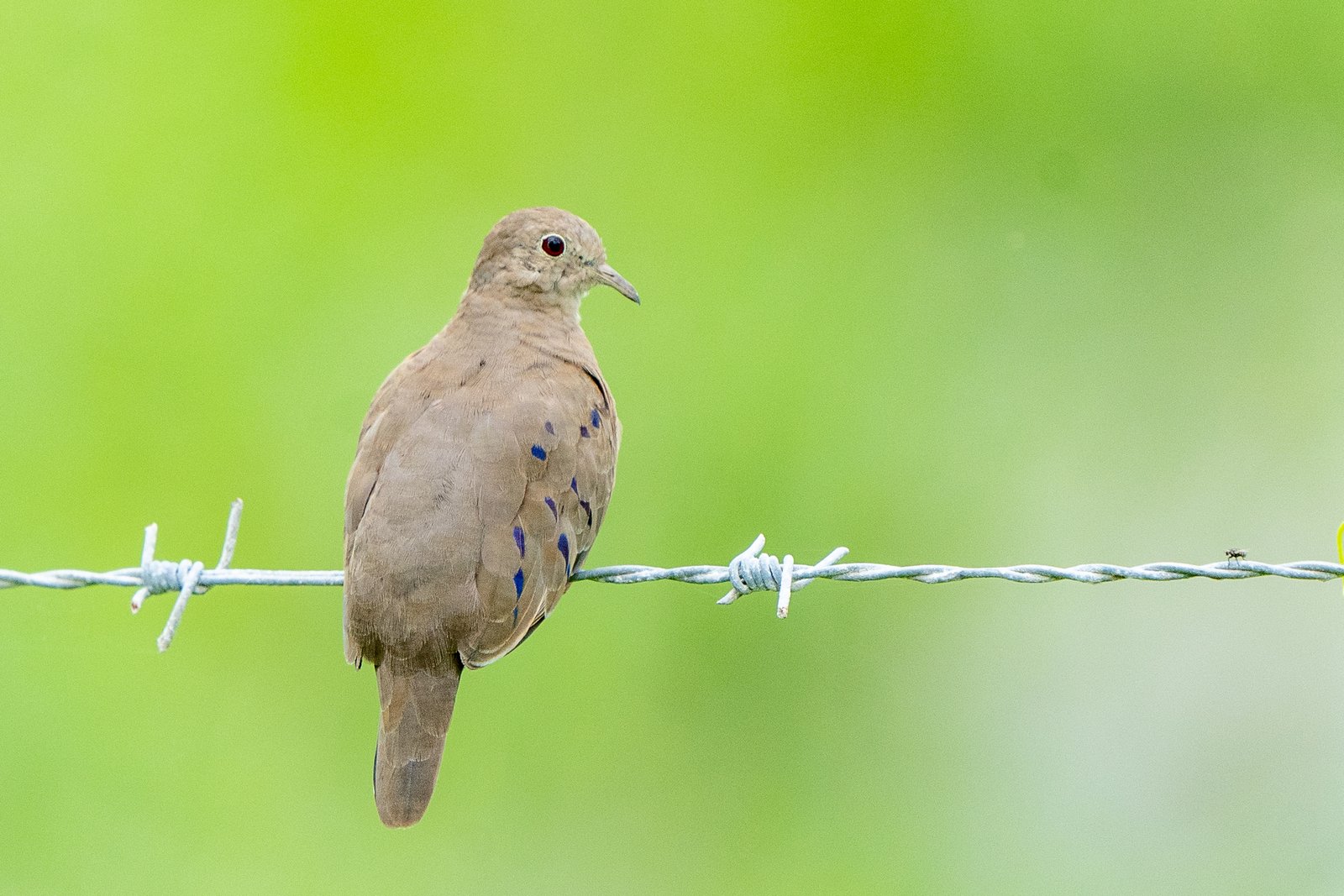
The Plain-breasted Ground Dove is the smallest dove in the guide area. It is a plainly patterned ground dove of open grassland, savanna and fields in the lowlands, without the scaling of the Common Ground Dove. In flight the wings show rufous primaries.
Voice
A monotonous, slowly repeated woop, at short intervals, often from a low branch or the ground.
Recording: Fernando Igor de Godoy — CC BY-NC-SA 4.0 · xeno-canto
Identification
13–15 cm, small, with a short tail. The male has a blue-grey crown and nape, a plain, unscaled pinkish-buff breast and greyish-brown upperparts; the wing coverts have a few spots with a purple gloss. The female is plain greyish brown, with less colourful spots. In flight the rufous primaries are obvious, and the dark tail has pale corners. The bill is dark and the legs are pink.
Confusion species
Common Ground Dove Columbina passerina is slightly larger, with a scaled head and breast and a pink base to the bill. The female Ruddy Ground Dove Columbina talpacoti is larger and warmer brown, with black spots on the wing and black underwing coverts. Long-tailed Ground Dove Uropelia campestris in Bolivia has a longer tail and black-and-white wing bars.
Habitat
Open grassland, savanna, pasture, fields, rice fields and shrubby edges of forest and riverbanks, mainly in the lowlands up to about 1000 m, locally higher in dry valleys. It feeds on seeds on the ground, in pairs or small groups. The nest is low in a shrub or grass tussock.
Where the bird is most at home, classified by the vegetation units of the Andes and the west coast.


Range and movements
In Colombia in the Caribbean lowlands, in the Magdalena and Cauca valleys and in the llanos. In Ecuador locally in the western lowlands. In Peru locally in the Amazonian lowlands, mainly in open savannas in the south-east. In Bolivia in the savannas of the Beni and in Santa Cruz. Absent from the Galápagos. Outside the guide area from southern Mexico through Central America to Venezuela, the Guianas, Brazil, Paraguay and northern Argentina.
- Resident
- dark = core range, pale = thinly spread
How and when to look
In open grassland and along roads in the llanos of Colombia and the savannas of the Beni; with small doves flushing, check for the plain breast and the rufous wings.
Conservation status
Least Concern (LC). Widespread; it benefits locally from deforestation and the creation of pasture.
Scientific name
Columbina minuta | (Linnaeus, 1766)
Linnaeus described the species in 1766 as Columba minuta; because it was later moved to another genus, the author and year stand in brackets. The genus Columbina was introduced in 1825 by Spix. The genus name comes from Latin columbinus, 'of a dove, dove-like'. The species name comes from Latin minutus, 'small'. The specimen the first description was based on came from Cayenne, French Guiana.