All species › Pigeons and doves › Doves and pigeons › Ruddy Ground Dove
Ruddy Ground Dove | Columbina talpacoti
Steenduif | Tortolita rojiza | Rolinha-roxa
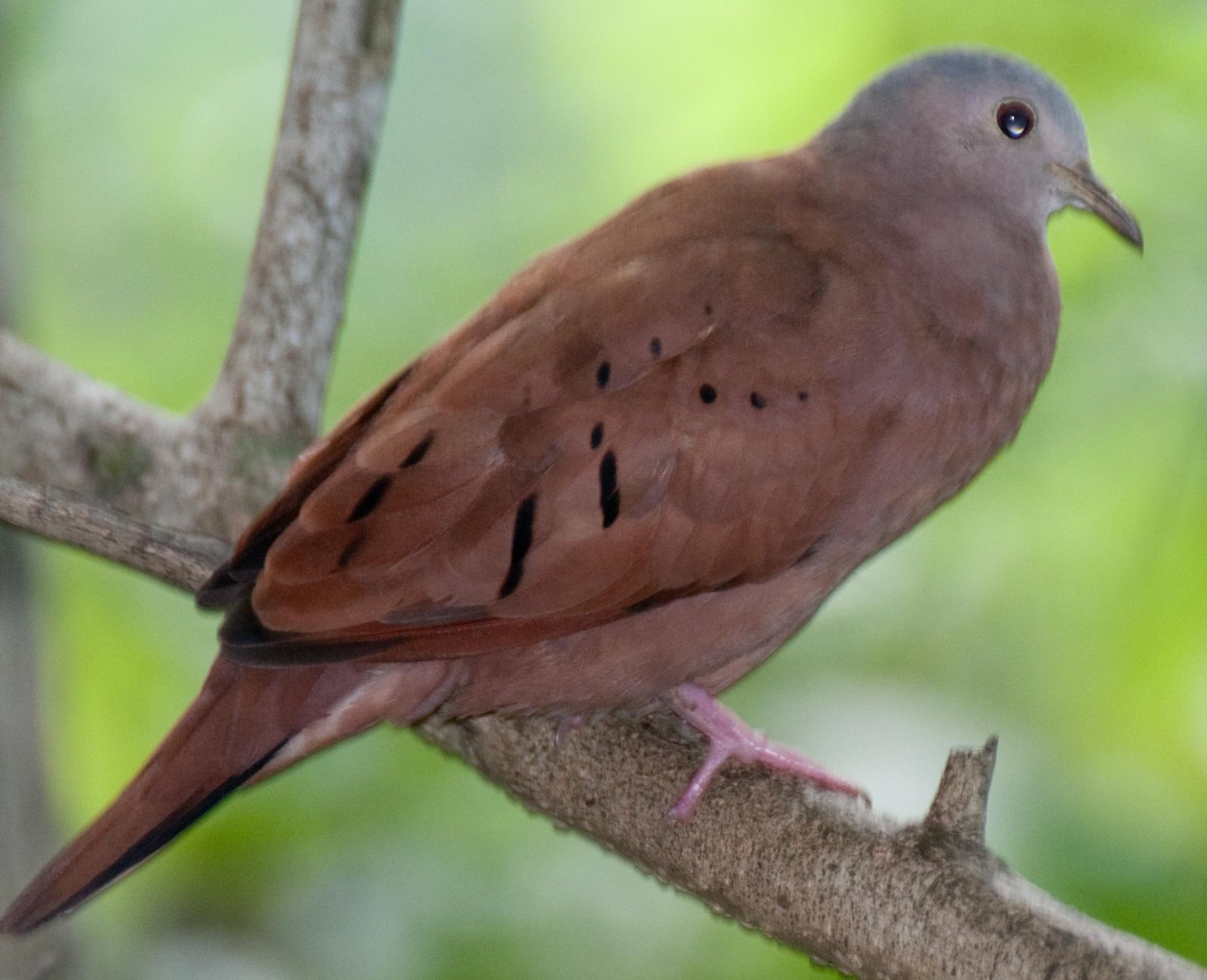
The Ruddy Ground Dove is a small ground dove of open lowland country, the male rufous with a bluish-grey head. It has benefited greatly from deforestation and is one of the commonest doves in the warm lowlands on both sides of the Andes. Pairs and small groups walk on roads, yards and fields in search of seeds.
Voice
A repeated, soft, hollow two-syllable cooing, koo-woo koo-woo koo-woo, often kept up for a long time from a branch or wire.
Recording: JAYRSON ARAUJO DE OLIVEIRA — CC BY-NC-SA 4.0 · xeno-canto
Identification
16–18 cm, compact, with a short tail. The male has a bluish-grey crown and hindneck; the rest of the plumage is rufous to vinaceous, paler below. There are a few black spots on the wing coverts. The underwing coverts are black, visible in flight, and the outer tail feathers are black with rufous edges. The female is dull greyish brown with a rufous wash on the wings and rump and the same black wing spots. Juveniles resemble the female, with pale feather fringes.
Confusion species
Common Ground Dove Columbina passerina has a scaly head and breast and rufous primaries in flight. Plain-breasted Ground Dove Columbina minuta is smaller and greyer brown, without a black underwing. The female resembles that of Ecuadorian Ground Dove Columbina buckleyi in western Ecuador and Peru, which is larger and greyer. The male of Blue Ground Dove Claravis pretiosa is bluish grey.
Habitat
Pasture, fields, forest edges, clearings, savanna, gardens and villages, mainly in the lowlands and locally in warm valleys to about 1500 m. It avoids closed forest. It searches the ground for small seeds. The nest is a loose cup of twigs and grasses low in a shrub or tree.
Where the bird is most at home, classified by the vegetation units of the Andes and the west coast.


Range and movements
In Colombia widespread in the lowlands and warm valleys west and east of the Andes. In Ecuador in the western and eastern lowlands. In Peru mainly in the Amazonian lowlands and the warm valleys of the east slope, and locally in the northwest. In Bolivia in the northern and eastern lowlands. Absent from the Galápagos and the high Andes. Outside the guide area from Mexico through Central America to northern Argentina.
- Resident
- dark = core range, pale = thinly spread
How and when to look
In villages, yards and along roads in the lowlands, often in pairs or small groups on the ground; when disturbed it flies up to a low branch, showing the black underwing.
Conservation status
Least Concern. Very common; it spreads with deforestation.
Scientific name
Columbina talpacoti | (Temminck, 1810)
Temminck described the species in 1810 as Columba Talpacoti; because it was later moved to another genus, the author and year stand in brackets. The genus Columbina was introduced in 1825 by Spix. The genus name comes from Latin columbinus, 'of a dove, dove-like'. The species name comes from the Nahuatl name Tlapalcocotli for a kind of dove, from tlapalli, 'red', and cocotli, 'dove'. The specimen the first description was based on came from South America.