All species › Pigeons and doves › Doves and pigeons › Ecuadorian Ground Dove
Ecuadorian Ground Dove | Columbina buckleyi
Buckleys duif | Tortolita ecuatoriana | Rolinha-equatoriana
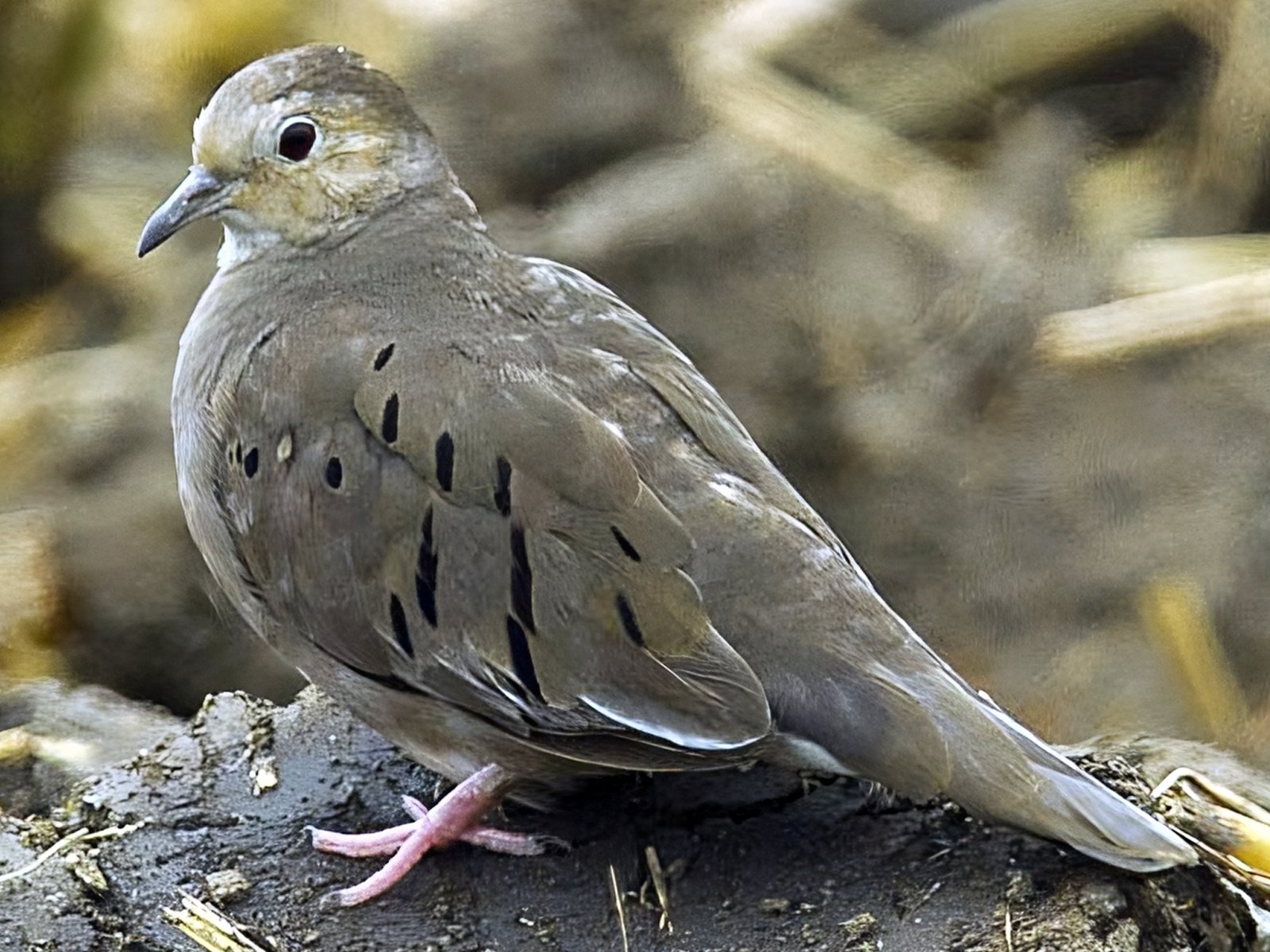
The Ecuadorian Ground Dove is a greyish-brown ground dove of the dry lowlands on the Pacific side of Ecuador and northern Peru. It is one of the characteristic species of the Tumbesian region and replaces Ruddy Ground Dove there in dry forest and scrub. Pairs walk quietly over the forest floor and along tracks.
Voice
A series of soft, hollow cooing notes, whoop whoop whoop, repeated at a fairly fast pace.
Recording: John V. Moore — CC BY-NC-SA 4.0 · xeno-canto
Identification
17–18 cm, compact, with a short tail. The male has a grey head; the upperparts are greyish brown, the underparts pale greyish pink with a vinaceous wash on the breast. There are black spots on the wing coverts, and the underwing coverts are black. The outer tail feathers are black. The female is browner, with a dull buffy breast. Juveniles have pale feather fringes.
Confusion species
Ruddy Ground Dove Columbina talpacoti also occurs locally on the west side; the male is rufous with a bluish-grey head, the female smaller and more rufous. Croaking Ground Dove Columbina cruziana has a yellow bill base, a purplish-brown band across the scapulars and a croaking call. Common Ground Dove Columbina passerina has a scaly breast and rufous primaries.
Habitat
Dry forest, semi-humid forest, scrub, forest edges and pasture with trees, mainly in the lowlands and foothills to about 1000 m. It searches the ground for seeds.
Where the bird is most at home, classified by the vegetation units of the Andes and the west coast.


Range and movements
In Ecuador in the western lowlands, mainly in the dry and semi-humid areas of Manabí, Guayas, El Oro and Loja. In Peru in the northwest, in Tumbes, Piura and Lambayeque and locally in adjacent valleys. In Colombia at most in the extreme southwest. Absent from Bolivia, east of the Andes and from the Galápagos. Does not occur outside the guide area.
- Resident
- dark = core range, pale = thinly spread
How and when to look
In dry forest and scrub in western Ecuador and in Tumbes and Piura, on tracks and open patches in the forest, often in pairs.
Conservation status
Least Concern. The dry forest of the Tumbesian region has been greatly reduced, but the species tolerates disturbed forest and scrub.
Scientific name
Columbina buckleyi | (Sclater & Salvin, 1877)
Sclater & Salvin described the species in 1877 as Chamaepelia buckleyi; because it was later moved to another genus, the author and year stand in brackets. The genus Columbina was introduced in 1825 by Spix. The genus name comes from Latin columbinus, 'of a dove, dove-like'. The species name honours Clarence Buckley, an English collector who collected birds in Ecuador and Bolivia in the 1870s. The specimen the first description was based on came from Santa Rita, Ecuador.