All species › Pigeons and doves › Doves and pigeons › Scaled Dove
Scaled Dove | Columbina squammata
Schubduif | Tortolita escamosa | Fogo-apagou
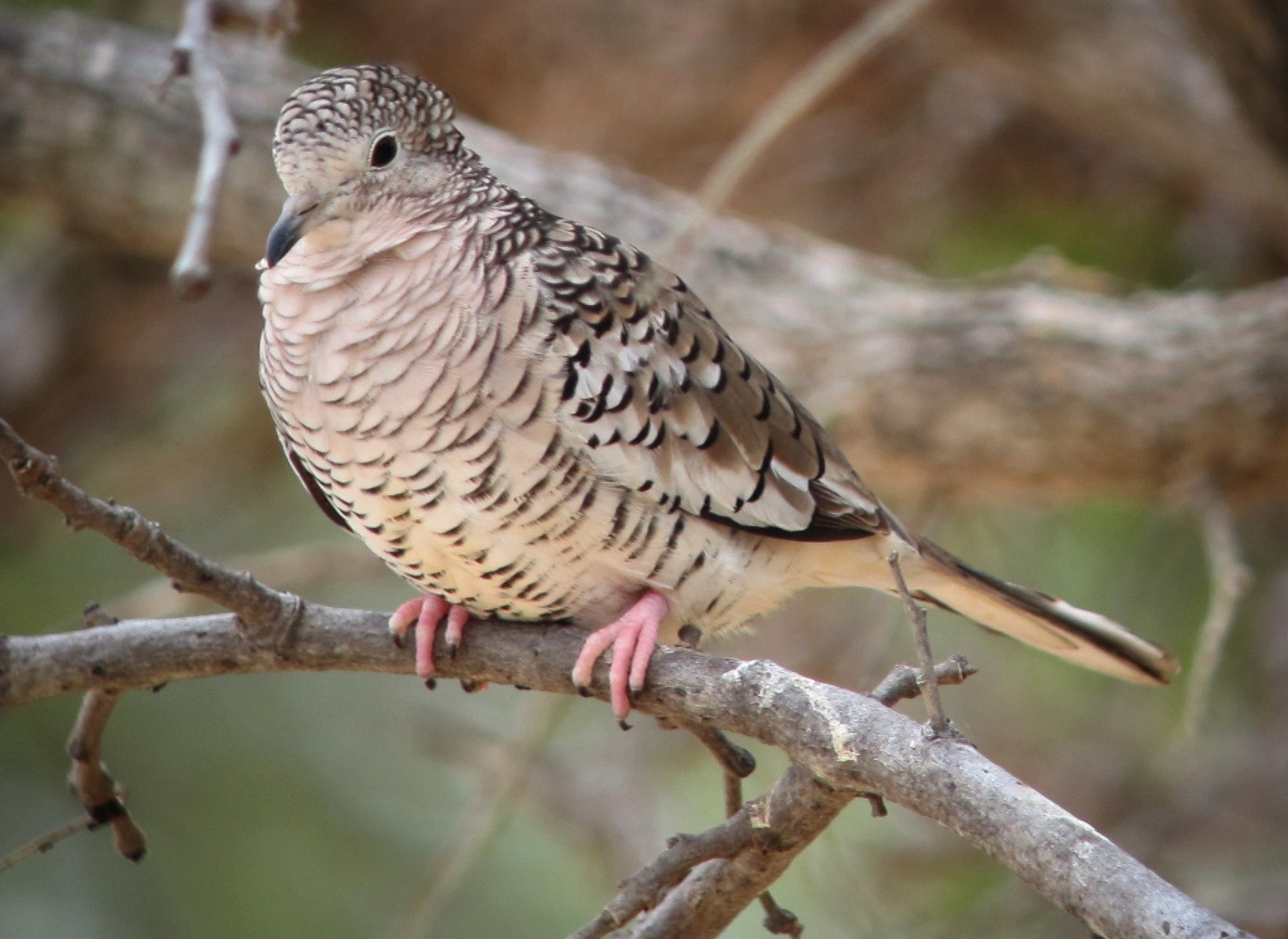
The Scaled Dove is a small, long-tailed dove scaled with dark fringes all over the body. In the guide area it lives only in the open lowlands of Colombia and eastern Bolivia, widely separated by the Amazon basin. The wings make a rattling sound on take-off.
Voice
A rhythmic, hollow three-note cooing, woo-woo-woop, repeated over and over; rendered in Brazil as fogo-apagou. The wings rattle on take-off.
Recording: JAYRSON ARAUJO DE OLIVEIRA — CC BY-NC-SA 4.0 · xeno-canto
Identification
20–22 cm, with a fairly long, graduated tail. The plumage is pale greyish brown, whitish to pale pinkish buff below, and everywhere with narrow black feather fringes that give a scaly pattern. The wing coverts have white edges forming a pale wing bar. In flight the rufous primaries and white outer tail feathers show. The sexes are alike; juveniles are less clearly marked.
Confusion species
Common Ground Dove Columbina passerina and Ruddy Ground Dove Columbina talpacoti are smaller and shorter-tailed, without a scaly pattern on the back. Long-tailed Ground Dove Uropelia campestris in eastern Bolivia is smaller, with a long, narrow tail, orange-yellow bare skin around the eye and white bars across the wing.
Habitat
Savanna, dry scrub, open woodland, pasture with trees, gardens and villages in the lowlands, up to about 1000 m. It searches the ground for seeds, often in pairs or small groups.
Where the bird is most at home, classified by the vegetation units of the Andes and the west coast.


Range and movements
In Colombia in the dry Caribbean lowlands in the north and in the llanos east of the Andes. In Bolivia in the eastern lowlands. Absent from Ecuador, Peru and the Galápagos. Outside the guide area in Venezuela and the Guianas, and in eastern and central Brazil to Paraguay and northeastern Argentina.
- Resident
- dark = core range, pale = thinly spread
How and when to look
In the llanos and the Caribbean lowlands of Colombia in yards, pastures and along roads; often first heard by its three-note call or the rattle of the wings on take-off.
Conservation status
Least Concern. Common in open country and benefits from deforestation.
Scientific name
Columbina squammata | (Lesson, 1831)
Lesson described the species in 1831 as Columba squammata; because it was later moved to another genus, the author and year stand in brackets. The genus Columbina was introduced in 1825 by Spix. The genus name comes from Latin columbinus, 'of a dove, dove-like'. The species name comes from Latin squamatus, 'scaly', after the scaled plumage. The specimen the first description was based on came from Bahia, Brazil.