All species › Jacamars and puffbirds › Puffbirds › Russet-throated Puffbird
Russet-throated Puffbird | Hypnelus ruficollis
Roestkeelbaardkoekoek | Buco bobito | Rapazinho-de-garganta-ruiva
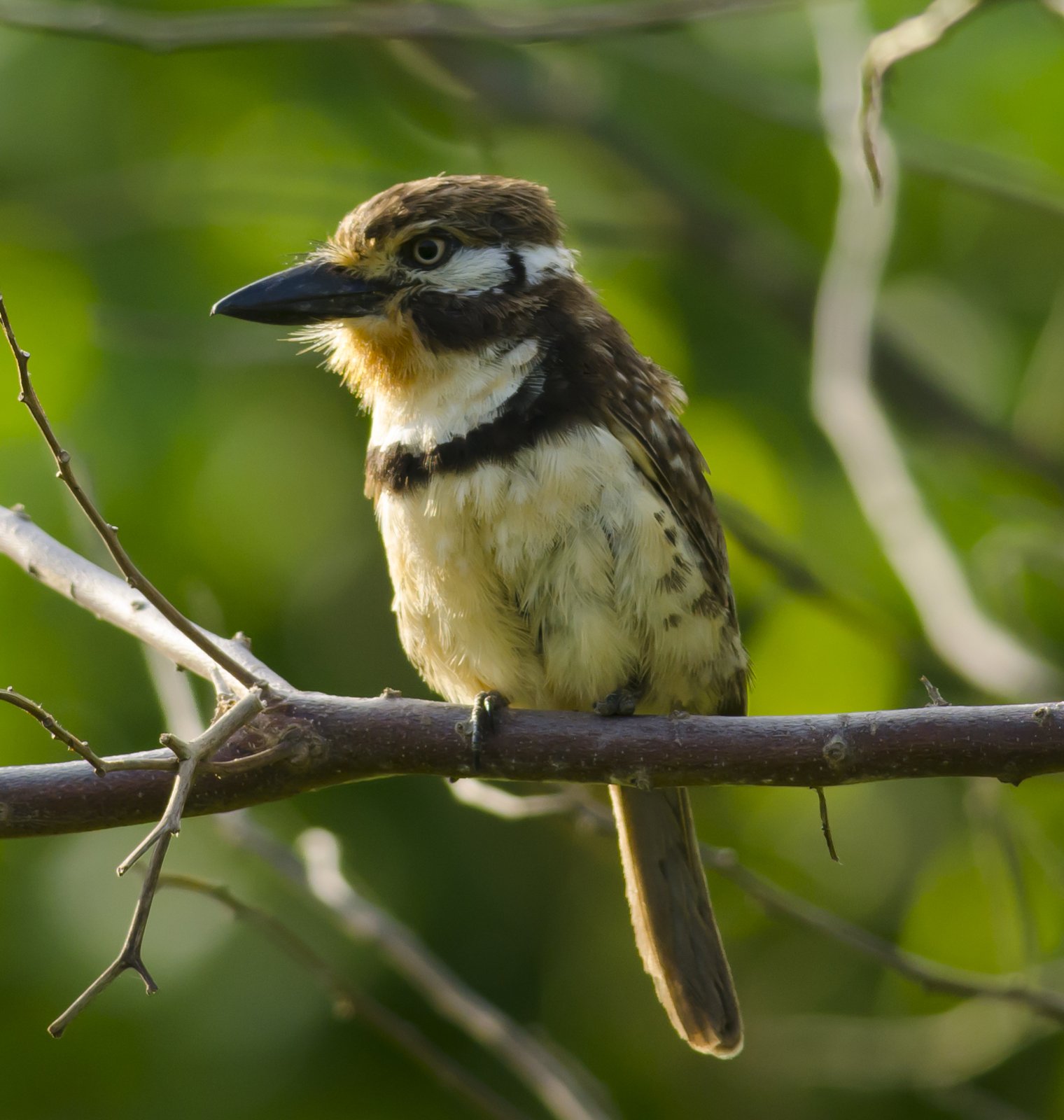
The Russet-throated Puffbird is a stocky brown and rufous puffbird of dry forest and scrub in northern Colombia. It often sits still for long periods on an open branch and draws attention mainly through the rhythmic duets of pairs and small groups. Of the puffbirds of the guide area it is the species of the dry Caribbean lowlands.
Voice
A loud, rhythmic series like woduk-woduk-woduk, repeated many times, first swelling and then fading; often sung as a duet or by a small group together.
Recording: Nick Komar — CC BY-NC-SA 4.0 · xeno-canto
Identification
20–22 cm, with a large head, a heavy, hook-tipped black bill and a fairly long tail. The upperparts are brown with fine buff spots. The forehead and lores are white to pale buff, the cheeks darker brown. The throat and underparts are rufous to warm buff, with a single black band across the breast. The iris is pale yellow. The sexes are alike.
Confusion species
Two-banded Puffbird Hypnelus bicinctus has a second black band across the belly and lives in the llanos east of the Andes. White-necked Puffbird Notharchus hyperrhynchus is larger and black and white, with a white collar, and lives in humid forest. Barred Puffbird Nystalus radiatus is finely barred black on rufous-brown and lives in humid forest west of the Andes.
Habitat
Dry forest, thorn scrub, cactus scrub, savanna with trees, open country with scattered trees and mangrove edges, from sea level to about 1200 m. It perches on a lookout and sallies for large insects and other invertebrates, sometimes small lizards, often taken from the ground. It nests in a cavity it excavates in an arboreal termite nest.
Where the bird is most at home, classified by the vegetation units of the Andes and the west coast.


Range and movements
In Colombia in the Caribbean lowlands, the region around the Sierra Nevada de Santa Marta, La Guajira and the dry parts of the Magdalena Valley. Absent from Ecuador, Peru, Bolivia and the Galápagos. Outside the guide area in north-western Venezuela, mainly around Lake Maracaibo.
- Resident
- dark = core range, pale = thinly spread
How and when to look
Search dry forest and thorn scrub along the Caribbean coast, for example around Santa Marta and in La Guajira, for birds on low, open branches along roads and tracks. In the early morning the duets give away their position.
Conservation status
Least Concern. The species tolerates open, partly agricultural country with scattered trees well; dry forest in its range is declining, however.
Scientific name
Hypnelus ruficollis | (Wagler, 1829)
Wagler described the species in 1829 as Capito ruficollis; because it was later moved to another genus, the author and year stand in brackets. The genus Hypnelus was introduced in 1863 by Cabanis & Heine. The genus name comes from Greek hupnēlos, 'drowsy, indolent' (from hupnos, 'sleep'), for the puffbirds' habit of sitting motionless for long periods. The species name comes from Latin rufus, 'rufous', and collum, 'neck', for the russet throat. The specimen the first description was based on came from Cartagena, Colombia.