All species › Jacamars and puffbirds › Puffbirds › Two-banded Puffbird
Two-banded Puffbird | Hypnelus bicinctus
Dubbelbandbaardkoekoek | Buco bicinto | Rapazinho-de-duas-faixas
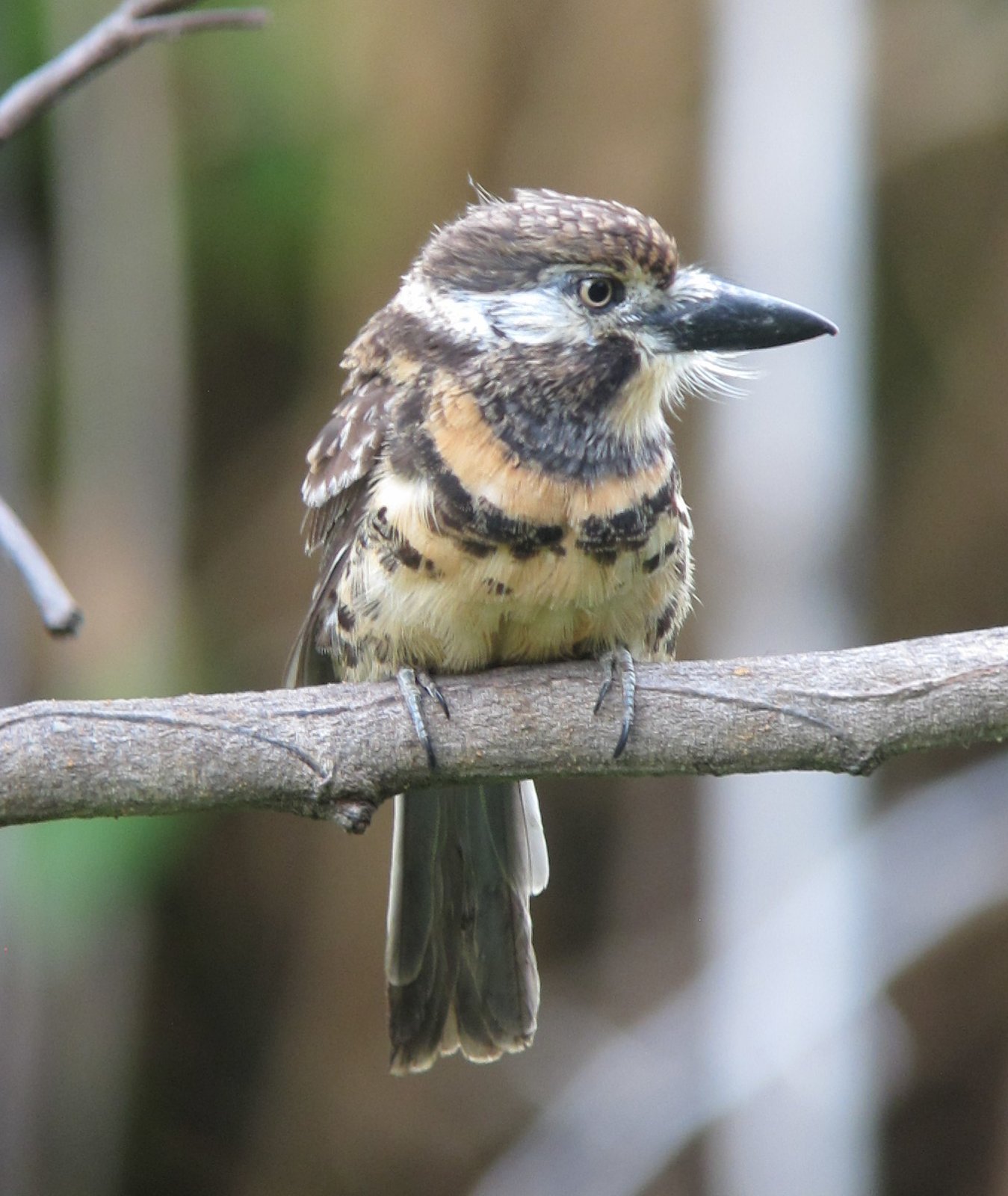
The Two-banded Puffbird is a brown puffbird with a white face and two black breast bands, of the Llanos of Colombia and Venezuela. It often perches in the open on a branch or post at the edge of gallery forest, often for a long time in the same spot. It is sometimes treated as a subspecies of Russet-throated Puffbird.
Voice
A loud, rhythmic series of repeated syllables, like wuk-wuk-wuk, which swells and fades again, often given by a pair in duet. Mainly in the morning.
Recording: Rosa Elena Albornoz @rosaelena_naturaleza — CC0 1.0 · xeno-canto
Identification
20–21 cm, with a large head, a heavy, hook-tipped black bill and a fairly long tail. The forehead, lores and cheeks are white to buff, the throat cinnamon. Two black bands cross the breast, the lower one narrower. The upperparts are brown with pale spots, the belly pale buff. The iris is pale yellow. The sexes are alike.
Confusion species
Russet-throated Puffbird Hypnelus ruficollis has a single black breast band and lives west of the Eastern Andes, in the Caribbean lowlands of Colombia. White-necked Puffbird Notharchus hyperrhynchus is larger and black and white, with a broad black breast band and a white neck. Swallow-winged Puffbird Chelidoptera tenebrosa is blackish, with a short tail, and flies like a swallow.
Habitat
Gallery forest, woodlots and wooded savanna, dry forest edges and pasture with scattered trees in the lowlands. It perches in the open on a branch, post or wire and sallies for large insects, spiders and small lizards. It nests in a cavity dug into an arboreal termite nest.
Where the bird is most at home, classified by the vegetation units of the Andes and the west coast.


Range and movements
In Colombia in the Llanos east of the Andes, in the north-east of the country. Absent from Ecuador, Peru, Bolivia and the Galápagos. Outside the guide area in much of Venezuela.
- Resident
- dark = core range, pale = thinly spread
How and when to look
Drive or walk along gallery forest and wooded savanna in the Llanos of Arauca and Casanare and look for birds sitting quietly on posts and branches along the edge. In the morning the duet gives away their position.
Conservation status
Least Concern. The species tolerates farmland with scattered trees well and also occurs in pasture.
Scientific name
Hypnelus bicinctus | (Gould, 1837)
Gould described the species in 1837 as Tamatia bicincta; because it was later moved to another genus, the author and year stand in brackets. The genus Hypnelus was introduced in 1863 by Cabanis & Heine. The genus name comes from Greek hupnēlos, 'drowsy, indolent' (from hupnos, 'sleep'), for the puffbirds' habit of sitting motionless for long periods. The species name comes from Latin bi-, 'two', and cinctus, 'girdled', for the two black breast bands. The specimen the first description was based on came from Venezuela.