All species › Jacamars and puffbirds › Puffbirds › Lanceolated Monklet
Lanceolated Monklet | Micromonacha lanceolata
Kleine trappist | Monjilla lanceolada | Macuru-pintado
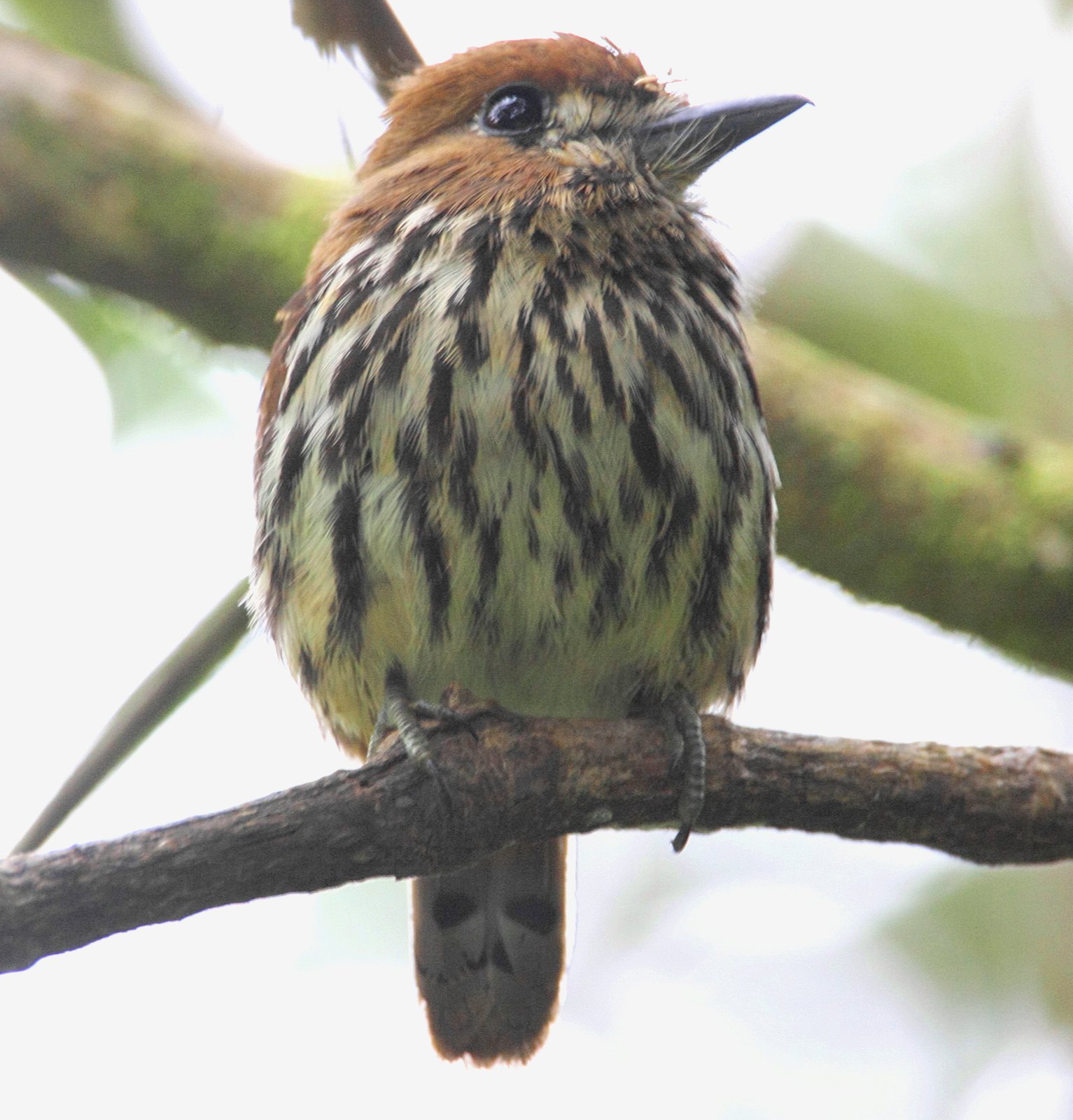
The Lanceolated Monklet is a small, stocky puffbird with a white blaze around the bill and a white breast heavily streaked with black. It lives in foothill forest on both sides of the Andes and sits still for hours in the middle storey, often near clearings or along streams. It is scarce everywhere.
Voice
A series of high, thin, slightly rising whistles, like tseeeet, repeated at intervals. It calls rather little.
Recording: Alonso Quevedo — CC BY-NC-SA 4.0 · xeno-canto
Identification
13–14 cm, with a large head, a short black bill and a short tail. The forehead and lores are white, forming a white blaze around the base of the bill. The upperparts are warm brown with fine pale scaling. The underparts are white with broad, lance-shaped black streaks. The tail has a black band before the whitish tip. The iris is dark. The sexes are alike.
Confusion species
Brown Nunlet Nonnula brunnea is unstreaked, with rufous-brown underparts and a slimmer, grey bill. Western Striolated Puffbird Nystalus obamai is much larger and buff, with fine streaks and an orange-red bill. White-chested Puffbird Malacoptila fusca is larger, with an orange bill and a white breast patch.
Habitat
Humid foothill forest and lower montane forest, also forest edges, clearings and stream banks, mainly between 300 and 1500 m, in the east also in the adjacent lowlands. It perches in the middle storey and sallies for insects in the air or on leaves. It nests in a cavity in a termite nest or in a burrow in the ground.
Where the bird is most at home, classified by the vegetation units of the Andes and the west coast.


Range and movements
In Colombia on the Pacific slope of the Western Andes and on the eastern slope. In Ecuador in the foothills on both sides of the Andes. In Peru on the eastern slope and in the adjacent lowlands. In Bolivia scarce in the north. Absent from the Galápagos. Outside the guide area in Costa Rica, Panama and western Amazonian Brazil.
- Resident
- dark = core range, pale = thinly spread
How and when to look
Check streams, clearings and forest edges in foothill forest. The bird often sits for a long time on a single twig in the middle storey and sometimes gives itself away only by a brief sally for an insect.
Conservation status
Least Concern. The species is scarce everywhere but has a large range; clearance of foothill forest affects the population locally.
Scientific name
Micromonacha lanceolata | (Deville, 1849)
Deville described the species in 1849 as Bucco lanceolata; because it was later moved to another genus, the author and year stand in brackets. The genus Micromonacha was introduced in 1881 by Sclater. The genus name comes from Greek mikros, 'small', and monakhos, 'monk' (Latin monacha). The species name comes from Latin lanceolatus, 'lance-shaped', for the lanceolate streaks on the underparts. The specimen the first description was based on came from Pampa del Sacramento, Peru.