All species › Jacamars and puffbirds › Puffbirds › White-faced Nunbird
White-faced Nunbird | Hapaloptila castanea
Diadeembaardkoekoek | Monja cariblanca | Chora-chuva-andino
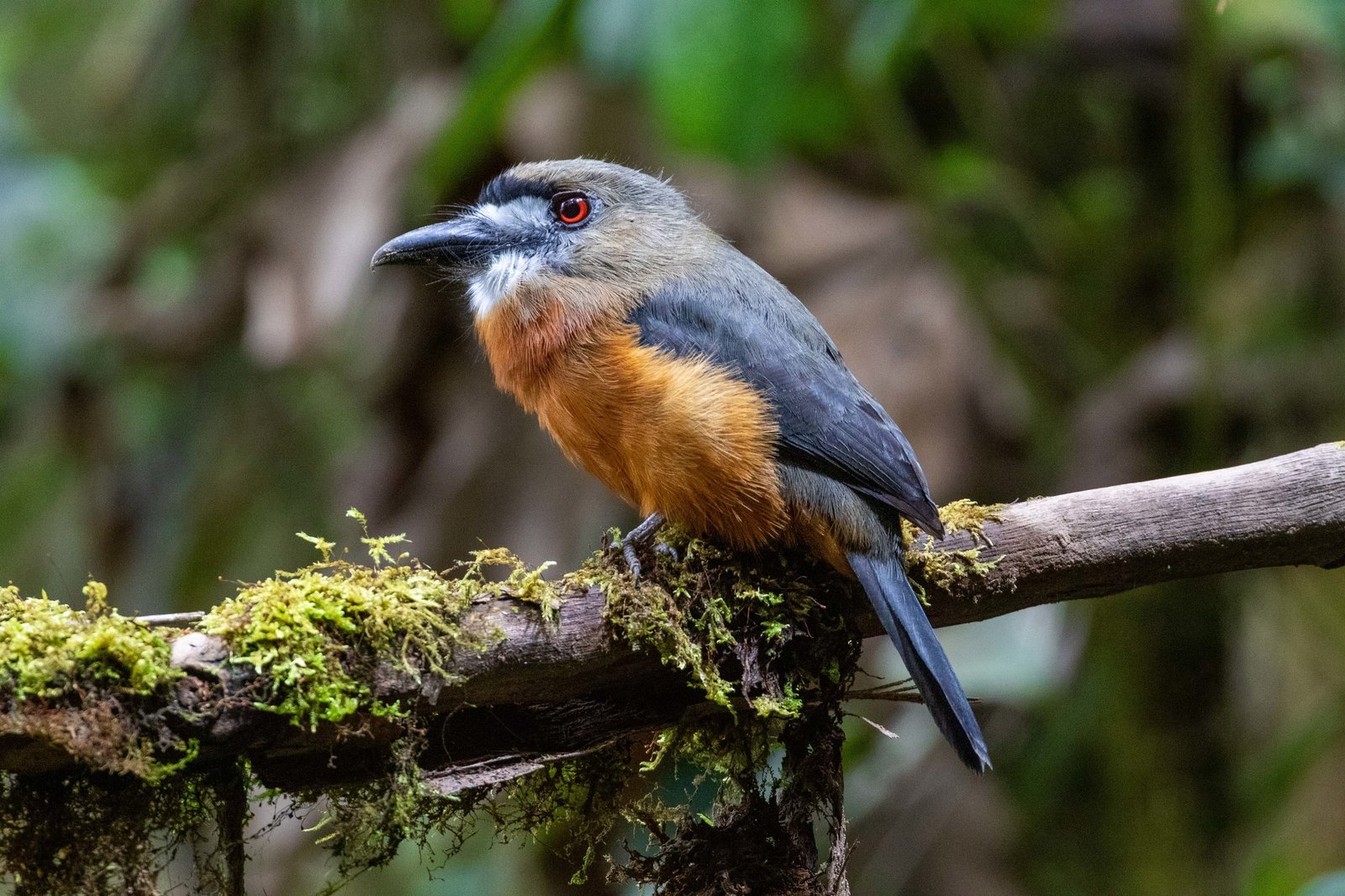
The White-faced Nunbird is a large, quiet puffbird of Andean cloud forest, with a white band across the forehead and a chestnut belly. It is the only puffbird that lives so high in the mountains. It is scarce and patchily distributed throughout; it sits motionless for long periods at mid-level and calls mainly at dusk and dawn.
Voice
A series of soft, hollow whistles or hooting notes, repeated slowly, sometimes in duet. It calls mainly before dawn and at dusk, when it is best located.
Recording: Juan Freile — CC BY-NC-SA 4.0 · xeno-canto
Identification
23–24 cm, with a large head, a heavy, hook-tipped black bill and a fairly long tail. The forehead, lores and chin are white, bordered behind with black, giving a white band around the base of the bill. The crown and hindneck are grey. The upperparts and tail are olive-brown to greyish brown. The underparts are warm chestnut to rufous-brown. The iris is red. The sexes are alike.
Confusion species
In cloud forest no other species closely resembles it. The nunbirds Monasa, such as White-fronted Nunbird Monasa morphoeus, live in the lowlands and are slate-grey with a red or yellow bill. Barbets and trogons in the same forest are slimmer and more colourful and have a different posture.
Habitat
Cloud forest and humid montane forest, also forest edges, roughly between 1600 and 3000 m, mainly between 2000 and 2600 m. It perches in the middle storey and lower canopy and sallies for large insects and other invertebrates, sometimes small vertebrates. Little is known about its breeding; it probably nests in a burrow in a slope.
Where the bird is most at home, classified by the vegetation units of the Andes and the west coast.


Range and movements
In Colombia scattered in the Andes. In Ecuador on both slopes of the Andes. In Peru on the eastern slope in the north and locally further south. Absent from Bolivia and the Galápagos. Does not occur outside the guide area.
- Resident
- dark = core range, pale = thinly spread
How and when to look
Search along trails and roads through cloud forest at about 2000–2500 m, for example on the western slope in north-western Ecuador. Listen before dawn for the hollow whistles and check thick, horizontal branches in the middle storey.
Conservation status
Least Concern. The species is scarce and patchily distributed; clearance of cloud forest affects the population locally.
Scientific name
Hapaloptila castanea | (Verreaux, 1866)
Verreaux described the species in 1866 as Malacoptila castanea; because it was later moved to another genus, the author and year stand in brackets. The genus Hapaloptila was introduced in 1881 by Sclater. The genus name comes from Greek hapalos, 'soft', and ptilon, 'feather'. The species name comes from Latin castaneus, 'chestnut', for the chestnut underparts. The specimen the first description was based on came from Frontino, Antioquia, Colombia.