All species › Jacamars and puffbirds › Puffbirds › Moustached Puffbird
Moustached Puffbird | Malacoptila mystacalis
Knevelbaardkoekoek | Buco bigotudo | Barbudo-bigodudo
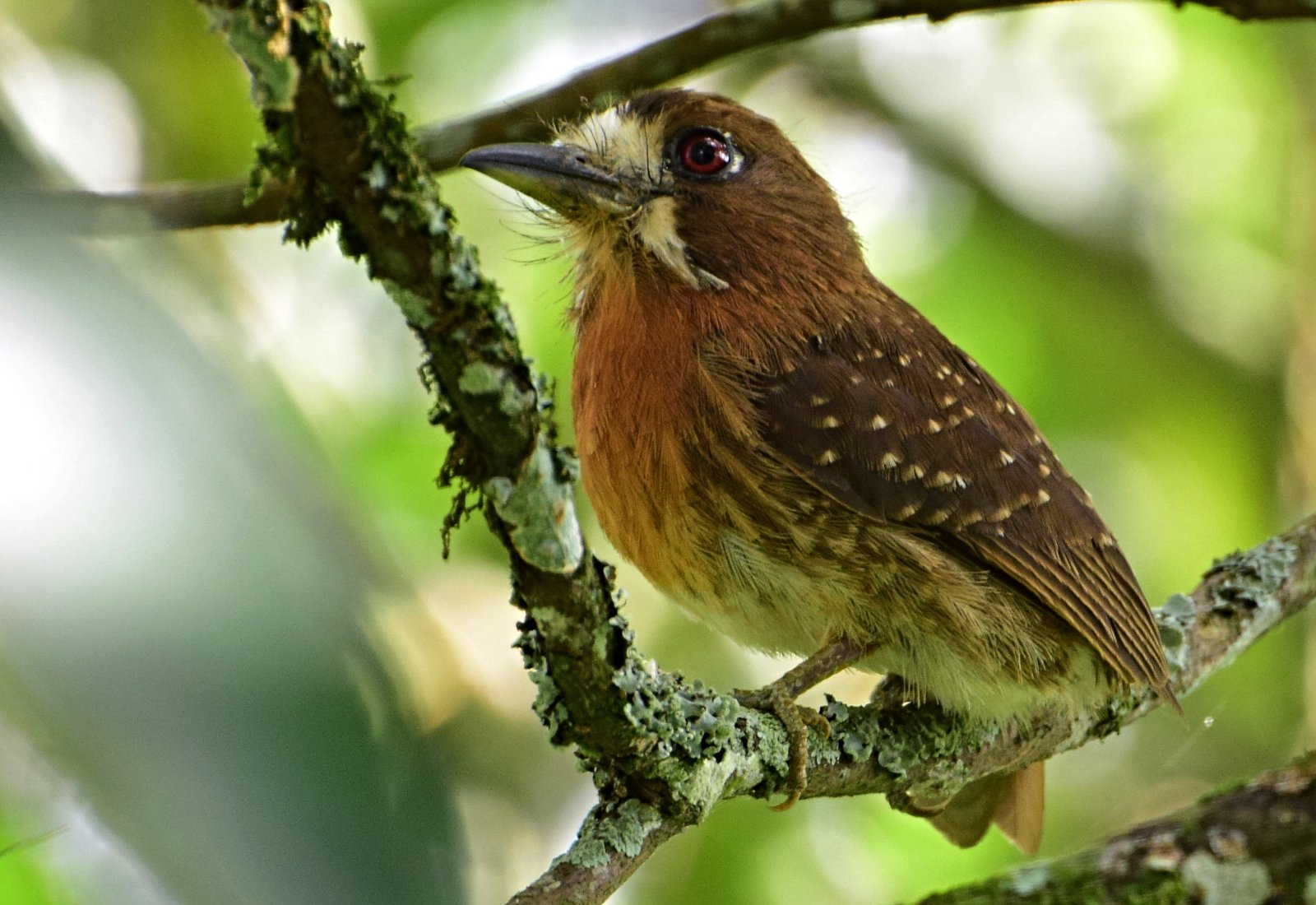
The Moustached Puffbird is a brown puffbird with a large white moustache that occurs in the guide area only in the northern Andes of Colombia. There it replaces the lowland White-whiskered Puffbird in montane forest. Like its relatives, it sits motionless for long periods in the understorey.
Voice
A high, thin whistle, tseee, repeated at intervals, and a soft series of thin whistles. Mainly in the morning and at dusk.
Recording: Ross Gallardy — CC BY-NC-SA 4.0 · xeno-canto
Identification
20–22 cm, with a large head, a heavy, dark bill and a fairly short tail. The upperparts are brown with fine pale spots. Long white feathers around the base of the bill and below the eye form a conspicuous moustache. The throat and breast are rufous-brown to cinnamon, the belly whitish with faint streaks. The iris is red. The female is slightly greyer and less rufous than the male.
Confusion species
White-whiskered Puffbird Malacoptila panamensis lives lower, mainly below 1200 m, is more heavily streaked below and has a smaller white moustache. Black-streaked Puffbird Malacoptila fulvogularis is much darker and heavily streaked black and white, and lives on the eastern slope further south.
Habitat
Humid montane and foothill forest, old secondary forest, forest edges and shade coffee, roughly between 300 and 2100 m, mainly at middle elevations. It lives in the understorey and lower middle storey and sallies for large insects and other invertebrates. It nests in a burrow in a slope or road cut.
Where the bird is most at home, classified by the vegetation units of the Andes and the west coast.


Range and movements
In Colombia in the northern Andes and in the Sierra de Perijá, on the border with Venezuela. Absent from Ecuador, Peru, Bolivia and the Galápagos. Outside the guide area in the Andes and coastal mountains of northern Venezuela.
- Resident
- dark = core range, pale = thinly spread
How and when to look
Search montane forest and shade coffee at middle elevations in the northern Colombian Andes. Look for a brown bird sitting motionless on a low branch; in the shade the white moustache is the first thing to stand out.
Conservation status
Least Concern. The range is small, but the species also occurs in secondary forest and shady plantations.
Scientific name
Malacoptila mystacalis | (de Lafresnaye, 1850)
De Lafresnaye described the species in 1850 as Monasa mystacalis; because it was later moved to another genus, the author and year stand in brackets. The genus Malacoptila was introduced in 1841 by Gray. The genus name comes from Greek malakos, 'soft', and ptilon, 'feather' or 'plumage'. The species name comes from Greek mustax, 'moustache', for the white whisker stripe. The specimen the first description was based on came from Valparaíso, Sierra Nevada de Santa Marta, Colombia.