All species › Jacamars and puffbirds › Puffbirds › Black-streaked Puffbird
Black-streaked Puffbird | Malacoptila fulvogularis
Okerborstbaardkoekoek | Buco negrilistado | Barbudo-de-estrias-pretas
The Black-streaked Puffbird is a dark, heavily streaked puffbird of the montane forests on the eastern slope of the Andes. Almost its entire range lies within the guide area, from Colombia to Bolivia. It is one of the few puffbirds that live in montane forest above the foothills.
Voice
A high, thin whistle, repeated slowly and at long intervals, and a series of thin, slightly descending whistles. It calls mainly in the early morning.
Recording: Jacob Wijpkema — CC BY-NC-SA 4.0 · xeno-canto
Identification
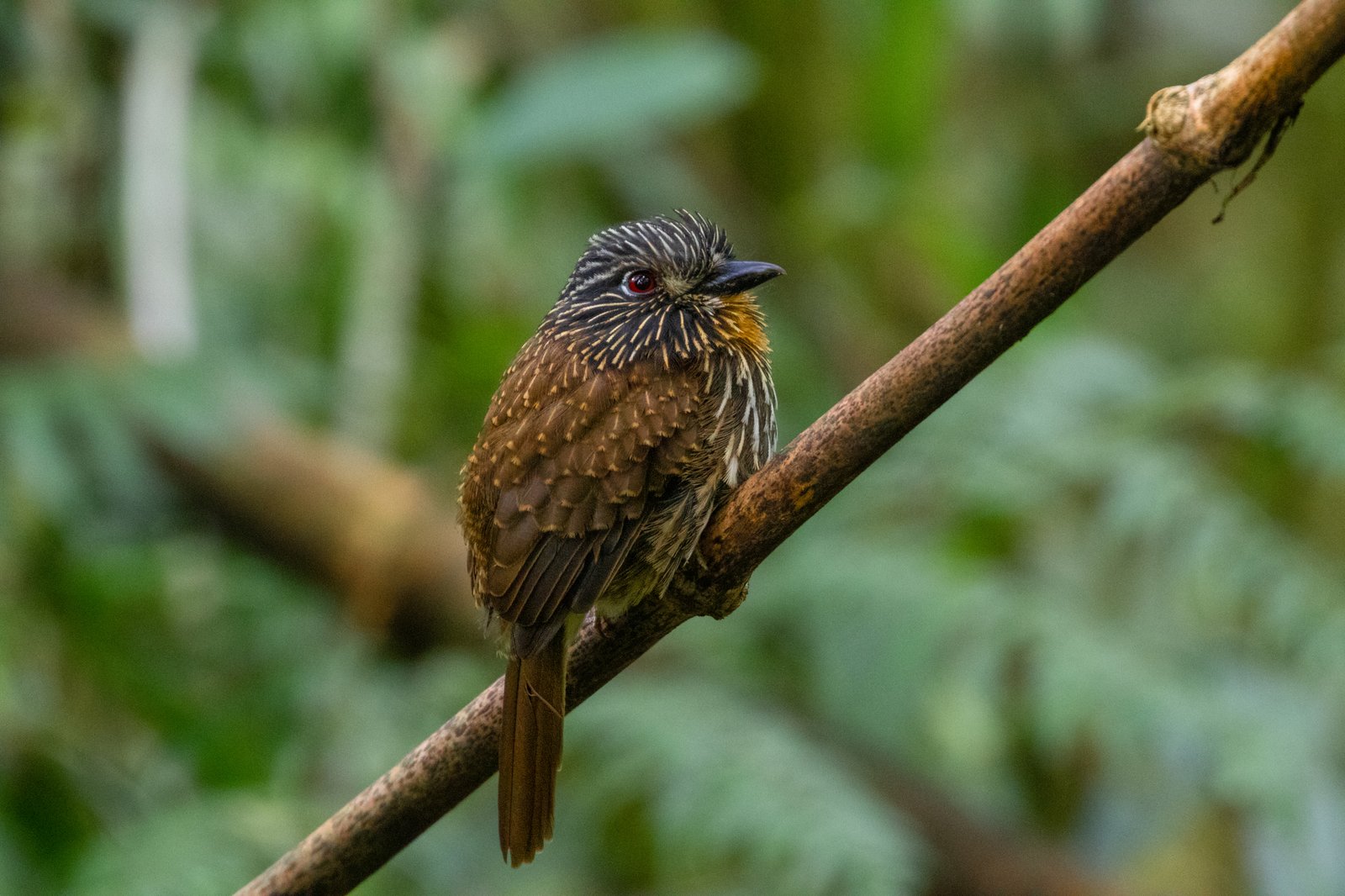
20–21 cm, with a large head, a heavy black bill and a fairly long tail. The head and upperparts are dark brown, densely streaked buff and white. A white moustachial stripe runs below the eye. The throat and upper breast are warm ochre-brown. The rest of the underparts are whitish with broad black streaks. The iris is red. The sexes are alike.
Confusion species
White-chested Puffbird Malacoptila fusca lives lower, in the Amazonian lowlands, and has an orange bill and a white breast patch instead of an ochre breast. Semicollared Puffbird Malacoptila semicincta also lives in the lowlands, in south-eastern Peru and Bolivia, and has a rufous nuchal collar and a yellow lower mandible. Eastern Striolated Puffbird Nystalus striolatus is paler buff, with finer streaks and an orange-red bill.
Habitat
Humid montane and foothill forest on the eastern slope of the Andes, roughly between 600 and 2000 m. It lives in the understorey and lower middle storey, also at forest edges and along roads through forest. It waits quietly on a branch and sallies for large insects and other invertebrates. The nest is in a burrow in a road cut or bank.
Where the bird is most at home, classified by the vegetation units of the Andes and the west coast.


Range and movements
In Colombia on the eastern slope of the Eastern Andes in the south of the country. In Ecuador on the eastern slope of the Andes. In Peru along the entire eastern slope. In Bolivia on the eastern slope of the Andes in the west and centre of the country. Absent from the Galápagos. Not known outside the guide area.
- Resident
- dark = core range, pale = thinly spread
How and when to look
Search forest edges and roads through montane forest on the eastern slope, for example in the lower Yungas of Bolivia and southern Peru. The bird often perches low and motionless in the shade of the undergrowth.
Conservation status
Least Concern. The species has a narrow range along the eastern slope and is locally threatened by clearance of montane forest, but occurs scattered over a large area.
Scientific name
Malacoptila fulvogularis | Sclater, 1854
Sclater described the species in 1854 and placed it straight away in the genus where it still stands. The genus Malacoptila was introduced in 1841 by Gray. The genus name comes from Greek malakos, 'soft', and ptilon, 'feather' or 'plumage'. The species name comes from Latin fulvus, 'tawny', and gula, 'throat'. The specimen the first description was based on came from Bolivia.