All species › Jacamars and puffbirds › Puffbirds › White-whiskered Puffbird
White-whiskered Puffbird | Malacoptila panamensis
Witsnorbaardkoekoek | Buco barbón | Barbudo-de-bigode-branco
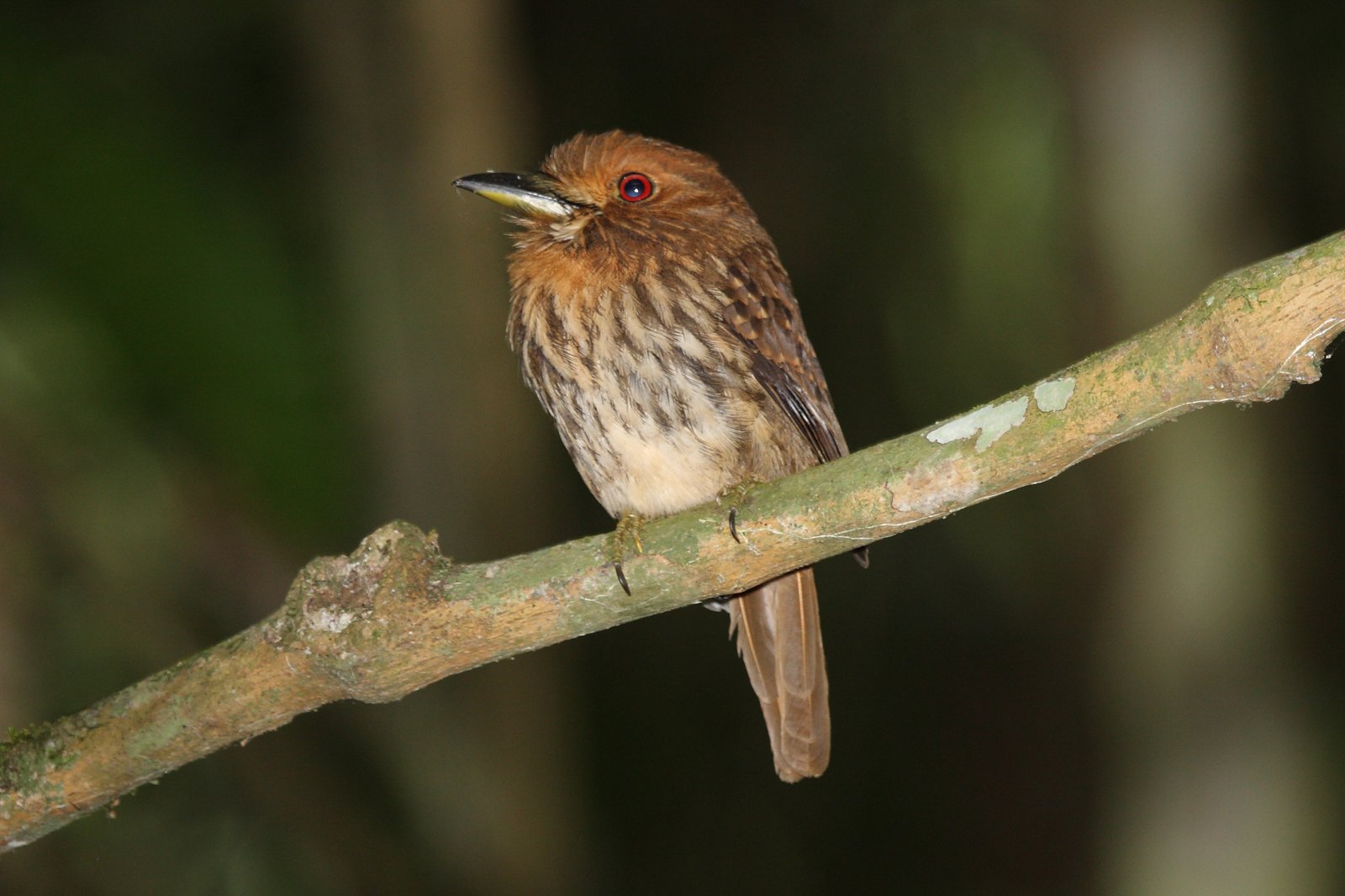
The White-whiskered Puffbird is a rufous-brown, streaked puffbird of the wet forests west of the Andes. Distinctive are the white feathers around the base of the bill and the white moustachial stripe. It often sits motionless for long periods on a low branch in the shade and allows a close approach.
Voice
A thin, high whistle, tseee, often repeated at length, and a series of descending, thin whistles. It usually calls softly and is therefore often overlooked.
Recording: Sue Riffe — CC BY-NC-SA 4.0 · xeno-canto
Identification
19–20 cm, with a large head, a short, heavy bill and a fairly short tail. The male is warm rufous-brown with fine pale spots on the upperparts; the throat and breast are cinnamon, merging into a whitish belly with dark streaks. White bristly feathers surround the base of the bill and a white moustachial stripe runs below the eye. The female is greyer brown and less rufous. The bill is dark with a paler lower mandible, the iris red.
Confusion species
Moustached Puffbird Malacoptila mystacalis is very similar but lives higher in the Andes of Colombia, has a larger white moustache and is less streaked below. Sooty-capped Puffbird Bucco noanamae is black and white, with a dark cap and a black breast band.
Habitat
Understorey and middle storey of humid lowland and foothill forest, old secondary forest, forest edges and shady plantations, mainly below 1200 m. It waits motionless on a branch and sallies for large insects, spiders and sometimes small lizards. It nests in a burrow dug into a bank or into level forest floor.
Where the bird is most at home, classified by the vegetation units of the Andes and the west coast.


Range and movements
In Colombia in the Pacific lowlands and the foothills of the Western Andes, and in the north in the lowlands and valleys at the foot of the Andes. In Ecuador in the west, in the lowlands and lower foothills. Absent from Peru, Bolivia and the Galápagos. Outside the guide area from south-eastern Mexico through Central America to Panama.
- Resident
- dark = core range, pale = thinly spread
How and when to look
Walk slowly along trails through humid forest in the Chocó or in north-western Ecuador and check low, horizontal branches in the shade. The bird often sits there for minutes without moving.
Conservation status
Least Concern. The species tolerates some disturbance and also occurs in old secondary forest, but disappears where the forest is cleared completely.
Scientific name
Malacoptila panamensis | de Lafresnaye, 1847
De Lafresnaye described the species in 1847 and placed it straight away in the genus where it still stands. The genus Malacoptila was introduced in 1841 by Gray. The genus name comes from Greek malakos, 'soft', and ptilon, 'feather' or 'plumage'. The species name refers to Panama. The specimen the first description was based on came from Panama.