All species › Jacamars and puffbirds › Puffbirds › Rufous-necked Puffbird
Rufous-necked Puffbird | Malacoptila rufa
Roodnekbaardkoekoek | Buco cuellirrojo | Barbudo-de-pescoço-ferrugem
The Rufous-necked Puffbird is a brown puffbird of southern Amazonia with a grey head and a rufous neck. In the guide area it reaches only the outer edges, in north-eastern Peru and north-eastern Bolivia. Like other puffbirds of the genus Malacoptila it sits motionless for long periods in the forest understorey.
Voice
A long, descending series of high, thin whistles, very similar to that of related Malacoptila species. Also a thin whistle and, when agitated, a rasping series.
Recording: Scott Olmstead — CC BY-NC-SA 4.0 · xeno-canto
Identification
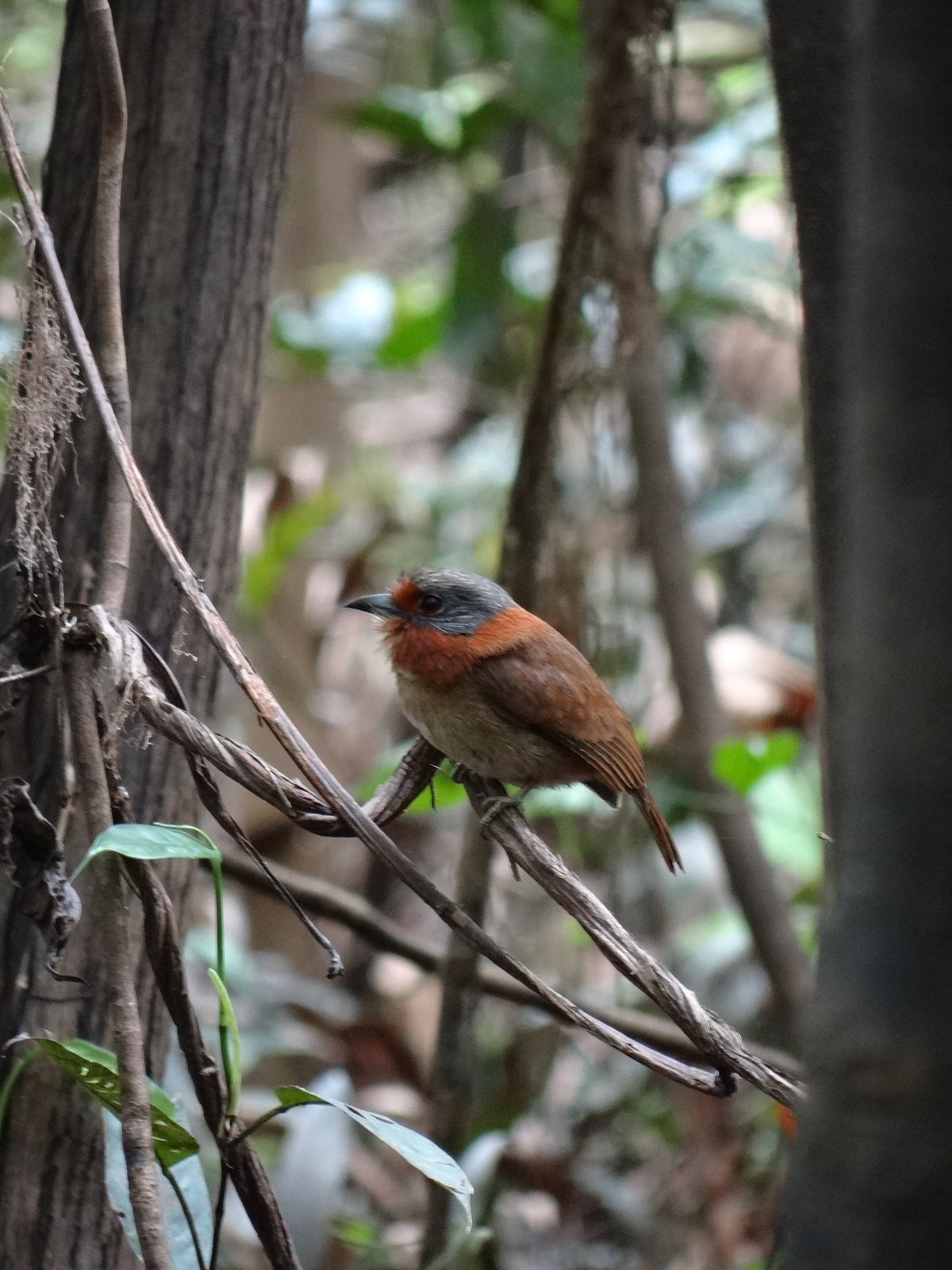
18–19 cm, with a large head, a heavy, dark bill and a fairly short tail. The crown and cheeks are grey, the hindneck and sides of the neck rufous. A white moustachial stripe runs below the eye. The throat and upper breast are ochre, with a narrow white crescent on the breast below. The upperparts are brown with fine pale spots, the underparts paler buffy brown with faint streaks. The iris is red. The sexes are alike.
Confusion species
White-chested Puffbird Malacoptila fusca lacks the grey head and rufous neck, is more heavily streaked and has an orange bill; it lives mainly north of the Amazon. Semicollared Puffbird Malacoptila semicincta also has a rufous nuchal collar, but a streaked brown crown and a yellow lower mandible; it lives in south-eastern Peru and Bolivia, largely outside the range of the Rufous-necked Puffbird.
Habitat
Understorey of humid lowland forest; in most of the range terra firme forest, but in north-eastern Peru mainly várzea forest along the large rivers. It sits still on a low branch and sallies for large insects and other invertebrates. The nest is in a burrow in the ground.
Where the bird is most at home, classified by the vegetation units of the Andes and the west coast.


Range and movements
In Peru only in the north-east, in the lowlands south of the Amazon. In Bolivia in the north-east. Absent from Colombia, Ecuador and the Galápagos. Outside the guide area in Amazonian Brazil south of the Amazon, east to the Atlantic coast.
- Resident
- dark = core range, pale = thinly spread
How and when to look
Search the understorey of várzea forest along the rivers of north-eastern Peru. Birds sit still for a long time; the descending whistled series in the morning gives away their position.
Conservation status
Least Concern. The range is large, but in southern Amazonian Brazil much forest is being lost to deforestation.
Scientific name
Malacoptila rufa | (Spix, 1824)
Spix described the species in 1824 as Bucco rufus; because it was later moved to another genus, the author and year stand in brackets. The genus Malacoptila was introduced in 1841 by Gray. The genus name comes from Greek malakos, 'soft', and ptilon, 'feather' or 'plumage'. The species name comes from Latin rufus, 'rufous'. The specimen the first description was based on came from Amazon basin.