All species › Jacamars and puffbirds › Puffbirds › Semicollared Puffbird
Semicollared Puffbird | Malacoptila semicincta
Todds baardkoekoek | Buco semiacollarado | Barbudo-de-coleira
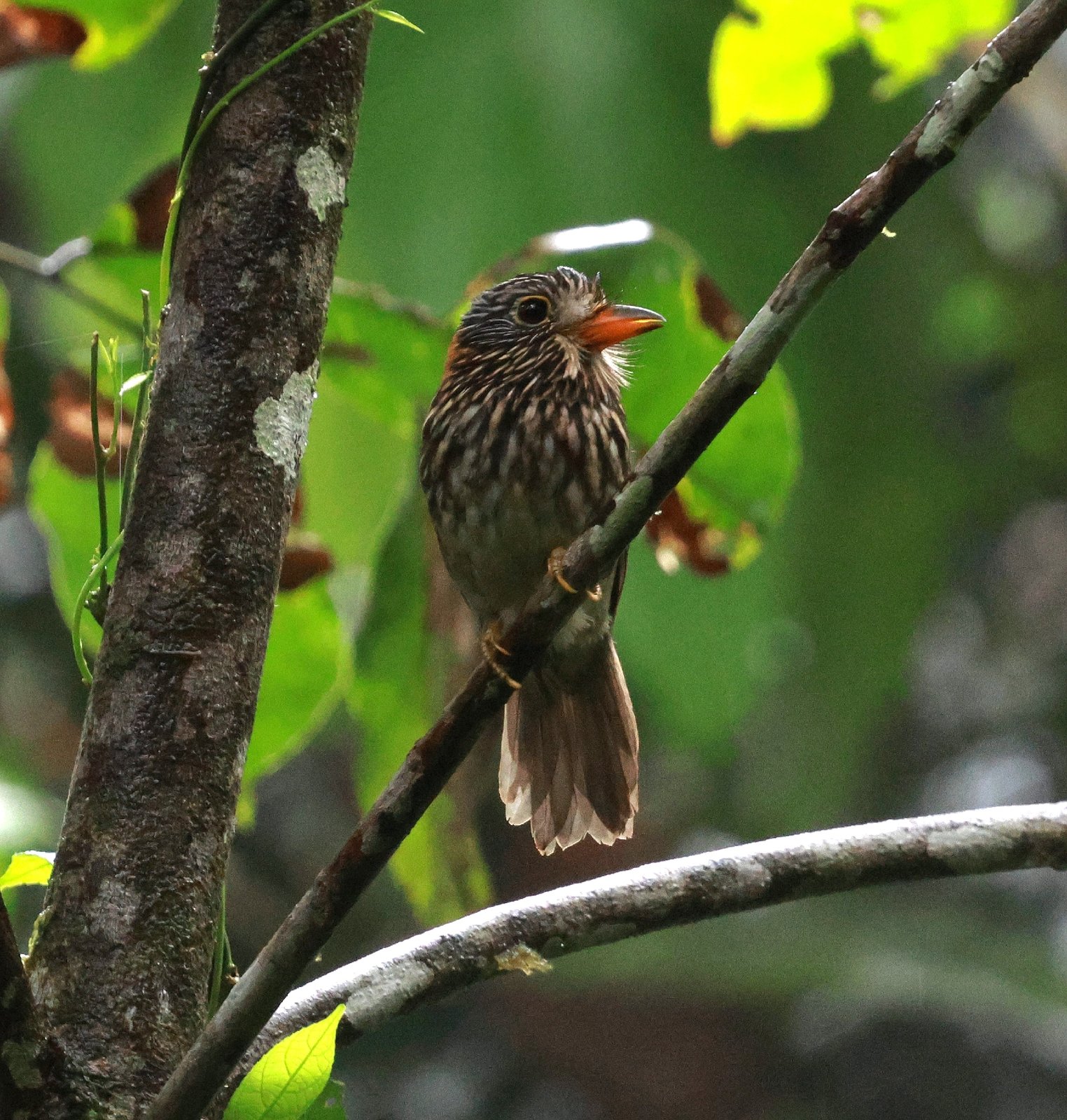
The Semicollared Puffbird is a dark brown, streaked puffbird with a rufous hind-collar and a narrow white crescent on the breast. It lives in a small area of south-western Amazonia, where Peru, Bolivia and Brazil meet. The scientific name semicincta means 'half-girdled' and refers to the collar.
Voice
A series of thin, high, melancholy-sounding whistles; the first notes are widely spaced on the same pitch, then they descend.
Recording: Rainforest Connection — CC BY-NC-SA 4.0 · xeno-canto
Identification
18–19 cm, with a large head and a heavy bill: the upper mandible mostly black, the lower orange-yellow. The head and upperparts are blackish brown, with pale feather shafts giving a streaked look; the tail is brown. A rufous band crosses the hindneck. The whisker and chin are whitish and a narrow white crescent crosses the upper breast. The underparts are whitish with blackish streaks on the lower breast and flanks. The eye is dark red with a white eye-ring. The sexes are alike.
Confusion species
White-chested Puffbird Malacoptila fusca lacks the rufous collar and has an entirely orange-yellow bill with a black tip; their ranges meet in central Peru. Black-streaked Puffbird Malacoptila fulvogularis has a dark bill and a buffy throat and breast, and lives higher in the foothills. Rufous-necked Puffbird Malacoptila rufa has a grey head and an unstreaked rufous neck and breast.
Habitat
Transitional forest and the edges of humid evergreen terra firme forest, from the understorey to the lower mid-storey. From the lowlands to about 1050 m in the foothills. It probably hunts like its relatives from a low perch; diet and breeding have not been described.
Where the bird is most at home, classified by the vegetation units of the Andes and the west coast.


Range and movements
In Peru in the south-east. In Bolivia in the far north. Absent from Colombia, Ecuador and the Galápagos. Outside the guide area in the far west of Brazil.
- Resident
- dark = core range, pale = thinly spread
How and when to look
Search forest edges and transitional forest in the lowlands and lower foothills of south-eastern Peru; listen for the descending series of thin whistles and check low branches in the understorey.
Conservation status
Least Concern. Its range is limited but still largely forested; clearance along roads and gold mining in south-eastern Peru affect its habitat locally.
Scientific name
Malacoptila semicincta | Todd, 1925
Todd described the species in 1925 and placed it straight away in the genus where it still stands. The genus Malacoptila was introduced in 1841 by Gray. The genus name comes from Greek malakos, 'soft', and ptilon, 'feather' or 'plumage'. The species name comes from Latin semi-, 'half', and cinctus, 'girdled', for the rufous half-collar. The specimen the first description was based on came from Hyutanahan, Rio Purus, Brazil.