All species › Jacamars and puffbirds › Puffbirds › White-chested Puffbird
White-chested Puffbird | Malacoptila fusca
Witborstbaardkoekoek | Buco pechiblanco | Barbudo-pardo
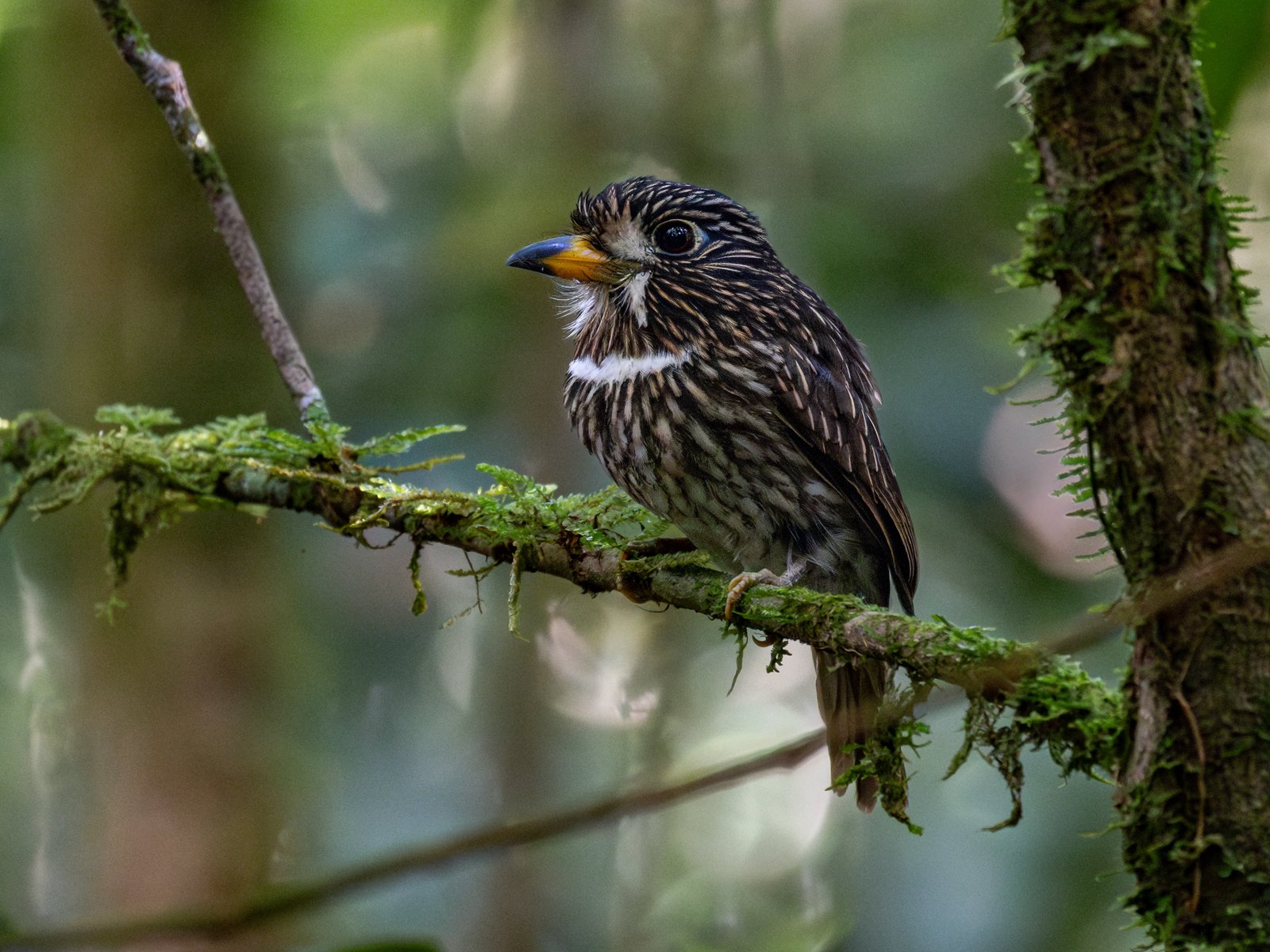
The White-chested Puffbird is a stocky, dark brown puffbird with an orange-yellow bill and a narrow white crescent on the upper breast. It sits motionless for long periods in the understorey of Amazonian forest and then suddenly drops onto prey on the ground or among leaves. Its range falls into two separate parts: western Amazonia and the lower Amazon region.
Voice
The song is a long, descending, musical trill. The call is a high, descending, mewing whistle.
Recording: Phil Stouffer — CC BY-NC-SA 4.0 · xeno-canto
Identification
18–19 cm, with a large head and a short, heavy, orange-yellow bill with a black tip. The head, upperparts and wing coverts are dark brown, the crown blackish brown; pale feather shafts give a finely streaked look. The tail is warm brown. The whisker and chin are whitish and a narrow white crescent crosses the upper breast. The underparts are dirty white to buff with brown streaks and mottling. The eye is reddish brown to red or yellow. The sexes are alike.
Confusion species
Semicollared Puffbird Malacoptila semicincta has a rufous hind-collar and a black upper mandible. Black-streaked Puffbird Malacoptila fulvogularis has a dark bill and a buffy throat and breast streaked black, and lives higher in the Andean foothills. Rufous-necked Puffbird Malacoptila rufa has a grey head and a rufous neck and breast.
Habitat
Understorey of evergreen lowland forest, both terra firme and várzea. In Colombia up to about 600 m, in Ecuador to 900 m and locally 1200 m, in Peru to about 1500 m. It hunts from a perch a few metres above the ground and sallies to prey on the ground or in vegetation, usually landing on a different perch; it sometimes follows army ant swarms. It eats mainly insects and other small invertebrates. The nest is probably in a burrow in the ground.
Where the bird is most at home, classified by the vegetation units of the Andes and the west coast.


Range and movements
In Colombia in the Amazonian lowlands of the east. In Ecuador in the eastern lowlands and foothills. In Peru in the north and centre, south to the Apurímac valley. Absent from Bolivia and the Galápagos. Outside the guide area in south-western Venezuela and, separately, in the Guianas and northern Brazil.
- Resident
- dark = core range, pale = thinly spread
How and when to look
Search the understorey of terra firme forest in eastern Ecuador or northern Peru on low, horizontal branches; the bird often sits still for minutes. Chances are higher at army ant swarms.
Conservation status
Least Concern. The range is large, but the species is declining locally through deforestation.
Scientific name
Malacoptila fusca | (Gmelin, 1788)
Gmelin described the species in 1788 as Bucco fuscus; because it was later moved to another genus, the author and year stand in brackets. The genus Malacoptila was introduced in 1841 by Gray. The genus name comes from Greek malakos, 'soft', and ptilon, 'feather' or 'plumage'. The species name comes from Latin fuscus, 'dusky brown'. The specimen the first description was based on came from Cayenne, French Guiana.